Christchurch City Council
Agenda
Notice of Meeting Te Pānui o te Hui:
An ordinary meeting of the Christchurch
City Council will be held on:
Date: Wednesday 1 April 2026
Time: 9.30 am
Venue: Camellia Chambers, Civic Offices,
53 Hereford Street, Christchurch
Membership
|
Chairperson
Deputy Chairperson
Members
|
Mayor Phil Mauger
Deputy Mayor Victoria Henstock
Councillor Kelly Barber
Councillor David Cartwright
Councillor Melanie Coker
Councillor Pauline Cotter
Councillor Celeste Donovan
Councillor Tyrone Fields
Councillor Tyla Harrison-Hunt
Councillor Nathaniel Herz Jardine
Councillor Yani Johanson
Councillor Aaron Keown
Councillor Sam MacDonald
Councillor Jake McLellan
Councillor Andrei Moore
Councillor Mark Peters
Councillor Tim Scandrett
|
26 March 2026
Website: www.ccc.govt.nz

TABLE OF CONTENTS NGĀ IHIRANGI
Karakia Tīmatanga................................................................................................... 4
1. Apologies Ngā Whakapāha................................................................................. 4
2. Declarations of Interest Ngā Whakapuaki Aronga.................................................. 4
Please note the Monthly
Report from the Community Boards and presentation of their Annual Plan
submissions to the Council will be considered between approximately 9.30am and
11am.
Public
Participation and Presentation of Petitions will be considered from 11.15am.
3. Public
Participation Te Huinga
Tūmatanui............................................................ 4
3.1 Public Forum Te Huinga Whānui.......................................................................................... 4
3.2 Deputations by
Appointment Ngā Huinga Whakaritenga...................................................... 5
4. Presentation
of Petitions Ngā
Pākikitanga............................................................ 5
5. Confirmation of Previous Minutes Te Whakaāe o te
hui o mua................................. 5
Community Board Monthly
Reports
6. Monthly
Report from the Community Boards - March 2026.................................... 31
7. Draft
2026/27 Annual Plan - Community Board Submissions.................................. 93
Community board Part A
Reports
8. Property
Disposal, Millstead Oaks Subdivision, Casebrook.................................... 95
Staff Reports
9. Christchurch
Wastewater Treatment Plant Pond Odour Mitigation....................... 107
10. 2025-26
Sustainability Fund Allocation............................................................. 123
11. Hearings
Panel report to the Council on the Future of Lichfield Street Carpark....... 193
12. International
Relations Update........................................................................ 199
13. Hagley
Park & Botanic Gardens - No Stopping & Mobility Park Parking
Restrictions - Update......................................................................................................... 219
14. Biodiversity
Fund Allocation - Correction.......................................................... 227
Governance Items
15. Notice of
Motion - Parker / Gilberthorpes / Waterloo Intersection Signalisation...... 229
16. Mayor's
Monthly Report................................................................................. 257
17. Resolution
to Exclude the Public...................................................................... 258
Karakia Whakamutunga
Actions
Register Ngā Mahinga Tuwhera
Karakia Tīmatanga
Whakataka te hau ki te uru
Whakataka te hau ki te tonga
Kia mākinakina ki uta
Kia mātaratara ki tai
E hī ake ana te atakura
He tio, he huka, he hau hū
Tihei mauri ora
1. Apologies Ngā Whakapāha
Apologies will
be recorded at the meeting.
2. Declarations of Interest Ngā
Whakapuaki Aronga
Members are
reminded of the need to be vigilant and to stand aside from decision-making
when a conflict arises between their role as an elected representative and any
private or other external interest they might have.
Please note the Monthly Report from the Community Boards and
presentation of their Annual Plan submissions to the Council will be considered
between approximately 9.30am and 11am.
Public Participation and Presentation of Petitions will be
considered from 11.15am.
3. Public Participation Te Huinga
Tūmatanui
3.1 Public Forum Te Huinga Whānui
A period of up to 30 minutes is available
for people to speak for up to five minutes on any issue that is not the subject
of a separate hearings process.
|
3.1.1
|
Laura Fergusson Brain Injury Trust
Kathryn Jones will speak on behalf of the
Laura Fergusson Brain Injury Trust regarding the major capital housing
development being undertaken to provide fully accessible residential
accommodation for 30 people living with brain injuries and other neurological
conditions.
|
|
3.1.2
|
Zoran Rakovic
Zoran Rakovic will speak regarding
concerns about the Council deliberating on constitutional questions outside
of its jurisdiction and the limit of council authority under the Local
Government Act 2002.
|
|
3.1.3
|
Non-Resident Nepali Association (NRNA)
Dr. Sulav Paudel will speak on behalf of
the Non-Resident Nepali Association (NRNA) regarding the Nepal Festival (18
April 2026), a multicultural celebration with a traditional parade, Everest
exhibitions, authentic Nepalese cuisine and cultural performances to
celebrate and strengthen community ties.
|
|
3.1.4
|
South Island Wildlife Hospital
Jenny Fisher will speak on behalf of the
South Island Wildlife Hospital regarding the hospital’s work treating
sick and injured wildlife and provide an update on current issues.
|
|
3.1.5
|
Jolt Dance Company
Lachlan Oakes, Joel Foreman, Lyn Cotton
and Kate Finnerty will speak on behalf of Jolt Dance Company regarding what
the Company does and its inclusive dance practice and programmes.
|
|
3.1.6
|
AquaPave Permeable Concrete
Adrianna Hess will speak on behalf of
AquaPave Permeable Concrete regarding a stormwater map used by Council that
outlines areas where staff will consent stormwater discharge to ground and
which disallows permeable pavements from being consented for most of
Christchurch.
|
3.2 Deputations by Appointment Ngā
Huinga Whakaritenga
Deputations may be heard on a matter, or
matters, covered by a report on this agenda and approved by the Chairperson.
Deputations
will be recorded in the meeting minutes.
4. Presentation of Petitions Ngā
Pākikitanga
There were no
Presentations of Petitions at the time the agenda was prepared.
To present to the Council, refer
to the Participating in decision-making webpage or
contact the meeting advisor listed on the front of this agenda.
5. Confirmation
of Previous Minutes Te Whakaāe o te hui o mua
That the
minutes of the Council meeting held on Wednesday, 4 March 2026 be confirmed
(refer page 6).

Christchurch City Council
Minutes
Date: Wednesday 4 March 2026
Time: 9.32 am
Venue: Camellia Chambers, Civic Offices,
53 Hereford Street, Christchurch
Present
|
Chairperson
Deputy Chairperson
Members
|
Mayor Phil Mauger
Deputy Mayor Victoria Henstock
Councillor Kelly Barber
Councillor David Cartwright
Councillor Melanie Coker
Councillor Pauline Cotter
Councillor Celeste Donovan
Councillor Tyrone Fields
Councillor Tyla Harrison-Hunt
Councillor Nathaniel Herz Jardine
Councillor Yani Johanson
Councillor Aaron Keown
Councillor Sam MacDonald
Councillor Andrei Moore
Councillor Mark Peters
Councillor Tim Scandrett
|

Karakia Tīmatanga
The agenda was dealt with in the following
order. Where no voting record is shown, the item was carried unanimously by
those present.
1. Apologies
Ngā Whakapāha
|
Council Resolved CNCL/2026/00020
That the apologies from Councillor
McLellan for absence and from Councillor Coker for lateness, be accepted.
Mayor/Councillor
MacDonald Carried
|
2. Declarations
of Interest Ngā Whakapuaki Aronga
Councillor Coker
declared an interest in Item 14 - 2025/2026 Biodiversity Fund Allocation
in relation to the Summit Road Society application.
Councillor
Fields declared an interest in Item 12 - Walking
Access Act 2008 - Request to be a Controlling Authority
Councillor Coker joined the meeting at 9.43
am during consideration of Item 6.
Councillor Fields left the meeting at 9.39
am and returned at 9.50 am during consideration of Item 6.
Councillor MacDonald left the meeting at
10.04 am and returned at 10.10 am during consideration of Item 6.
|
6. Monthly
Report from the Community Boards - February 2026
|
|
|
Sunita Gautam, Chairperson, and Simon
Britten, Deputy Chair, joined the meeting for presentation of the Waipapa Papanui-Innes-Central Community
Board area report.
Keir Leslie,
Chairperson, and Sophie Bond, Deputy Chair, joined the meeting for
presentation of the Waihoro
Spreydon-Cashmere-Heathcote Community Board area report.
Jason
Middlemiss, Chairperson, and Maryanne Lomax, Community Governance Manager,
joined the meeting for presentation of the Waimāero Fendalton-Waimairi-Harewood Community
Board area report.
Marie Pollisco,
Chairperson, and Bailey Peterson, Community Governance Manager, joined the
meeting for presentation of the Waipuna Halswell-Hornby-Riccarton Community Board area report.
Paul McMahon, Chairperson, and Jackie
Simons, Deputy Chairperson, joined the meeting for presentation of the Waitai Coastal-Burwood-Linwood Community
Board area report.
Lyn Leslie,
Chairperson, and Nigel Millar, Deputy Chairperson, joined the meeting for
presentation of the Te
Pātaka o Rākaihautū Banks Peninsula Community Board area report.
|
|
|
Council Resolved CNCL/2026/00021
Officer Recommendation accepted without
change
That the Council:
1. Receives the information in the Monthly
Report from the Community Boards - February 2026 Report.
Mayor/Councillor
Cotter Carried
|
For
|
16
|
Councillor Barber, Councillor
Cartwright, Councillor Coker, Councillor Cotter, Councillor Donovan, Councillor
Fields, Councillor Harrison-Hunt, Councillor Herz Jardine, Councillor
Johanson, Councillor Keown, Councillor MacDonald, Councillor Moore, Councillor
Peters, Councillor Scandrett, Deputy Mayor Henstock, Mayor Mauger
|
|
Against
|
0
|
|
|
Abstain
|
0
|
|
|
TOTAL
|
16
|
|
|
|
|
|
Absent
|
1
|
Councillor McLellan
|
|
|
|
Attachments
a Waipapa
Papanui-Innes-Central Community Board - Presentation to Council
b Waihoro
Spreydon-Cashmere-Heathcote Community Board - Presentation to Council
c Waimāero
Fendalton-Waimairi-Harewood Community Board - Presentation to Council
d Waipuna
Halswell-Hornby-Riccarton Community Board - Presentation to Council
e Waitai
Coastal-Burwood-Linwood Community Board - Presentation to Council
f Te
Pātaka o Rākaihautū Banks Peninsula Community Board -
Presentation to Council
|
Councillor Cotter left the meeting at 10.18
am during consideration of Item 3.1.1.
3. Public
Participation Te Huinga Tūmatanui
3.1 Public Forum Te Huinga
Whānui
|
3.1.1
|
Stephen Wood
Stephen Wood
spoke regarding vulnerable road users.
|
|
Attachments
a Stephen
Wood - Presentation to Council
|
|
3.1.2
|
Phillip Bates
This public
forum did not proceed.
|
|
|
Councillor Cotter returned to the meeting
at 10.20 am during consideration of Item 3.1.3.
Councillor Barber left the meeting at 10.19
am and returned at 10.22 am during consideration of Item 3.1.3.
|
3.1.3
|
Whaka-Ora Healthy Harbour
Co-Chair
Yvette Couch and Sarah Wilson spoke on behalf of Whaka-Ora Healthy Harbour to
update the Council on the Whaka-Ora Healthy Harbour programme.
|
|
|
|
Attachments
a Whaka-Ora
Healthy Harbour - Presentation to Council
|
|
3.1.4
|
Rebecca Robin
Rebecca Robin
spoke regarding trauma-led emergency responses in Christchurch East,
including Bromley, Wainoni and Aranui, and evidence-based recommendations for
strengthening future emergency responses using Christchurch’s
documented learnings, national emergency management guidance, and
Mātauranga Māori frameworks.
|
|
|
Councillor Donovan left the meeting at
10.43 am and returned at 10.45 am during consideration of Item 3.1.5.
|
3.1.5
|
Robina Dobbie and Ann Satterthwaite
Robina Dobbie
and Ann Satterthwaite spoke regarding the introduction of 5G and their
concerns for residents’ health.
|
|
|
|
Attachments
a Robina
Dobbie - Presentation to Council
b Ann
Satterthwaite - Presentation to Council
|
|
3.1.6 John Minto
|
|
John Minto spoke regarding Item 20 – Notice of Motion -
Request for staff advice regarding protest free areas.
|
|
|
3.2 Deputations by Appointment Ngā Huinga Whakaritenga
|
3.2.1 Hayley Guglietta
|
|
Hayley Guglietta spoke regarding Item 17 – Ōtākaro Avon
River Corridor Regeneration Committee - draft Terms of Reference.
|
|
|
The meeting adjourned at 11.04 am and
reconvened at 11.25 am.
|
17. Ōtākaro
Avon River Corridor Regeneration Committee - draft Terms of Reference
|
|
|
Council Comment
1. The
Officer Recommendations were Moved by the Mayor and Seconded by Deputy Mayor
Henstock with the following additions:
a. Recommendation
4 – The appointment of the Burwood Ward Councillor to the Ōtākaro
Avon River Corridor Regeneration Committee (Committee).
b. Additional
Recommendation 8 – Noting that the Committee’s meetings and
minutes are open to the public.
2. Council
Officer Andrew Rutledge joined the table to present the report.
3. Tania
Wati was invited to the table speak to the report on behalf of Ngāi
Tūāhuriri.
4. Following
debate, the meeting voted on the Motion which was declared carried.
|
|
|
Officer Recommendations
That the
Council:
1. Receives the information in the Ōtākaro Avon
River Corridor Regeneration Committee - draft Terms of Reference Report.
2. Notes that the decision in this report is
assessed as low significance based on the Christchurch City Council’s
Significance and Engagement Policy.
3. Agrees to establish the Ōtākaro
Avon River Corridor Regeneration Committee.
4. Confirms the appointment of the Councillor for [ward] Ward to the Ōtākaro Avon River Corridor
Committee.
5. Notes that Te Ngāi
Tūāhūriri Rūnanga and Te Ihutai Ahu Whenua Trust (MR900) will appoint its representatives.
6. Approves the Terms of Reference (Attachment
A) for the Ōtākaro Avon River Corridor, Governance Committee.
7. Notes that staff will schedule the first
OARC Committee meeting for the second quarter of 2026.
|
|
|
Council Resolved CNCL/2026/00022
That the
Council:
1. Receives the information in the Ōtākaro Avon
River Corridor Regeneration Committee - draft Terms of Reference Report.
2. Notes that the decision in this report is
assessed as low significance based on the Christchurch City Council’s
Significance and Engagement Policy.
3. Agrees to establish the Ōtākaro
Avon River Corridor Regeneration Committee.
4. Confirms the appointment of the Councillor for Burwood Ward to the Ōtākaro Avon River
Corridor Committee
5. Notes that Te Ngāi
Tūāhūriri Rūnanga and Te Ihutai Ahu Whenua Trust (MR900) will appoint its representatives.
6. Approves the Terms of Reference (Attachment
A) for the Ōtākaro Avon River Corridor, Governance Committee.
7. Notes that staff will schedule the first
OARC Committee meeting for the second quarter of 2026.
8.
Notes that the meetings and minutes of the Ōtākaro Avon River
Corridor Regeneration Committee are public in accordance with the Local
Government Act and Local Government Official Information and Meetings Act.
Mayor/Deputy
Mayor Carried
|
For
|
13
|
Councillor Barber, Councillor
Cartwright, Councillor Coker, Councillor Cotter, Councillor Fields,
Councillor Harrison-Hunt, Councillor Herz Jardine, Councillor Keown,
Councillor MacDonald, Councillor Peters, Councillor Scandrett, Deputy Mayor
Henstock, Mayor Mauger
|
|
Against
|
2
|
Councillor Johanson, Councillor Moore
|
|
Abstain
|
1
|
Councillor Donovan
|
|
TOTAL
|
16
|
|
|
|
|
|
Absent
|
1
|
Councillor McLellan
|
|
4. Presentation
of Petitions Ngā Pākikitanga
There was no
presentation of petitions.
5. Confirmation
of Previous Minutes Te Whakaāe o te hui o mua
|
Council Resolved CNCL/2026/00023
That the
Open and Public Excluded minutes of the Council meeting held on Wednesday, 4
February 2026 be confirmed.
Mayor/Councillor
MacDonald Carried
|
|
Report from Waihoro Spreydon-Cashmere-Heathcote Community
Board - 12 February 2026
|
|
7. Cashmere
- Penruddock Roundabout
|
|
|
Council Resolved CNCL/2026/00024
Community Board Recommendations accepted without
change
That the
Council:
1. Receives the information in the Cashmere -
Penruddock Roundabout Report.
2. Notes that the decision in this report is assessed as low
significance based on the Christchurch City
Council’s Significance and Engagement Policy.
3. Approves that a special vehicle lane in accordance with Clause 18
of the Christchurch City Council Traffic & Parking Bylaw 2017, for the
use of westbound road users as defined in Section 11.1A of the Land Transport
(Road User) Rule: 2004, excepting pedestrians and riders of mobility devices,
be installed on the south side of Cashmere Road, commencing at a point
approximately 166 metres east of its intersection
with Penruddock Rise and extending in a westerly
direction for 126 metres, as detailed on Attachment B to the report on the meeting agenda.
4. Approves that a special vehicle lane in accordance with Clause 18
of the Christchurch City Council Traffic & Parking Bylaw 2017, for the
use of southbound road users as defined in Section 11.1A of the Land
Transport (Road User) Rule: 2004, excepting pedestrians and riders of
mobility devices, be installed on the east side of Penruddock
Rise, commencing at a point approximately 21 metres
south of its intersection with Cashmere Road and extending in an southerly
direction for a distance of 10 metres, as detailed on Attachment B to the report on the meeting agenda.
5. Approves that a special vehicle lane in accordance with Clause 18
of the Christchurch City Council Traffic & Parking Bylaw 2017, for the
use of northbound road users as defined in Section 11.1A of the Land
Transport (Road User) Rule: 2004, excepting pedestrians and riders of
mobility devices, be installed on the west side of Penruddock
Rise, commencing at a point approximately 33 metres
south of its intersection with Cashmere Road and extending in a northerly
direction for a distance of 10 metres, as detailed on Attachment B to the report on the meeting agenda.
6. Approves that a special vehicle lane in accordance with Clause 18
of the Christchurch City Council Traffic & Parking Bylaw 2017, for the
use of westbound road users as defined in Section 11.1A of the Land Transport
(Road User) Rule: 2004, excepting pedestrians and riders of mobility devices,
be installed on the south side of Cashmere Road, commencing at a point approximately 31
metres west of its intersection with Brookford Place
and extending in an easterly direction for a distance of 74 metres, as
detailed on Attachment B to the report on the
meeting agenda.
7. Approves that a special vehicle lane in accordance with Clause 18
of the Christchurch City Council Traffic & Parking Bylaw 2017, for the
use of eastbound road users as defined in Section 11.1A of the Land Transport
(Road User) Rule: 2004, excepting pedestrians and riders of mobility devices,
be installed on the north side of Cashmere Road, commencing at a point approximately 31
metres west of the prolongation of the western kerb
line of its intersection with Brookford Place and extending in an easterly direction for a distance of 76
metres, as detailed on Attachment B to the
report on the meeting agenda.
8. Approves that a special vehicle lane in accordance with Clause 18
of the Christchurch City Council Traffic & Parking Bylaw 2017, for the
use of eastbound road users as defined in Section 11.1A of the Land Transport
(Road User) Rule: 2004, excepting pedestrians and riders of mobility devices,
be installed on the north side of Cashmere Road, commencing at a point approximately 39 metres east of the
prolongation of the eastern kerb line of Penruddock Rise and extending in an
easterly direction for a distance of 127 metres, as detailed on Attachment
B to the report on the meeting agenda.
Councillor
Scandrett/Mayor Carried
|
For
|
16
|
Councillor Barber, Councillor
Cartwright, Councillor Coker, Councillor Cotter, Councillor Donovan, Councillor
Fields, Councillor Harrison-Hunt, Councillor Herz Jardine, Councillor
Johanson, Councillor Keown, Councillor MacDonald, Councillor Moore, Councillor
Peters, Councillor Scandrett, Deputy Mayor Henstock, Mayor Mauger
|
|
Against
|
0
|
|
|
Abstain
|
0
|
|
|
TOTAL
|
16
|
|
|
|
|
|
Absent
|
1
|
Councillor McLellan
|
|
|
8. Hagley
Avenue - Clearway
|
|
|
Council Resolved CNCL/2026/00025
Officer Recommendations accepted without
change
That the
Council:
1. Receives the information in the Hagley
Avenue - Clearway Report.
2. Notes that the decision outlined in this report is assessed as low
significance based on the Christchurch City Council’s Significance and
Engagement Policy.
3. Approves, pursuant to Clause 7 of the Christchurch City Council
Traffic and Parking Bylaw 2017, that the existing no stopping restrictions on the northern side of Hagley Avenue, commencing at a point 82
metres northwest of its intersection with St Asaph Street and extending in a
north-westerly direction for 102 meters be revoked.
4. Approves that, in accordance with Clause 7 of the Christchurch
City Council Traffic and Parking Bylaw 2017 and Section 1.6 of the Land
Transport (Road User) Rule 2004, the stopping of vehicles is to be prohibited
only during the clearway hours on the northern side of Hagley Avenue,
commencing at a point 82 metres northwest of its intersection with St Asaph
Street and extending in a north-westerly direction for 102 meters. The
clearway is to apply between 07:30 AM – 07:30 PM, seven days a week, as
detailed in Plan TG146302, dated 17/01/2025, and attached to this report as
Attachment A.
5. Approves that these resolutions take effect when parking signage
and/or road markings that evidence the restrictions described in this staff
report are in place (or removed in the case of revocations).
Mayor/Councillor
Keown Carried
|
For
|
16
|
Councillor Barber, Councillor
Cartwright, Councillor Coker, Councillor Cotter, Councillor Donovan, Councillor
Fields, Councillor Harrison-Hunt, Councillor Herz Jardine, Councillor
Johanson, Councillor Keown, Councillor MacDonald, Councillor Moore, Councillor
Peters, Councillor Scandrett, Deputy Mayor Henstock, Mayor Mauger
|
|
Against
|
0
|
|
|
Abstain
|
0
|
|
|
TOTAL
|
16
|
|
|
|
|
|
Absent
|
1
|
Councillor McLellan
|
|
|
9. Pihipihi
Lane: Name Correction
|
|
|
Council Resolved CNCL/2026/00026
Officer Recommendations accepted without
change
That the Council:
1. Receives the information in the Pihipihi
Lane: Name Correction Report.
2. Notes that the decision in this report are assessed as low
significance based on the Christchurch City Council’s Significance
and Engagement Policy.
3. Under Clause 6(2) of the Christchurch City Council Traffic and
Parking Bylaw 2017 revokes the Central City Parking
Restrictions Committee’s resolution of 22 August 2025
(CCPRC/2025/00012) regarding the stopping of vehicles on
“Pipihihi” Lane, due to the incorrect spelling of the lane name.
4. Under Clause 6(2) of the Christchurch City Council Traffic and
Parking Bylaw 2017 revokes any previous resolutions pertaining to traffic
controls made pursuant to any bylaw to the extent that they are in conflict
with the parking or stopping restrictions described in Recommendation 5
below.
5. Approves that, in accordance with Clause 7 of the Christchurch
City Council Traffic and Parking Bylaw 2017, the stopping of vehicles be
prohibited at any time on Pihipihi Lane, as detailed on Attachment A, plan TG151615, Issue 3, dated
19/11/2025, subject to the following exceptions and conditions:
a. Goods Service Vehicles, for the purposes of loading /unloading
activities relating to properties within, or requiring access from, Pihipihi Lane only.
b. Street cleaning & rubbish collection vehicles operated by the
Christchurch City Council or its nominated contractor.
c. Trade
and other vehicles (including those operated by service authorities) of any
class of vehicle, if authorised to do so by the council officer who holds the
position of Head of Transport at that time.
d. Emergency vehicles
e. Any vehicle or specified class of vehicle that has
entered Pihipihi Lane under
the above provisions must not be parked for longer than is necessary for its
driver to carry out their business or for the period of any emergency.
6. Approves that these resolutions take effect when parking signage
and/or road markings that evidence the restrictions are in place (or removed
in the case of revocations).
Mayor/Councillor
Coker Carried
|
For
|
16
|
Councillor Barber, Councillor
Cartwright, Councillor Coker, Councillor Cotter, Councillor Donovan, Councillor
Fields, Councillor Harrison-Hunt, Councillor Herz Jardine, Councillor
Johanson, Councillor Keown, Councillor MacDonald, Councillor Moore, Councillor
Peters, Councillor Scandrett, Deputy Mayor Henstock, Mayor Mauger
|
|
Against
|
0
|
|
|
Abstain
|
0
|
|
|
TOTAL
|
16
|
|
|
|
|
|
Absent
|
1
|
Councillor McLellan
|
|
|
10. Bus stop
upgrades on Gloucester and St Asaph Streets
|
|
|
Council Resolved CNCL/2026/00027
Officer Recommendations accepted without
change
That the
Council:
1. Receives the information in the Bus stop
upgrades on Gloucester and St Asaph Streets Report.
2. Notes that the decision in this report is assessed as low
significance based on the Christchurch City Council’s Significance and
Engagement Policy.
3. Under Clause 6(2) of the Christchurch City Council Traffic and
Parking Bylaw 2017 revokes any previous resolutions pertaining to parking or
stopping restrictions and traffic controls made pursuant to any bylaw to the
extent that they conflict with the parking or stopping restrictions and
traffic controls described in resolutions 4 to 6 below.
Bus stop 14271 – 78 St Asaph
Street (Attachment A)
4. Pursuant to Section 339(1) of the Local Government Act 1974:
a. Approves that a bus passenger shelter be installed on the south
side of St Asaph Street commencing at a point 37 metres west of its
intersection with Montreal Street and extending in a westerly direction for a
distance of approximately 3.6 metres.
Bus stop 30688 – 203
Gloucester Street (Attachment A)
5. Pursuant to Clause 7 of the Christchurch City Council Traffic and
Parking Bylaw 2017:
a. Approves that a bus stop on the northern side of Gloucester Street
commencing at a point 127 metres east of its intersection with Manchester
Street and extending in an easterly direction for a distance of 15 metres be
revoked.
b. Approves that the stopping of all vehicles be prohibited at any
time, on the north side of Gloucester Street commencing at a point 108 metres
east of its intersection with Manchester Street and extending in an easterly
direction for a distance of 4 metres.
c. Approves that a Bus Stop be installed, on the northern side of
Gloucester Street commencing at a point 118 metres east of its intersection
with Manchester Street and extending in a westerly direction for a distance
of 14 metres.
d. Approves that the stopping of all vehicles be prohibited at any
time, on the north side of Gloucester Street commencing at a point 132 metres
east of its intersection with Manchester Street and extending in an easterly
direction for a distance of 5 metres.
6. Approves that a bus stop sign, a seat, and directional and warning
tactile pavers be installed at bus stop 30688 outside 203 Gloucester Street,
as shown on Attachment A.
7. Approves that these resolutions, described in clauses 4 to 6
above, take effect when traffic controls or parking signage and/or road
markings that evidence the restrictions described in the staff report are in
place (or removed in the case of revocations).
Councillor
Harrison-Hunt/Councillor Cartwright Carried
|
For
|
16
|
Councillor Barber, Councillor
Cartwright, Councillor Coker, Councillor Cotter, Councillor Donovan, Councillor
Fields, Councillor Harrison-Hunt, Councillor Herz Jardine, Councillor
Johanson, Councillor Keown, Councillor MacDonald, Councillor Moore, Councillor
Peters, Councillor Scandrett, Deputy Mayor Henstock, Mayor Mauger
|
|
Against
|
0
|
|
|
Abstain
|
0
|
|
|
TOTAL
|
16
|
|
|
|
|
|
Absent
|
1
|
Councillor McLellan
|
|
|
11. Cathedral
Square Roading Network- Worcester Boulevard from Oxford Terrace to Cathedral
Square (Area 9B)
|
|
|
Council Resolved CNCL/2026/00028
Officer Recommendations accepted without
change
That the
Council:
1. Receives the information in the Cathedral Square Roading Network-
Worcester Street from Oxford Terrace to Cathedral Square (Area 9B) Report.
2. Notes that the decision in this report is assessed as low
significance based on the Christchurch City Council’s Significance and
Engagement Policy.
3. Makes the following resolutions required for the implementation of
the project, including any traffic controls and /or parking/ stopping
restrictions, relying on its powers under the Christchurch City Council
Traffic and Parking Bylaw 2017 and Part 21 of the Local Government Act 1974.
4. Revokes any previous resolutions pertaining to kerb lines, traffic
calming devices, traffic controls, parking, and stopping restrictions made
pursuant to any bylaw to the extent that they are in conflict with the
traffic calming, parking and stopping restrictions described in
recommendations 5 – 11 below.
5. Approves all kerb alignments, road surface treatments, signage and
road markings on Worcester Boulevard, commencing at its intersection with
Oxford Terrace and extending in an easterly direction to its intersection
with Cathedral Square as detailed on plan RD4011S7, dated 16/01/2026, and
attached to this report as Attachment A.
6. Approves all kerb alignments, road surface treatments, signage and
road markings on Oxford Terrace, commencing at its intersection with Club
Lane and extending in a southerly direction to its intersection with
Worcester Boulevard as detailed on plan RD4011S7, dated 16/01/2026, and
attached to this report as Attachment A.
No stopping
7. Approves that, in accordance with Clause 7 of the Christchurch
City Council Traffic and Parking Bylaw 2017, the stopping of vehicles be
prohibited at all times:
a. On the east side of Oxford Terrace commencing at a point six
metres south of its intersection with Club Lane and extending in a southerly
direction for a distance of 34 metres, as detailed on plan RD4011S7, dated
16/01/2026, and attached to this report as Attachment A.
b. On the west side of Oxford Terrace commencing at a point four
metres north of its intersection with Club Lane and extending in a southerly
direction for a distance of 59 metres, as detailed on plan RD4011S7, dated
16/01/2026, and attached to this report as Attachment A.
c. On the north side of Worcester Boulevard commencing at a point 10
metres east of its intersection with Oxford Terrace and extending in an
easterly direction for a distance of 40 metres as detailed on plan RD4011S7,
dated 16/01/2026, and attached to this report as Attachment A.
d. On the north side of Worcester Boulevard commencing at a point 65
metres east of its intersection with Oxford Terrace and extending in an
easterly direction for a distance of 19 metres as detailed on plan RD4011S7,
dated 16/01/2026, and attached to this report as Attachment A.
e. On the north side of Worcester Boulevard commencing at a point 93
metres east of its intersection with Oxford Terrace and extending in an
easterly direction to its intersection with Cathedral Square as detailed on
plan RD4011S7, dated 16/01/2026, and attached to this report as Attachment
A.
Parking restrictions
8. Approves that, in accordance with Clause 7 of the Christchurch
City Council Traffic & Parking Bylaw 2017, a Loading Zone be
installed, on the north side of Worcester Boulevard commencing at a point 50
metres east of its intersection with Oxford Terrace and extending in a
easterly direction for a distance of 15 metres, as detailed on plan RD4011S7,
dated 16/01/2026 and attached to this report as Attachment A. This
Loading Zone is to be restricted to the use of Goods Vehicles only for a
maximum loading period of five minutes. This restriction is to apply 6:00am
to 10:00pm, Monday to Sunday.
9. Approves that, in accordance with Clause 7 of the Christchurch
City Council Traffic & Parking Bylaw 2017, a small passenger service
vehicles stand be installed on the north side of Worcester Boulevard
commencing at a point 50 metres east of its intersection with Oxford Terrace
and extending in an easterly direction for a distance of 15 metres, as
detailed on plan RD4011S7, dated 16/01/2026 and attached to this report as Attachment
A. This restriction is to apply 10:00 pm to 6:00 am (the following
day), Monday to Sunday.
10. Approves that, in accordance with Clause 7 of the Christchurch
City Council Traffic & Parking Bylaw 2017, a mobility parking space be
reserved for vehicles with an approved disabled person’s parking
permit, prominently displayed in the vehicle to a maximum period of 120
minutes, on the north side of Worcester Boulevard commencing at a point 84
metres east of its intersection with Oxford Terrace and extending in an
easterly direction for a distance of nine metres as detailed on plan
RD4011S7, dated 16/01/2026, and attached to this report as Attachment A.
This restriction is to apply at all times.
General approval
11. Approve that these resolutions 4 – 11, take effect when
parking signage and/or road marking that evidence the restrictions described
in the staff report are in place (or removed in the case of revocations).
Councillor
MacDonald/Deputy Mayor Carried
|
For
|
15
|
Councillor Barber, Councillor
Cartwright, Councillor Coker, Councillor Cotter, Councillor Donovan, Councillor
Fields, Councillor Harrison-Hunt, Councillor Herz Jardine, Councillor Keown,
Councillor MacDonald, Councillor Moore, Councillor Peters, Councillor
Scandrett, Deputy Mayor Henstock, Mayor Mauger
|
|
Against
|
1
|
Councillor Johanson
|
|
Abstain
|
0
|
|
|
TOTAL
|
16
|
|
|
|
|
|
Absent
|
1
|
Councillor McLellan
|
|
|
12. Walking
Access Act 2008 - Request to be a Controlling Authority
|
|
|
Council Resolved CNCL/2026/00029
Officer Recommendations accepted without
change
That the
Council:
1. Receives the information in the Walking
Access Act 2008 - Request to be a Controlling Authority Report.
2. Notes that the decision in this report is assessed as low
significance based on the Christchurch City Council’s Significance and
Engagement Policy.
3. Approves the request made by the relevant community groups that
Council become a Controlling Authority of the two (unnamed) Walkways, to be
established pursuant to the Act.
Councillor
Peters/Mayor Carried
|
For
|
15
|
Councillor Barber, Councillor
Cartwright, Councillor Coker, Councillor Cotter, Councillor Donovan,
Councillor Harrison-Hunt, Councillor Herz Jardine, Councillor Johanson,
Councillor Keown, Councillor MacDonald, Councillor Moore, Councillor
Peters, Councillor Scandrett, Deputy Mayor Henstock, Mayor Mauger
|
|
Against
|
0
|
|
|
Abstain
|
0
|
|
|
TOTAL
|
15
|
|
|
|
|
|
Conflict of Interest
|
1
|
Councillor Fields
|
|
Absent
|
1
|
Councillor McLellan
|
|
|
13. Environmental
Partnership Fund - Correction to report
|
|
|
Council Resolved CNCL/2026/00030
Officer Recommendations accepted without
change
That the Council:
1. Receives the information in the Environmental
Partnership Fund - Correction to report.
2. Notes that the decision in this report is assessed as low
significance based on the Christchurch City Council’s Significance and
Engagement Policy.
3. Alters the 4 February 2026 Council decision (CNCL/2026/00015) only
in relation to the Environmental Partnership Fund allocation to the Friends
of Coronation Reserve and Witch-Hazel McAlister, as
follows (underlining being the addition):
4. Approves the recommended
allocations from the 2025/26 Environmental Partnership Fund amounting to
$443,033 as detailed below:
|
Organisation
|
Project Name
|
Amount Recommended
|
|
Opawaho
Heathcote River Network Incorporated as the fund holder on behalf of the Friends of Coronation Reserve
|
Coronation
Reserve biodiversity enhancement
|
$32,580
|
|
The
Little River Wairewa Community Trust as the fund holder on behalf of the Witch-Hazel McAlister
|
Okuti
Reserve Education Trail
|
$14,327
|
Councillor
Harrison-Hunt/Councillor Scandrett Carried
|
For
|
16
|
Councillor Barber, Councillor
Cartwright, Councillor Coker, Councillor Cotter, Councillor Donovan, Councillor
Fields, Councillor Harrison-Hunt, Councillor Herz Jardine, Councillor
Johanson, Councillor Keown, Councillor MacDonald, Councillor Moore, Councillor
Peters, Councillor Scandrett, Deputy Mayor Henstock, Mayor Mauger
|
|
Against
|
0
|
|
|
Abstain
|
0
|
|
|
TOTAL
|
16
|
|
|
|
|
|
Absent
|
1
|
Councillor McLellan
|
|
|
14. 2025/2026
Biodiversity Fund Allocation
|
|
|
Council Resolved CNCL/2026/00031
Officer Recommendations accepted without
change
That the
Council:
1. Receives the information in the 2025/2026
Biodiversity Fund Allocation Report.
2. Notes that the decision in this report is assessed as low
significance based on the Christchurch City Council’s Significance and
Engagement Policy.
3. Approves a grant of $20,000 from its 2025/26 Biodiversity Fund to Banks
Peninsula Conservation Trust towards Pig's Ear weed control - Le Bons Bay
Conservation Trust covenant.
4. Approves a grant of $20,000 from its 2025/26 Biodiversity Fund to Banks
Peninsula Conservation Trust towards Weed control Kōwhai Bush and Te Ara
Pātiki covenants.
5. Approves the application of a grant totalling $74,988 from the
2025/26 Biodiversity Fund to the Christchurch City Council regional parks
operations budget, to fund the delivery of specialist services for the
control of Pigs Ear and Mt Evans Spur Valerian in areas requiring contracted
abseiling techniques, across the next three years.
6. Approves a grant of $51,745 from its 2025/26 Biodiversity Fund to The
Summit Road Society towards Ōhinetahi and Linda Woods Reserves
Biodiversity Project.
7. Approves a grant of $15,000 from its 2025/26 Biodiversity Fund to
Conservation Volunteers New Zealand towards Whaka Ora Pest Project.
8. Approves a grant of $4,000 from its 2025/26 Biodiversity Fund to Little
River Campground towards Manaia Native Habitat Significant Ecological Site.
9. Approves a grant of $60,000 from its 2025/26 Biodiversity Fund to Marie
Neal towards Kaituna Community Weeding.
10. Approves a grant of $8,475 from its
2025/26 Biodiversity Fund to Orton Bradley Park Board towards Sea frontage
and fish passage restoration for possum traps only.
11. Approves a grant of $25,272 from its 2025/26 Biodiversity Fund to Pikiraki
Limited towards Owhetoro Forest Restoration.
12. Approves a grant of $68,812 from its
2025/26 Biodiversity Fund to Styx Living Laboratory Trust towards
Pūharakekenui | Styx River Restoration at 188 Radcliffe Road.
a. Notes the total amount to be paid in 2025/26 to be spent over two
years with progress reporting to be provided in January 2027 and January
2028.
13. Approves a grant of $43,080 from its
2025/26 Biodiversity Fund to Te Hapū o Ngāti Wheke Inc towards
Hokinga Rāpaki Native Reserve 875.
14. Declines a grant from its 2025/26 Biodiversity Fund to Living
Springs Trust for Living Springs Weed control.
15. Declines a grant from its 2025/26 Biodiversity Fund to Macbeth and
Dann Farm Partnership for Macbeth and Dann Waterway and Wetland Restoration
Project.
16. Declines a grant from its 2025/26 Biodiversity Fund to Reagan Knapp for
Opara Riverside Biodiversity Enhancement.
17. Declines a grant from its 2025/26 Biodiversity Fund to Reagan
Knapp for Opara Riverside Biodiversity Enhancement - site 2.
18. Declines a grant from its 2025/26 Biodiversity Fund to Te Ara
Kākāriki Greenway Canterbury Trust for Whakaora Hoon Hay Valley
Project.
19. Declines a grant from its 2025/26 Biodiversity Fund to Te
Hapū o Ngāti Wheke Inc for Whakamahere a Ngāti Wheke.
Councillor
Cotter/Mayor Carried
Councillor Coker
declared an interest in Recommendation 6 in relation to the Summit Road Society application.
|
For
|
16
|
Councillor Barber, Councillor
Cartwright, Councillor Coker, Councillor Cotter, Councillor Donovan, Councillor
Fields, Councillor Harrison-Hunt, Councillor Herz Jardine, Councillor
Johanson, Councillor Keown, Councillor MacDonald, Councillor Moore, Councillor
Peters, Councillor Scandrett, Deputy Mayor Henstock, Mayor Mauger
|
|
Against
|
0
|
|
|
Abstain
|
0
|
|
|
TOTAL
|
16
|
|
|
|
|
|
Absent
|
1
|
Councillor McLellan
|
|
|
15. 2025/26
Capital Endowment Fund - March 2026
|
|
|
Council Resolved CNCL/2026/00032
Officer Recommendations accepted without
change
That the
Council:
1. Receive the information in the 2025/26
Capital Endowment Fund - March 2026 Report.
2. Notes that the decision in this report is assessed as low
significance based on the Christchurch City Council’s Significance and
Engagement Policy.
3. Approves a grant of $75,000 from its 2025/26 Capital Endowment
Fund to the Governors Bay Jetty Restoration Trust towards the relocation of
the yacht club building to Governors Bay, conditional
on the applicant demonstrating they have sufficient resources to complete the
project and the production of a robust project plan
demonstrating how the project will be delivered
before funds are drawdown.
Councillor
Fields/Mayor Carried
|
For
|
16
|
Councillor Barber, Councillor
Cartwright, Councillor Coker, Councillor Cotter, Councillor Donovan, Councillor
Fields, Councillor Harrison-Hunt, Councillor Herz Jardine, Councillor
Johanson, Councillor Keown, Councillor MacDonald, Councillor Moore, Councillor
Peters, Councillor Scandrett, Deputy Mayor Henstock, Mayor Mauger
|
|
Against
|
0
|
|
|
Abstain
|
0
|
|
|
TOTAL
|
16
|
|
|
|
|
|
Absent
|
1
|
Councillor McLellan
|
|
|
16. Discretionary
Response Fund March 2026
|
|
|
Council Comment
1. The
Officer Recommendations were Moved by Councillor Scandrett and Seconded by
Councillor Barber (the Motion).
2. A
Foreshadowed Motion was Moved by Councillor Moore and Seconded by Councillor
Johanson to grant $35,000 from its 2025/26 Citywide Discretionary Response
Fund to RDU 98.5FM towards RDU50 - Anniversary Events Programme.
3. With
the agreement of the Mover and Seconder, the Motion was amended to grant
$35,000 to RDU 98.5FM.
4. When
put to the vote, the Motion was declared carried.
|
|
|
Officer Recommendations
That the
Council:
1. Receives the information in the
Discretionary Response Fund March 2026 Report.
2. Notes that the decision in this report is assessed as low
significance based on the Christchurch City Council’s Significance and
Engagement Policy.
3. Approves a grant of $20,000 from its 2025/26 Citywide
Discretionary Response Fund to RDU 98.5FM towards RDU50 - Anniversary Events
Programme.
|
|
|
Council Resolved CNCL/2026/00033
That the
Council:
1. Receives the information in the
Discretionary Response Fund March 2026 Report.
2. Notes that the decision in this report is assessed as low
significance based on the Christchurch City Council’s Significance and
Engagement Policy.
3. Approves a grant of $35,000 from its 2025/26 Citywide
Discretionary Response Fund to RDU 98.5FM towards RDU50 - Anniversary Events
Programme.
Councillor
Scandrett/Councillor Barber Carried
|
For
|
16
|
Councillor Barber, Councillor
Cartwright, Councillor Coker, Councillor Cotter, Councillor Donovan, Councillor
Fields, Councillor Harrison-Hunt, Councillor Herz Jardine, Councillor
Johanson, Councillor Keown, Councillor MacDonald, Councillor Moore, Councillor
Peters, Councillor Scandrett, Deputy Mayor Henstock, Mayor Mauger
|
|
Against
|
0
|
|
|
Abstain
|
0
|
|
|
TOTAL
|
16
|
|
|
|
|
|
Absent
|
1
|
Councillor McLellan
|
|
|
|
|
|
18. Three Waters
Quarterly Activities Update (October - December 2025)
|
|
|
Council Resolved CNCL/2026/00034
Officer Recommendation accepted without
change
That the Council:
1. Receives the information in the Three
Waters Quarterly Activities Update (October - December 2025) Report.
Councillor
Barber/Councillor Scandrett Carried
|
For
|
16
|
Councillor Barber, Councillor
Cartwright, Councillor Coker, Councillor Cotter, Councillor Donovan, Councillor
Fields, Councillor Harrison-Hunt, Councillor Herz Jardine, Councillor
Johanson, Councillor Keown, Councillor MacDonald, Councillor Moore, Councillor
Peters, Councillor Scandrett, Deputy Mayor Henstock, Mayor Mauger
|
|
Against
|
0
|
|
|
Abstain
|
0
|
|
|
TOTAL
|
16
|
|
|
|
|
|
Absent
|
1
|
Councillor McLellan
|
|
|
20. Notice of
Motion - Request for staff advice regarding protest free areas
|
|
|
Council Decision
Councillor
Notice of Motion:
That the Council:
1. Requests staff to investigate and report back to the Council with
advice on establishing protest-free zones at sensitive sites in Christchurch,
including the Bridge of Remembrance, the Earthquake Memorial, places of
worship and cemeteries.
Councillor
Keown/Councillor Cartwright Lost
|
For
|
7
|
Councillor Barber, Councillor
Cartwright, Councillor Keown, Councillor MacDonald, Councillor Peters,
Deputy Mayor Henstock, Mayor Mauger
|
|
Against
|
8
|
Councillor Coker, Councillor Cotter,
Councillor Donovan, Councillor Fields, Councillor Harrison-Hunt, Councillor
Herz Jardine, Councillor Johanson, Councillor Moore
|
|
Abstain
|
1
|
Councillor Scandrett
|
|
TOTAL
|
16
|
|
|
|
|
|
Absent
|
1
|
Councillor McLellan
|
|
Councillor Herz Jardine left the meeting at
12.37 pm and returned at 12.38 pm during consideration of Item 19.
|
19. Mayor's
Monthly Report
|
|
|
Council Resolved CNCL/2026/00035
Officer Recommendation accepted without
change
That the Council:
1. Receives the information in this report.
Mayor/Councillor
Keown Carried
|
For
|
16
|
Councillor Barber, Councillor
Cartwright, Councillor Coker, Councillor Cotter, Councillor Donovan, Councillor
Fields, Councillor Harrison-Hunt, Councillor Herz Jardine, Councillor
Johanson, Councillor Keown, Councillor MacDonald, Councillor Moore, Councillor
Peters, Councillor Scandrett, Deputy Mayor Henstock, Mayor Mauger
|
|
Against
|
0
|
|
|
Abstain
|
0
|
|
|
TOTAL
|
16
|
|
|
|
|
|
Absent
|
1
|
Councillor McLellan
|
|
|
21. Resolution
to Exclude the Public Te whakataunga kaupare hunga tūmatanui
|
|
|
Council Resolved CNCL/2026/00036
That at 12.39 pm the resolution to exclude the public set out on
pages 239 to 240 of the agenda be adopted.
Mayor/Deputy
Mayor Carried
|
The public were re-admitted to the meeting
at 12.46 pm.
Karakia
Whakamutunga
Meeting
concluded at 12.46 pm.
CONFIRMED THIS 1ST DAY OF APRIL 2026
Mayor Phil Mauger
Chairperson
|
6. Monthly
Report from the Community Boards - March 2026
|
|
Reference Te Tohutoro:
|
26/496809
|
|
Report of Te Pou Matua:
|
The
Chairpersons of all Community Boards
|
|
Accountable ELT Member Pouwhakarae:
|
Andrew
Rutledge, General Manager Citizens and Community
|
1. Purpose and Origin of the Report Te
Pūtake Pūrongo
1.1 The
purpose of this report is to provide the Council with an overview of
initiatives and issues recently considered by the Community Boards. This
report attaches the most recent Community Board Area Report included in each
Board's public meeting. Please see the individual agendas for the attachments
to each report.
1.2 Each
Board will present important matters from their respective areas during the
consideration of this report and these presentations will be published with the
Council minutes after the meeting.
2. Community Board Recommendations Ngā Tūtohu a te Poari
Hapori
That the Council:
1. Receives the information in the Monthly Report from the Community Boards -
March 2026 Report.
Attachments
Ngā
Tāpirihanga
|
No.
|
Title
|
Reference
|
Page
|
|
a ⇩ 
|
Waihoro
Spreydon-Cashmere-Heathcote Community Board Area Report March 2026
|
26/497189
|
32
|
|
b ⇩
|
Waimāero
Fendalton-Waimairi-Harewood Community Board Area Report March 2026
|
26/497187
|
44
|
|
c ⇩
|
Waipuna
Halswell-Hornby-Riccarton Community Board Area Report March 2026
|
26/497185
|
51
|
|
d ⇩ 
|
Waitai
Coastal-Burwood-Linwood Community Board Area Report March 2026
|
26/497193
|
58
|
|
e ⇩
|
Te Pātaka
o Rākaihautū Banks Peninsula Community Board Area Report March 2026
|
26/497192
|
68
|
|
f ⇩
|
Waipapa
Papanui-Innes-Central Community Board Area Report March 2026
|
26/497191
|
74
|
|
7. Draft
2026/27 Annual Plan - Community Board Submissions
|
|
Reference Te Tohutoro:
|
26/552588
|
|
Responsible Officer(s) Te Pou Matua:
|
Samantha
Kelly, Team Leader Democratic Services Support
|
|
Accountable ELT Member Pouwhakarae:
|
Andrew
Rutledge, General Manager Citizens and Community
|
1. Purpose and Origin of the Report Te Pūtake Pūrongo
1.1 The
purpose of this report is for the Community Boards to present their draft
2026/27 Annual Plan submissions to the Council.
Attachments Ngā Tāpirihanga
There are no attachments to this report.
Report from Waimāero
Fendalton-Waimairi-Harewood Community Board – 16 February 2026
|
8. Property
Disposal, Millstead Oaks Subdivision, Casebrook.
|
|
Reference Te Tohutoro:
|
26/312978
|
|
Responsible Officer(s) Te Pou Matua:
|
Sarah
Stuart, Property Consultant
|
|
Accountable ELT Member Pouwhakarae:
|
Anne
Columbus, General Manager Corporate Services/Chief People Officer
|
|
1. Waimāero
Fendalton-Waimairi-Harewood Community Board Recommendation to Council
|
|
|
Officer
recommendations accepted without change
That the Council:
1. Receives the information in the Property Disposal, Millstead
Oaks Subdivision, Casebrook Report.
2. Notes that the decision in this report is
assessed as low significance based on the Christchurch City Council’s
Significance and Engagement Policy.
3. Resolves to transfer:
a. section 2 RPS6694 to the owner of Lot 40 DP
602661 and issue one amalgamated title and
b. section 3 RPS6694 to the owner of Lot 41 DP
602661 and issue one amalgamated title and
c. section 4 RPS6694 to the owner of Lot 42 DP
602661 and issue one amalgamated title and
d. section 5 RPS6694 to the owner of Lot 43 DP
602661 and issue one amalgamated title
4. Authorises the Manager Property Consultancy
to undertake all actions, negotiate and conclude all the agreements necessary
to facilitate the recommendations above on terms and conditions acceptable to
him at his sole discretion.
|
In addition to the attached documents, the following background
information is available:
|
Document
Name – Location / File Link
|
|
Not
applicable
|
Attachments Ngā Tāpirihanga
|
No.
|
Report Title
|
Reference
|
Page
|
|
1
|
Property Disposal, Millstead Oaks
Subdivision, Casebrook.
|
25/2303090
|
97
|
|
No.
|
Title
|
Reference
|
Page
|
|
a ⇩
|
304/7050 SO 570152 Diagram
|
25/2349079
|
104
|
|
b ⇩
|
304/7050 Upper Styx ODP
|
25/2349184
|
105
|
|
Property Disposal, Millstead Oaks Subdivision, Casebrook.
|
|
Reference Te Tohutoro:
|
25/2303090
|
|
Responsible Officer(s) Te Pou Matua:
|
Stuart
McLeod, Property Consultant
|
|
Accountable ELT Member Pouwhakarae:
|
Anne
Columbus, General Manager Corporate Services/Chief People Officer
|
1. Purpose and Origin of the Report Te Pūtake Pūrongo
1.1 The
purpose of this report is to seek the Community Boards recommendation to
Council to dispose of a narrow strip of land within the Millstead Oaks
subdivision.
1.2 The
origin of this report results from the completion of the Millstead Oaks
subdivision and the subsequent need to practically manage ongoing costs of land
maintenance.
2. Officer Recommendations Ngā Tūtohu
That the
Waimāero Fendalton-Waimairi-Harewood Community Board:
1. Receives the information in the Property
Disposal, Millstead Oaks Subdivision, Casebrook. Report.
2. Notes that the decision in this report is assessed as low significance
based on the Christchurch City Council’s Significance and Engagement
Policy.
3. Recommends that the Council resolves to transfer:
a. section 2 RPS6694 to the owner of Lot 40 DP 602661 and issue one
amalgamated title and
b. section 3 RPS6694 to the owner of Lot 41 DP 602661 and issue one
amalgamated title and
c. section 4 RPS6694 to the owner of Lot 42 DP 602661 and issue one
amalgamated title and
d. section 5 RPS6694 to the owner of Lot 43 DP 602661 and issue one
amalgamated title
4. Authorises the Manager Property Consultancy to undertake all
actions, negotiate and conclude all the agreements necessary to facilitate the
recommendations above on terms and conditions acceptable to him at his sole
discretion.
3. Executive Summary Te Whakarāpopoto Matua
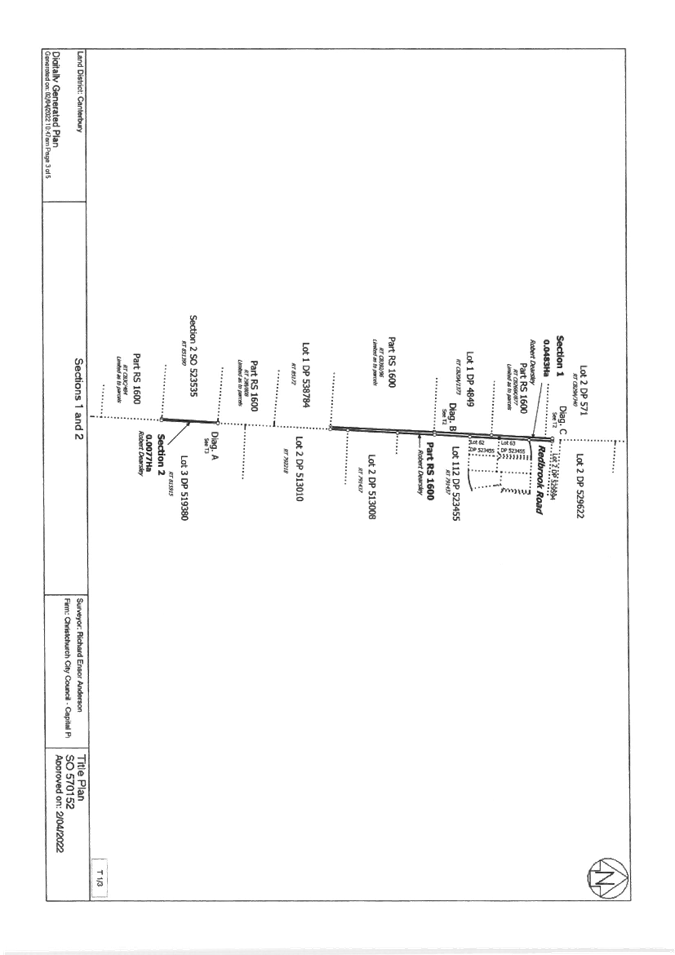
3.1 Council
acquired the boxed drain contained within Section 1 SO 570152 to facilitate the
naturalisation of the Styx Drain and enable the Millstead Oaks subdivision.
3.2 All
subdivision, road formation and reserve works have been completed, leaving a
140-metre long and 3.5-metre wide strip of land not required by council for its
works and therefore to be resolved.
3.3 It
is proposed that section 1 will vest as road, section 6 will vest as Local
Purpose (Utility) Reserve and sections 2–5 will be transferred to each of
their respective adjoining owners to the west. All sections are shown on scheme
plan RPS6694.
4. Background/Context Te Horopaki
4.1 The
Styx Mill Drain was one of the old style boxed drains common throughout
Christchurch and although Council has statutory rights to maintain drains of
this nature these rights do not confer ownership. Given the Council’s
desire to naturalise the Styx Drain it was logical for Council to take
ownership of it to enable development.
4.2 In
the first quarter of 2023 Council compulsorily acquired the land identified as
Section 1 SO 570152 that contained the boxed Styx drain and was held in the
historic Deeds Register with its owner being long deceased.
4.3 This
drain extended through the (now) formed Redbrook Road to the north and adjoins
Council utility reserve to the south. Section 1 is to vest as road, Section 6
will vest as Local Purpose (Utility) Reserve and it is planned to transfer
sections 2-5 to their respective adjoining owners to the west.
4.3.1
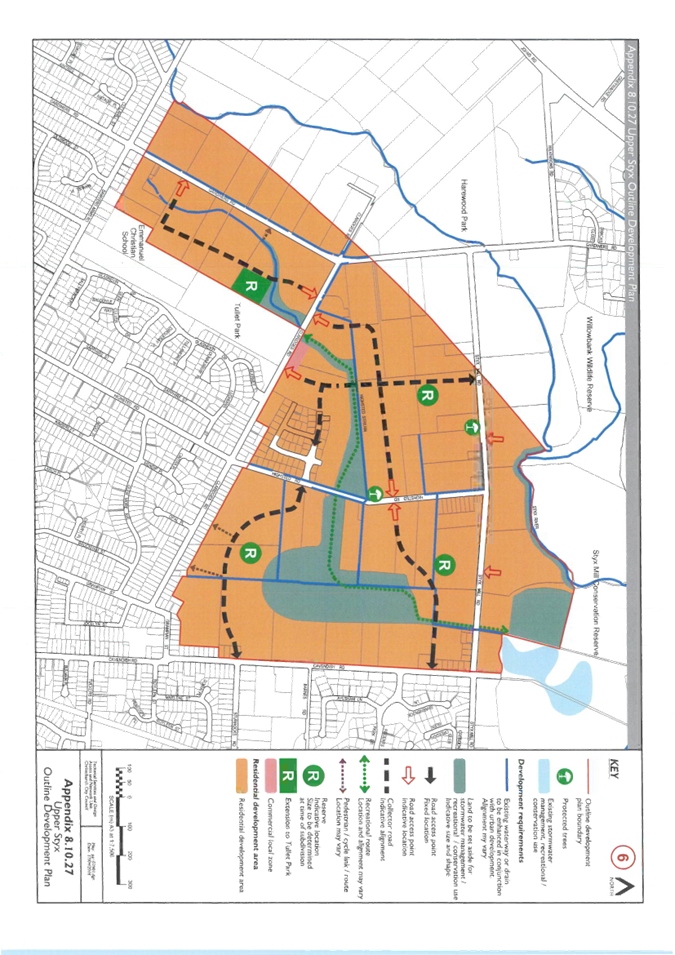
4.4 This
strip of land falls within the Upper Styx Outline Development Plan (attached),
which includes land for residential sections, roads and utility reserves.
Specifically this portion of the boxed drain is intended for road, residential
development and reserve. 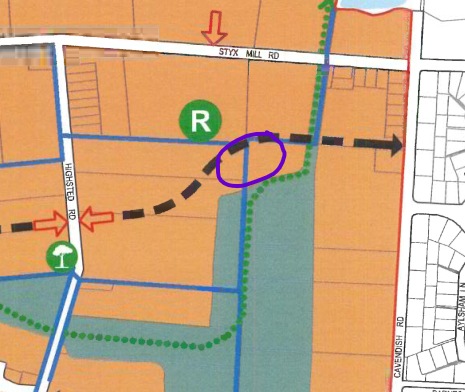
4.5 By
taking ownership, the Council was able to divert and naturalise the Styx Drain
and investigate whether to fully fill the old drain or if it was required
provide subsoil drainage in the form of a piped easement, the later was the
case.
4.6 This
subsoil drainage work was to be completed by either the developer or the
Council dependent on timing, as it transpired the developer completed the
drainage works at its cost which allowed its development to proceed in a timely
manner.
4.7 The
subsoil drain is now operative and will be protected by way of easement,
however, this strip of land remains problematic for the Council for the
following reasons;
· Due to its elongated and restricted width, it provides little
meaningful public access. There are alternative points of access to the Council
reserves from Redbrook Road.
· It is too narrow for contactors mowers to safely manoeuvre.
· Council could be liable for 50% share of fencing costs for up to 140
linear metres of fencing.
4.8 To
mitigate these issues and with development having been completed on the strips
eastern boundary it is proposed to transfer the strip of land to each of the
(now) four adjoining owners on the western side for a nominal consideration,
however staff have no delegation to dispose of property, a decision by the full
Council is required.
4.9 A
nominal consideration is justified given the issues outlined in paragraph 4.7,
these issues justify a significant discount on any perceived value. In
addition, we cannot force the adjoining owners to purchase the land, the
nominal consideration has been an incentive for them to accept the Council
proposal that has little or no added benefit for them.
Options Considered Ngā
Kōwhiringa Whaiwhakaaro
4.10 The following
reasonably practicable options were considered and are assessed in this report:
4.10.1 Dispose of the land to
owners on the western boundary.
4.10.2 Retain ownership.
4.11 The following
options were considered but ruled out:
4.11.1 Dispose of the land to
the properties on its eastern boundary – This option was ruled out
because the land to the eastern side has already been built on and fenced.
4.11.2 Lease or licence the land
to adjoining owners – This option was ruled out because it does not
provide a permanent solution.
Options Descriptions Ngā
Kōwhiringa
4.12 Preferred
Option: Dispose of the land.
4.12.1 Option Description: Dispose
of the land to the owners of four sections on its western side.
4.12.2 Option Advantages
· No cost of maintenance.
· No cost of fencing.
· Disposal of a thin strip of land that has little or no practical
access.
· The subsoil drain can be protected by way of registered easement.
4.12.3 Option Disadvantages
· Cost of survey and associated staff costs.
4.13 Option
Description: Retain ownership.
4.13.1 Option Description: Hold
the land in Council ownership.
4.13.2 Option Advantages
· 100% control of the land.
4.13.3 Option Disadvantages
· Ongoing maintenance cost.
· Costs of fencing.
· Due to its elongated and restricted width, it provides little or no
practical access.
· Potential problems i.e. fly dumping, antisocial behaviour
Analysis Criteria Ngā Paearu
Wetekina
4.14 The criteria for
the above options were analysed by comparing any need to retain the land
against the benefits of disposal and what that means at a practical operational
level.
5. Financial Implications Ngā Hīraunga Rauemi
Capex/Opex Ngā Utu Whakahaere
|
|
Recommended Option
|
Option 2 – Council ownership
|
Option 3 - <enter text>
|
|
Cost to Implement
|
$10,000
|
Nil
|
|
|
Maintenance/Ongoing Costs
|
Nil
|
Estimated $10,500 immediate fencing costs
$1150 p/a mowing costs
|
|
|
Funding Source
|
Three waters operational budget
|
Three Waters operational budget
|
|
|
Funding Availability
|
LTP 2024-2034
|
LTP 2024-2034
|
|
|
Impact on Rates
|
<0.01%
|
<0.01%
|
|
6. Considerations Ngā Whai Whakaaro
Risks and Mitigations Ngā
Mōrearea me ngā Whakamātautau
6.1 Because
the pipe work for the subsoil drain will be protected by an easement that gives
rights to access the pipe should maintenance be required, there is no risk
associated with the disposal of this land.
Legal Considerations Ngā
Hīraunga ā-Ture
6.2 Statutory
and/or delegated authority to undertake proposals in the report:
6.2.1 The Council
has full capacity to carry on or undertake any activity as prescribed in s12 of
the Local Government Act 2002. There is however no staff delegation to dispose
of land.
6.3 Other Legal Implications:
6.3.1 There is no
legal context, issue, or implication relevant to this decision Strategy
and Policy Considerations.
6.4 The
required decisions:
6.4.1 Align with the
Christchurch
City Council’s Strategic Framework. Community
Outcomes – Manage ratepayers’ money wisely.
6.4.2 Are assessed
as low significance based on the
Christchurch City Council’s Significance and Engagement Policy. The
level of significance was determined by evaluation
of the need to retain ownership of the land given is size situation and shape.
6.4.3 Are consistent with Council’s Plans and Policies. Disposal of Surplus
Property – There is no other logical purchaser.
6.5 This
report is consistent with the Council's
Long Term Plan (2024 - 2034).
Community Impacts and Views Ngā Mariu
ā-Hāpori
6.6 There
are no community impacts in this decision. The significance was assessed as
being of low significance and therefore community views are unknown.
6.7 The decision affects the following wards/Community Board areas:
6.7.1 Harewood ward.
6.8 The Community Boards view has not been canvased ahead of this report.
Impact on Mana Whenua Ngā Whai Take
Mana Whenua
6.9 The decision does not
involve a significant decision in relation to ancestral land, a body of
water or other elements of intrinsic value, therefore this decision does not specifically impact Mana Whenua, their culture, and
traditions.
6.10 The decision does
not involve a matter of interest to Mana Whenua and will not impact on
our agreed partnership priorities with Ngā Papatipu
Rūnanga.
6.11 The land has no customary uses or
ongoing mana whenua activities and does not impact Mana Whenua.
Climate Change Impact Considerations Ngā
Whai Whakaaro mā te Āhuarangi
6.12 The decisions in
this report are likely to:
6.12.1 Have no impact on the adaptation
to the impacts of climate change.
6.12.2 Have no impact to emissions reductions.
6.15 The
proposals in this report are unlikely to contribute significantly to adaptation
to the impacts of climate change or emissions reductions.
6.16 No significant
impacts are anticipated because there is no change in the nature of the land,
it is only the underlying ownership that changes.
7. Next Steps Ngā Mahinga ā-muri
7.1 Survey
the land.
7.2 Transfer
to the adjoining owners and.
7.3 Issue
titles.
Attachments Ngā Tāpirihanga
|
No.
|
Title
|
Reference
|
Page
|
|
a
|
304/7050 SO
570152 Diagram
|
25/2349079
|
|
|
b
|
304/7050 Upper
Styx ODP
|
25/2349184
|
|
In addition to the attached documents, the following background
information is available:
|
Document
Name – Location / File Link
|
|
Not
applicable
|
Signatories Ngā Kaiwaitohu
|
Author
|
Sarah Stuart -
Property Consultant
|
|
Approved By
|
Angus Smith -
Manager Property Consultancy
Gavin
Hutchison - Head of Three Waters
Brent Smith -
General Manager City Infrastructure
|
|
9. Christchurch Wastewater Treatment
Plant Pond Odour Mitigation
|
|
Reference Te Tohutoro:
|
26/525589
|
|
Responsible Officer(s) Te Pou Matua:
|
Gavin
Hutchison, Head of Three Waters
|
|
Accountable ELT Member Pouwhakarae:
|
Brent
Smith, General Manager City Infrastructure
|
1. Purpose and Origin of the Report Te Pūtake Pūrongo
1.1 The
purpose of this report is for Council to decide how to mitigate the risk of
odour from the Christchurch wastewater treatment ponds.
1.2 The
report is staff generated.
1.3 There are two reasonably viable options: increased aeration in the
ponds; or a combination of increased aeration and diverting some partly treated
wastewater around the ponds for about 16-60 days per annum. Staff recommend
increased aeration of the ponds without diversion because it is most
cost-effective, is supported by mana whenua, avoids possible ecological effects
of diversion and is more straightforward both for construction and operation.
2. Officer Recommendations Ngā
Tūtohu
That the Council:
1. Receives the information in the Christchurch Wastewater
Treatment Plant Pond Odour Mitigation Report.
2. Notes that the decision in this report is
assessed as medium significance based on the Christchurch City Council’s
Significance and Engagement Policy.
3. Agrees to increase aeration of the
Christchurch Wastewater Treatment Plant ponds sufficient to mitigate the 95th
percentile increase in Biological Oxygen Demand (BOD) and requests this be
implemented urgently.
3. Executive Summary Te Whakarāpopoto Matua
3.1 Offensive
and objectionable odours from the Christchurch Wastewater Treatment Plant
(CWTP) are mainly caused by the ponds. There are other causes of odour at the
CWTP but this is the most significant one and the one that produces the most
issues. The odour occurs when Biological Oxygen Demand (BOD) levels in the CWTP
ponds are high. The problem will be solved after a new activated sludge plant
and its supporting systems are operating in 2028. In the meantime, there are
two options for reducing BOD levels in the ponds:
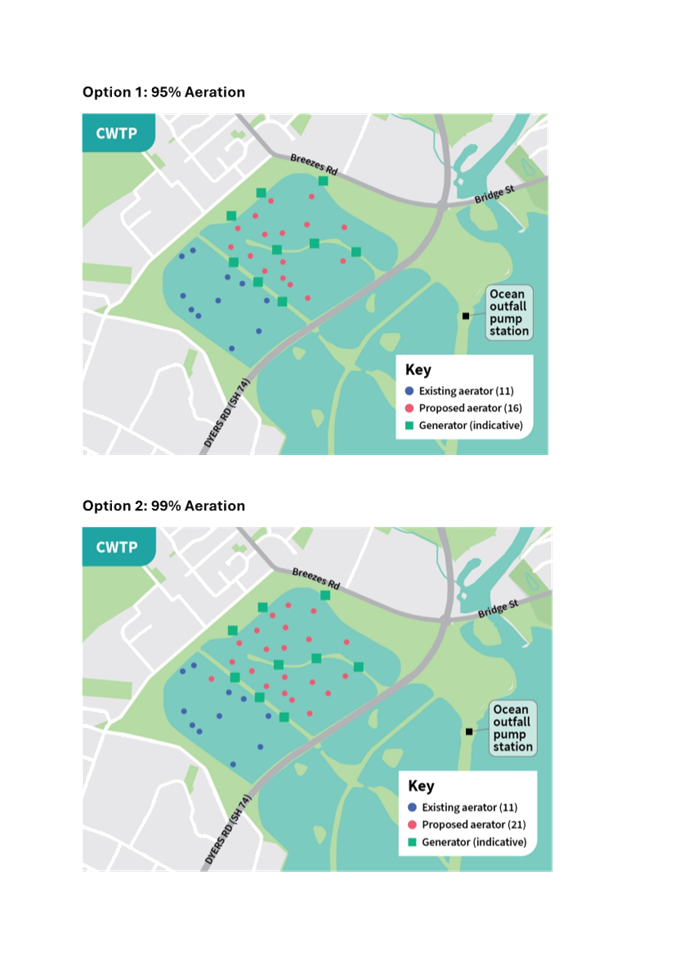
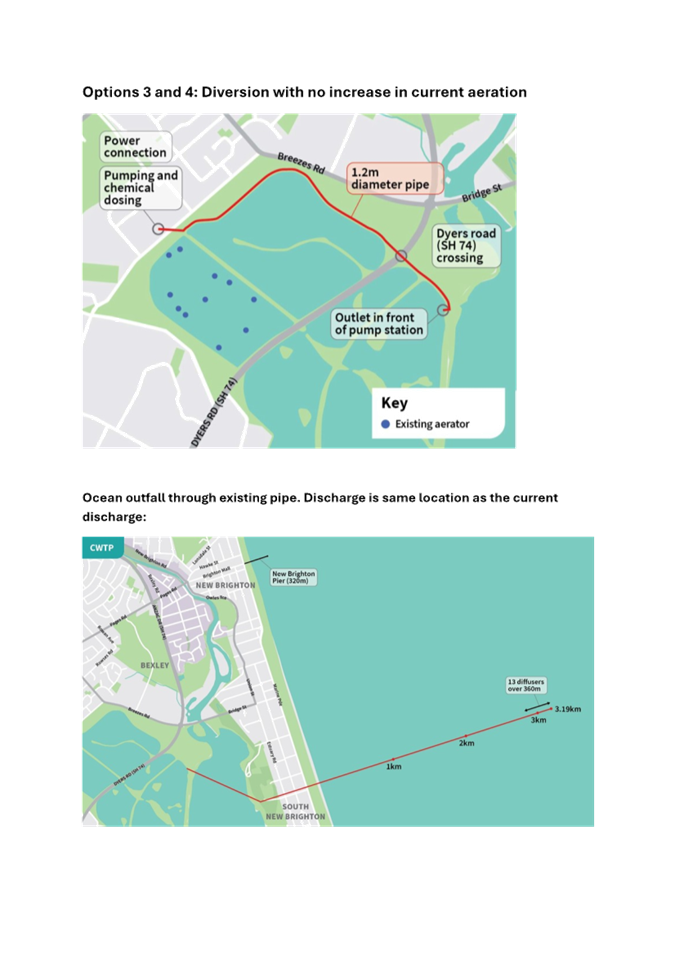
3.1.1 Increased
aeration in the ponds (see Attachment A). This entails putting more
aerators in the ponds and having increased power supply to run the aerators. It
might take four months to get the increased power supply to the aerators. The
Council would seek resource consent, if needed, for using diesel generators in
the meantime; or
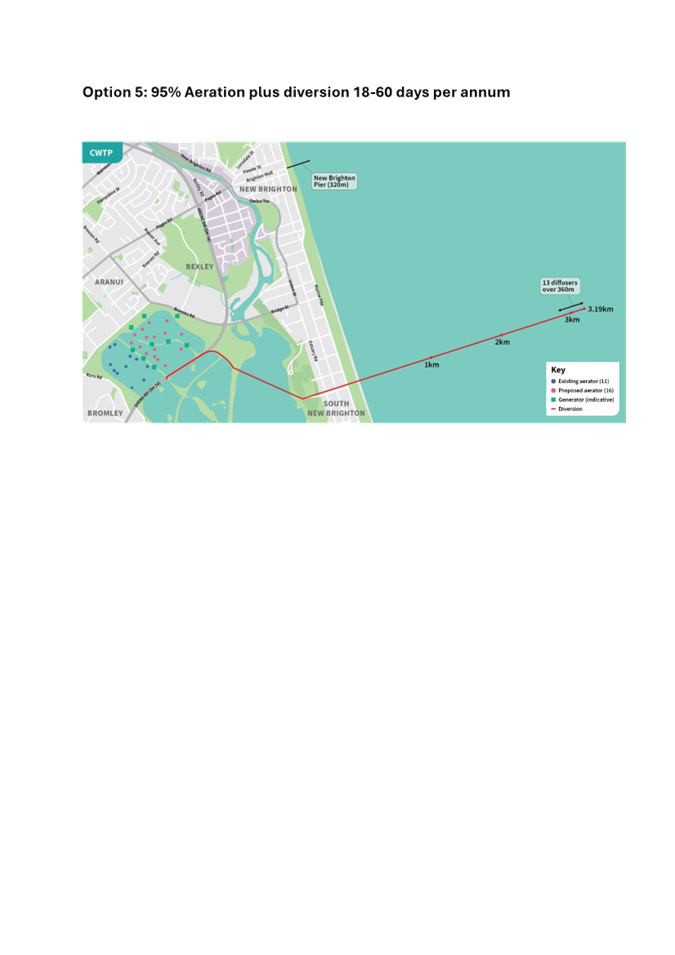
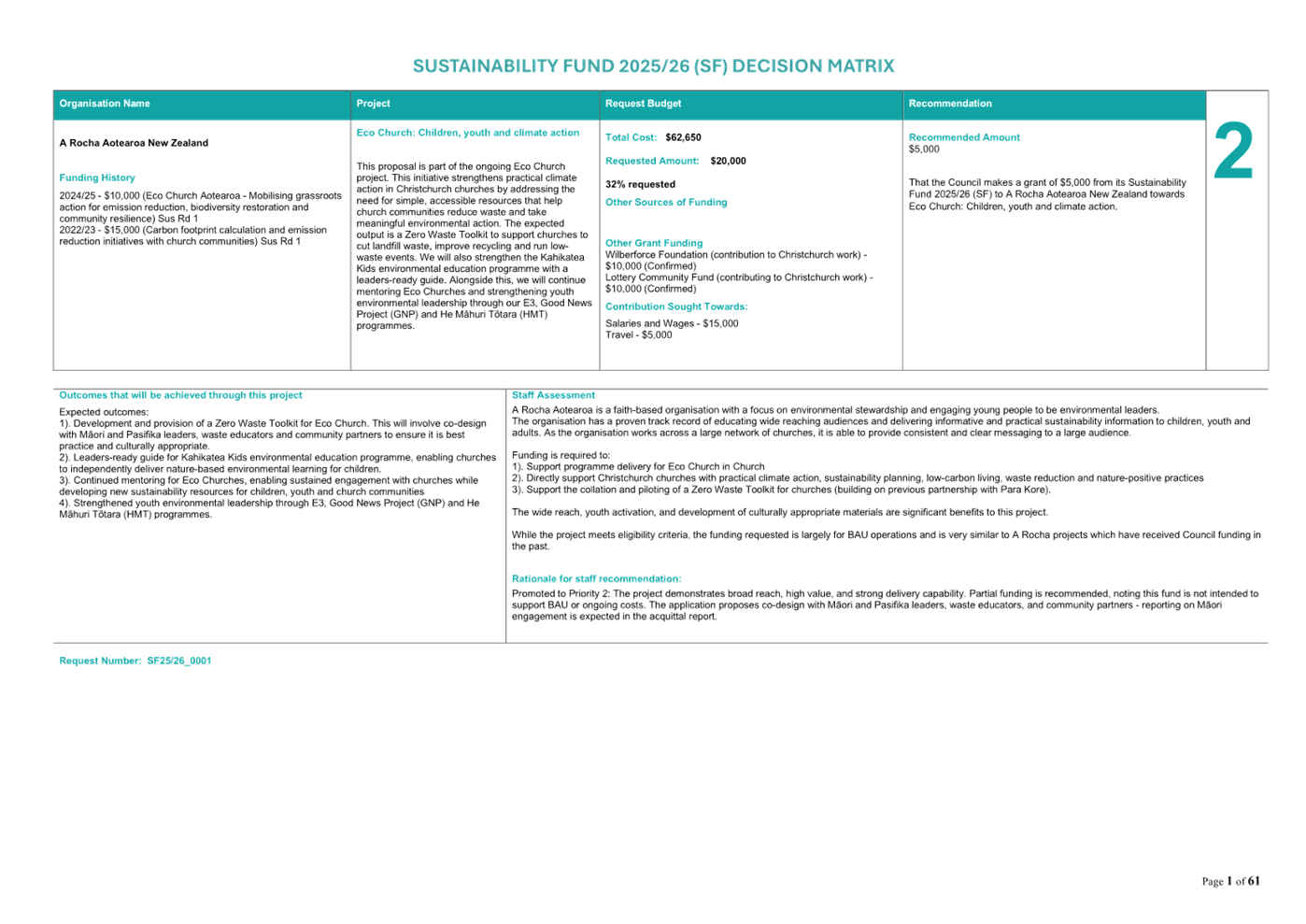
3.1.2 Diverting
some of the partly treated wastewater around the ponds, adding disinfection to
it, and then combining it with the treated wastewater that has passed through
the ponds and discharging it together in the existing 3.5 km long outfall (see
Attachment A). This entails piping the partly treated wastewater
around the ponds and combining it, in the existing outfall structure, with the
fully treated wastewater being discharged from the ponds.
3.2 The
table in Attachment B compares those options. It shows that increased
aeration, diversion (with no change to current aeration) or a combination
of increased aeration and diversion will all be effective in substantially
reducing the frequency and likelihood of offensive and objectionable odour.
However, the potential adverse effects of continuous diversion (options 3, 4
and 6) mean that they cannot be cost-effective and have not been short listed
for consideration.
3.3 Of
options 1, 2 and 5, aeration is more cost-effective than combined aeration and
diversion. It is cheaper than diversion, has more straightforward resource
consent requirements, and has less potential construction and operational
complexity.
3.4 Mana
whenua have indicated that they support aeration.
3.5 If
Council prefers aeration over diversion, the Council needs to decide what its
target is for the effectiveness of the aeration. The higher the target, the
fewer the modelled possible days of odour issues but the higher the cost. Staff
present two options in this report for the quantity of aeration (Attachment
B):
(a) Enough
aeration to mitigate the risk of offensive and objectionable odour, due to BOD
loads, on 95% of the days in a calendar year; or
(b) Enough
aeration to mitigate the risk of offensive and objectionable odour, due to BOD
loads, on 99% of the days in a calendar year.
3.6 The
differences in effectiveness and costs are:
(a) In
targeting 95% of the time, the pond improvement arising from aeration means the
ponds could be expected to cope with some high BOD load days beyond that 95%
target; accordingly, there may be around three days per annum of offensive and
objectionable odour caused by BOD in the ponds. The cost of the 95% option is
$7.7m including operation for three years;
(b) In
targeting 99% of the time, the pond improvement arising from aeration
means the ponds could be expected to cope with some high BOD load days
beyond that 99% target. In this case there are unlikely to be any days of
offensive and objectionable odour caused by BOD in the ponds. The cost of the
99% option is $11.2m including operation for three years.
3.7 Either
aeration or diversion will require an increase in the Three Waters operating
budget as existing budgets will not be able to cover the operating cost of
either option.
3.8 There
has not been time to obtain a report on ecological and health effects from the
diversion options. The 16-60 days per annum of diversion of 400 L/sec in option
5 would have less adverse effects than the continuous discharge in options 3, 4
and 6; however, the extent of that adverse effect is unknown. Officers consider
that Council has sufficient information to decide that aeration to achieve the
95th percentile solution is the most cost-effective option without
needing that further information on ecological effects.
3.9 The
law requires the Council to choose the most cost-effective option.
4. Background/Context Te Horopaki
4.1 There
are several potential causes for offensive and objectionable from CWTP.
Council’s experts identify BOD overload of the pond system as a primary
cause. The mitigations discussed in this report do not address the other
potential causes. These mitigations will therefore not end potential offensive
and objectionable caused by the other factors:
4.1.1 From
the temporary activated sludge plant.
4.1.2 Excessive
loads or disruptive chemicals discharged into the city wastewater network,
which can cause poor process performance in the primary or secondary processes.
4.1.3 Significant
breakdowns or equipment failures that lead to failures in treatment or existing
odour control systems.
4.1.4 The
period after extreme rain events as the ponds re-establish their normal biota.
4.1.5 Odour
emissions from other parts of the process such as digester pressure relief
valves or access doors and hatches to high odour processes.
4.2 These
odour sources can occur, approximately, several times a month but not to the
scale and duration of the pond issues, nor to the same intensity.
4.3 Biological
Oxygen Demand (BOD) is a measure of how many kg of oxygen a given volume of
water needs to break down organic material into CO2 and an inert sludge. The
reason that BOD is the parameter of interest is that studies and experience
show that if ponds are overloaded with BOD there may be offensive and
objectionable odour beyond the boundary of the site.
4.4 Prior
to the 2021 fire, the ponds had been receiving very low BOD loads from the main
process for decades. This means that sludge accumulation in the ponds was
minimal and so the ponds had plenty of resilience. That resilience was of
benefit initially after the fire as there was no existing sludge breaking down
in the base of the pond. But over time this sludge has accumulated, is breaking
down and thereby reduces the ponds’ capacity to accept these high
loadings, meaning they are more likely to go anoxic and so generate more odour.
4.5 Aeration
would increase the capacity of the ponds to accommodate higher loads of BOD
than they normally tolerate.
4.6 Diversion
would reduce the BOD loading on the ponds to an appropriate level.
4.7 In
aeration, air is bubbled or pumped into wastewater to provide more oxygen and
permit more BOD to be treated. It reduces odour by ensuring microbe populations
are dominated by aerobic species which exhale odourless oxides such as carbon
dioxides. As part of the temporary fire recovery an aeration system was also
commissioned in Pond 1 in July 2023 to better treat BOD released to the ponds.
4.8 Diversion
means that some of the partially treated wastewater that has been through the
CWTP does not go into the ponds. That partially treated wastewater would
instead be piped around the ponds and then combined with the fully treated
wastewater in the outfall pump station. This would reduce the BOD load on the
ponds.
4.9 Adding
either aeration or diversion improves the resilience of the system, providing
extra tools if there are issues at the CWTP. They broadly provide the same
resilience benefits.
Options Considered Ngā Kōwhiringa Whaiwhakaaro
4.10 The
following reasonably practicable options were considered and are assessed in
this report:
4.10.1 Aeration,
without diversion, to achieve the 95th or 99th percentile
BOD mitigation (options 1 or 2).
4.10.2 Aeration
plus diversion to achieve complete BOD mitigation.
4.11 The
following options were considered but ruled out:
4.11.1 Doing
nothing was ruled out because it would not mitigate the odour.
4.11.2 Relying
on working with industry to reduce the spikes in BOD entering the system was
ruled out because achieving large reductions would need large and unrealistic
reductions in commercial activity. But Council can seek to work with industry
to seek gains at the same time as implementing its preferred option.
4.11.3 Continuous
diversion (options 3, 4 and 6 in Attachment B) was ruled out because it costs
significantly more than aeration alone, takes longer to implement, has
increased construction and operational complexity, might have adverse
ecological effects in the ocean and has additional consenting requirements.
Options Descriptions Ngā Kōwhiringa
4.12 Preferred
Option: Aeration that would substantially reduce the risk of offensive and
objectionable odour from BOD for 95% of the time (option 1 in Attachment B).
4.12.1 Option
Description: Aeration is described above. The number of aerators needed is
shown in Attachment A. The comparison between the aeration options, and
between aeration and diversion, is in Attachment B.
4.12.2 Option
Advantages
· It costs less
than diversion, has low risk of failure and operational simplicity, and does
not require discharge of partially treated wastewater to the ocean.
· is the Council
might consider it preferable to aeration seeking the 99th percentile
target (option 2) because while option 2 aims at no offensive and objectionable
odour, the modelled difference in effectiveness is not substantial and the
costs are higher.
4.12.3 Option
Disadvantages
· Quick
implementation may require use of diesel generators for about 6-10 weeks. That
has possible effects of noise and discharges to air. Staff consider that this
temporary noise can be mitigated and that the air discharges ought to be
readily consented by the Regional Council.
4.13 Aeration
to the 95% standard plus occasional diversion (18 – 60 days per annum) to
substantially reduce the risk of offensive and objectionable odour from BOD
(option 5).
4.13.1 Option
Description: Diversion is described above and shown in the plans in Attachment
A. The comparison between options is in Attachment B.
4.13.2 Option
Advantages
· This has no
material advantage aeration option 2 but might have the advantage over option 1
of seeking to avoid any days of offensive and objectionable odour.
4.13.3 Option
Disadvantages
· It may have
adverse ecological effects (as yet unquantified) from discharging partially
treated wastewater into the ocean. It is harder to implement and is more
complex to operate, leading to greater risk of failure.
Analysis Criteria Ngā Paearu Wetekina
4.14 The
analysis criteria are in Attachment B. Further explanation and key
points follow.
4.15 Days
per annum that BOD might still potentially cause offensive and objectionable
odour: Officers worked this out by modelling the extent to which the option
would have treated BOD, received by the ponds from the main CWTP process, to
acceptable levels using flow and BOD data from the last three years. The
modelling excluded a period in February 2024 in which the cause has now been
separately fixed. The modelling considered periods of 1-2 days of high BOD as
low risk because it is likely that aeration will improve pond health to the
extent that high BOD for 1-2 days is unlikely to cause offensive and
objectionable odour.
4.16 Effect
on ocean ecology: Ecological assessment has noted that:
(a) Increased
BOD levels might pose a high risk: The environment is sensitive to this. It
could lead to reduced dissolved oxygen concentrations (i.e., hypoxic or anoxic
conditions) in the marine receiving environment, with potentially significant
implication on biota survival;
(b) Increased
TSS might pose a medium risk;
(c) Some
disinfectants in the discharge might pose a very high risk and could be toxic
to marine biota. Ecological advice is that mitigation is difficult.
4.17 However,
there has not been a full assessment of the extent of any adverse effects of
diversion. That would require more detailed research.
4.18 Construction
complexity:
(a) Constructing
aeration is not complex. Extensions to the CWTP power system that would be
needed are well understood, key materials and aerators are available and
contracting resource available.
(b) Constructing
diversion is more complex. Complexities include:
§ Supply chain risks for pipes and
pumps;
· Construction
activities will require significant trenching activities around road crossings,
including crossing NZTA property;
§ Significant chemical storage, dosing
and electrical monitoring and control required.
4.19 Time
to implement: If the aerators are ready before the power supply is installed
then the Council can use diesel generators for a short time (possibly 6-10
weeks) as a temporary solution. Staff consider that this should be readily
consentable, and the Council’s ornithologist advises that it is unlikely
to adversely affect birdlife.
4.20 Operational
complexity and risk of performance failure:
(a) Aeration is
straightforward to operate and has little risk of performance failure;
(b) Adding
diversion to aeration has increased operational complexity. CWTP staff
will need to maintain chlorination dosing, ensure that chemical and fuel
supplies are maintained, and probably do additional monitoring both at the
ocean outfall pump station and shoreline monitoring to comply with new resource
consent conditions.
4.21 RMA
consent requirements:
(a) Aeration:
None needed for the aeration. A resource consent may be needed for the diesel
generators but officers consider that this will be a straightforward process
that does not cause any project delay.
(b) Diversion: A
new resource consent will be needed for discharge of partially treated
wastewater to the ocean. This is likely to need a full assessment of adverse
effects on the ocean ecology and public health risks to shellfish gathering.
The quality of the diverted wastewater is likely to comply with the standards
in the Wastewater Environment Performance Standards but that may not speed up
the consenting process. Disinfection (potentially by way of chlorination) is
needed for the discharge to be compliant, and this would add to the consenting
complexity.
4.22 Assessment
under the Local Government (Water Services) Act 2025 objectives and principles
is crucial.
4.23 Section
17 objectives of a water services provider: The relevant objectives are (in
summary):
· Provide
water services that are reliable, resilient, of sufficient quality and meet
regulatory requirements (s17(1)(a));
· Ensure
water services are provided in a cost-effective and financially sustainable way
(s17(1)(b));
· Perform
functions in accordance with sound business practice (s17(1)(c ));
· Act in
the best interests of current and future consumers (s17(1)(d))).
4.24 The
Council could reasonably consider that either aeration alone (options 1 and 2)
or aeration plus occasional diversion (option 5) meet those objectives.
4.25 Section
254 provides that that when the Council makes a decision about providing
wastewater infrastructure and treating wastewater, it must “choose
the option it considers to be the most cost-effective option for providing
wastewater services over the life of the infrastructure assets required to
implement that option”.
4.26 The
term “cost‑effective” requires an assessment of the value obtained for
the cost, over the life of infrastructure. Value for each project can include
social, cultural and environmental attributes. It is not possible to limit or
be precise about what attributes are relevant for any project. This will depend
on the circumstances and the objectives of Council. The most cost-effective
option is not necessarily the cheapest option.
4.27 In
practice, identifying the most cost‑effective option requires
assessing the financial costs with what can be purchased. A higher cost option
may still be the most cost‑effective if it provides better long‑term
value to achieve Council's objectives for infrastructure. For example, better
value may be achieved from a range of possible factors such as longer asset
life, improved environmental performance, easier consenting, stronger policy
alignment, reduced risk of failure, greater social or cultural acceptability.
Ultimately, the most cost‑effective option is the one that delivers the greatest overall value
for the cost during the asset’s life.
4.28 Officers
consider that aeration alone is more cost-effective than diversion alone for
the cost, effectiveness, and implementation reasons set out in Attachment B and
further described above.
4.29 Deciding
whether to use aerators sufficient to meet the 95th or the 99th
percentile BOD event, or aeration plus occasional diversion (option 5) is a
fine-grained cost-effective judgment. Regulatory compliance is more likely with
options 2 and 5, but it carries a significant cost burden for a reasonably
small modelled gain over the effectiveness of the 95th percentile
aeration option.
4.30 There
is an information gap about ecological effects of diversion. The diversion of
partially treated wastewater has potential to have adverse effects in the
ocean. The extent of adverse effect depends on the specific ocean environment
and on the quantity in the diversion compared to the status quo. That
ecological assessment is not available for this report; however, officers
consider that the Council can reasonably make a decision on its preferred
option without having that detail.
5. Financial Implications Ngā Hīraunga Rauemi
Capex/Opex Ngā Utu Whakahaere
|
|
Recommended Option Aeration to 95-99% BOD
Removal
|
Aeration to 95% BOD Removal + 400l/s Diversion
Option (Option 5)
|
|
Cost to Implement (CAPEX)
|
$5.6m - $8.2m
|
$8.6m
|
|
Maintenance/Ongoing Costs (OPEX)
|
$2.2m – $3.1m (three year period)
|
$3.6m (three year period)
|
|
Funding Source
|
Capital Source – Activated Sludge
Project
OPEX – Additional budget to be
sought
|
Capital Source – Activated Sludge
Project + additional capital
OPEX – Additional budget to be
sought
|
|
Funding Availability
|
Sufficient existing funding from
activated sludge project
|
Additional capital would be required to
manage funds required in excess of $8.5m
|
5.1 Capital
funding for the aeration option will use budget contingency assigned to the
Activated Sludge Project (ASP). However, the recent outbreak of war in the
Middle East has significantly increased cost risks and fuel constraint risks.
This means there is risk associated with reassigning capital budget from the
ASP to the aeration option as that places the ASP project at risk of a budget
over run. A maximum of $8.5M is available from the ASP budget, any capital
funding requirements above this would require additional funding.
5.2 There
is insufficient contingency to fund the diversion pumping works from the ASP
project and additional capital funding will be required from other areas.
6. Considerations Ngā Whai Whakaaro
Risks and Mitigations Ngā Mōrearea me
ngā Whakamātautau
6.1 Risks
are described in the option and assessment criteria above and in Attachment B.
6.2 The
fuel crisis causing all process to rise. That is unavoidable.
6.3 Project
delays risk more odour issues. That risk will be mitigated by seeking urgent
implementation of the Council resolution and by using diesel generators if
necessary.
6.4 Delays
caused by consenting delays can be mitigated by good communication and
engagement with Environment Canterbury as the regulatory authority. That
communication and engagement is already happening and is working well.
6.5 Lizards:
A Herpetologist site visit on 23.3.2026 has indicated no lizards are present
around the oxidation ponds, including the bunds between the ponds. That means a
wildlife permit regarding lizards will not be required. An accidental discovery
protocol will, however, be required during physical works.
Legal Considerations Ngā Hīraunga
ā-Ture
6.6 Statutory
and/or delegated authority to undertake proposals in the report:
6.6.1 The
Council has statutory authority to make the decision in this report.
6.7 Other Legal Implications:
6.7.1 Legal
considerations for consenting under the Resource Management Act have been
assessed in the option assessment above.
6.7.2 Te
Huingi Manu Wildlife Refuge -Bromley Oxidation ponds are a wildlife
refuge. No issues on lizards or birds have been identified, if aeration is
chosen. But diversion might have an adverse effect on the habitat.
6.7.3 Consistency
with the mandatory objectives of water services providers is assessed above.
That assessment shows aeration alone is more cost-effective than diversion
alone in meeting the Council’s and the Act’s objectives, but that
the cost-effectiveness assessment is a finely balanced judgement for the
Council for comparing aeration alone with aeration plus occasional diversion .
The Council must “choose the option it considers to be the most
cost-effective option for providing wastewater services over the life of the
infrastructure assets required to implement that option”. Aeration to
achieve the 95th percentile mitigation of BOD (option 1) is arguably
more cost-effective than that to achieve the 99th percentile
improvement (option 2) or aeration plus occasional diversion (option 5), as it
costs less, and as the minor difference in the calculation of potential days of
non-complying offensive and objectionable outcomes is a modelled estimate
rather than a certainty.
Strategy
and Policy Considerations Te
Whai Kaupapa here
6.8
The required decision:
6.8.1 Broadly
aligns with the Christchurch
City Council’s Strategic Framework .The 99% options for aeration or
diversion align with Council’s Integrated Water Strategy Te Wai Ora o
Tane, which targets 100% consent compliance (pg 32);
6.8.2 The
decision on whether to aerate or divert is of medium significance based on the
Christchurch City Council’s Significance and Engagement Policy. The
Council decision is a choice between aeration alone and aeration plus
occasional diversion. Doing nothing and continuing to discharge offensive and
objectionable odour from the site is not an option; and
6.8.3 Is
consistent the Council’s Plans and Policies.
6.9 This
report supports the Council's
Long Term Plan (2024 - 2034):
6.10 Wastewater Collection, Treatment and Disposal
6.10.1 Activity: Wastewater Collection, Treatment and Disposal
· Level of Service: 11.01.8 Number of wastewater odour
complaints per 1,000 connections to the wastewater network per year (DIA 4a) -
<=0.6
Community
Impacts and Views Ngā Mariu ā-Hāpori
6.11 Either
aeration alone or aeration plus occasional diversion will significantly reduce
the impacts of odour from the CWTP. Aeration alone will avoid community
concerns with discharge of partially treated wastewater to the ocean.
6.12 The
decision primarily affects the following wards/Community Board areas:
6.12.1 Coastal
Ward and Linwood Ward
6.13 The
Community Boards have not been asked for comment.
Impact
on Mana Whenua Ngā
Whai Take Mana Whenua
6.14 The decision is a significant decision in relation to a body of
water of intrinsic value, therefore this decision does
impact Mana Whenua, their culture, and traditions.
6.15 We here quote a
statement dated 24 March 2026 from the Upoko of Ngāi Tūāhuriri
regarding the Christchurch Wastewater Treatment:
Ngāi Tūāhuriri has been working closely
with Christchurch City Council over the past week to build a clearer
understanding of the issues affecting the Bromley Wastewater Treatment Plant
and the range of options available to address them.
During this time, Ngāi Tūāhuriri have not
made public statement. This has been deliberate. It is important to us that any
position we take is informed by evidence and a thorough understanding of the
facts. Forming a view in the absence of reliable information would not have
been appropriate.
Over the past week, we have been engaged in discussions
with council staff and have been reviewing technical reports and advice. We
acknowledge the work undertaken by the Council to evaluate a range of
alternative options to the proposed bypass.
We note that aeration presents a viable option that will
significantly reduce odour impacts for residents while also supporting improved
pond health within the treatment system, removing the need to discharge
partially treated wastewater into the ocean.
Ngāi Tūāhuriri will continue to work
constructively with the Council as further decisions are made, with a focus on
outcomes that uphold environmental integrity and the wellbeing of our
communities.
Climate
Change Impact Considerations Ngā Whai Whakaaro mā te Āhuarangi
6.16 The
decisions in this report are likely to impact CWTP’s greenhouse gas
emissions.
6.16.1 Increased
aeration in the ponds would support an improved ponds emission rating
(according to the Water NZ Greenhouse Gas Guidelines). Diversion pumping would
not have that benefit; however, this change is relatively minor and only for
the short period to the commissioning of the new activated sludge plant.
6.16.2 There might be emissions from diesel generators for a short time if
Council chooses the aeration option.
6.17 The
proposals in this report are unlikely to contribute significantly to adaptation
to the impacts of climate change or emissions reductions.
7. Next Steps Ngā Mahinga ā-muri
7.1 Implement
the Council decision and seek any necessary Resource Management Act approvals.
Attachments Ngā Tāpirihanga
|
No.
|
Title
|
Reference
|
Page
|
|
a ⇩
|
Options Maps
|
26/624104
|
117
|
|
b ⇩
|
Option Table
|
26/610052
|
121
|
In addition to the attached documents, the following background
information is available:
|
Document
Name – Location / File Link
|
|
Not
applicable
|
Signatories Ngā Kaiwaitohu
|
Authors
|
Kylie Hills -
Senior Engineer - Water & Waste Planning
Brent Pizzey -
Senior Legal Counsel
Gavin
Hutchison - Head of Three Waters
Tim Ure -
Senior Project Manager
|
|
Approved By
|
Brent Smith -
General Manager City Infrastructure
|
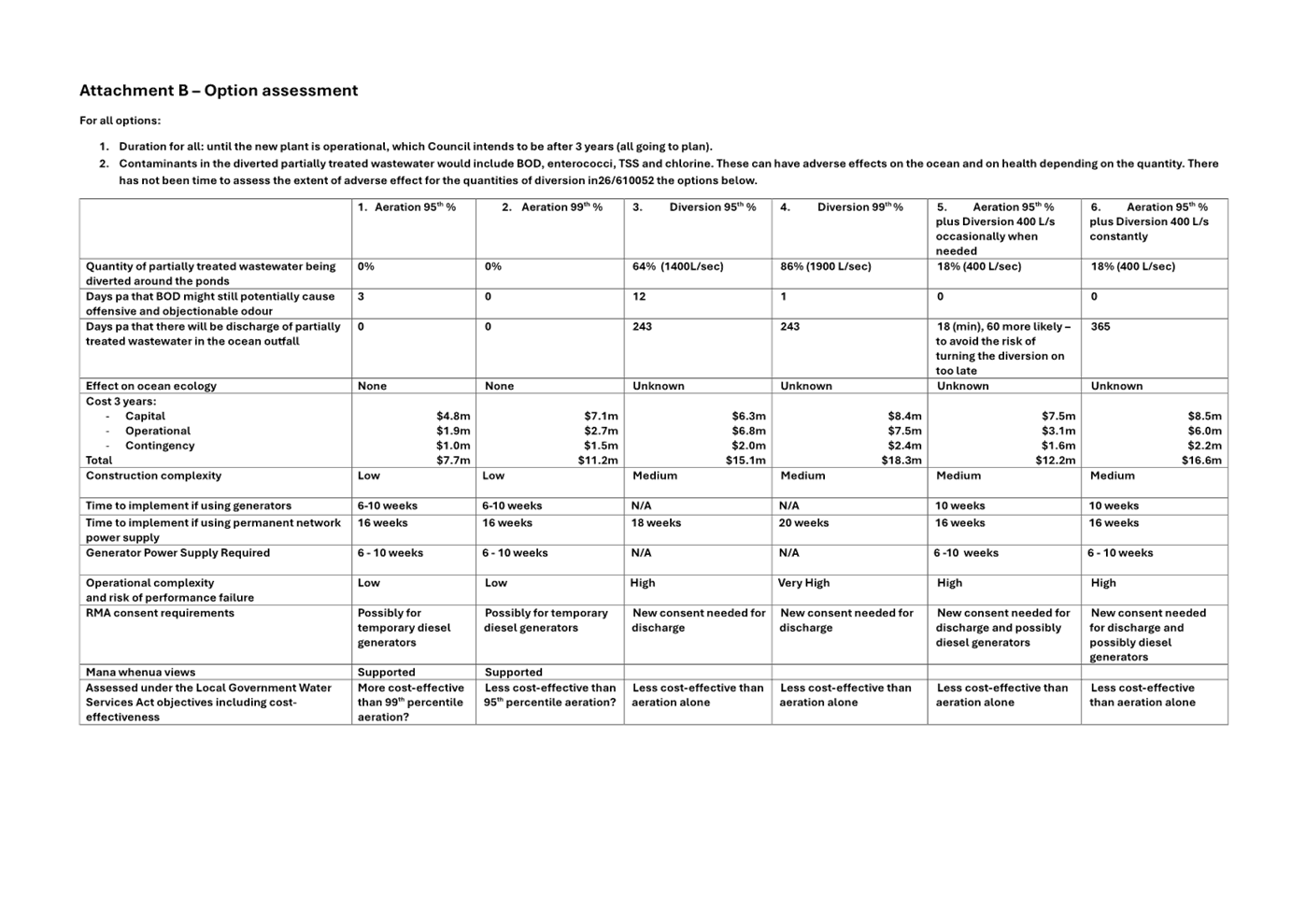
|
10. 2025-26 Sustainability Fund Allocation
|
|
Reference Te Tohutoro:
|
26/174795
|
|
Responsible Officer(s) Te Pou Matua:
|
Jessica
Weston, Senior Adaptation Advisor
Jane Morgan, Team Leader Climate Hazards Adaptation Planning
|
|
Accountable ELT Member Pouwhakarae:
|
John
Higgins, General Manager Strategy, Planning & Regulatory Services
|
1. Purpose and Origin of the Report Te Pūtake Pūrongo
1.1 The
purpose of this report is to seek the Council’s approval for the
allocation of the 2025-26 Sustainability Fund which supports projects that
address the Council’s climate change objectives.
2. Officer
Recommendations Ngā Tūtohu
That the Council:
1. Receives the information in the 2025-26
Sustainability Fund Allocation Report.
2. Notes that the decision in this report is assessed as low significance
based on the Christchurch City Council’s Significance and Engagement
Policy.
3. Approves the recommended allocations from the 2025-2026
Sustainability Fund as outlined in the following table:
|
Funding Request Number
|
Name
|
Name/Subject
|
Amount Recommended
|
|
27
|
Te Manawa Ora Trust
|
Pa Whakaoranga Kaupapa Māori Community Garden
|
$25,000.00
|
|
45
|
Smith Street Community Farm Trust
|
Water & Carbon Retention Project
|
$22,000.00
|
|
22
|
The New Brighton Community Gardens Charitable Trust
|
Young Propagating Gardeners and Sustainability Hub
|
$20,000.00
|
|
61
|
Food Resilience Network Inc
|
Roots of Resilience: Growing Climate‑Ready Soils
|
$20,000.00
|
|
65
|
Hornby Presbyterian Community Trust (Te Whare Awhero)
|
Grow Hornby
|
$20,000.00
|
|
55
|
Para Kore Marae
|
Mai i Kurawaka & Kope Tautaiao 2026
|
$15,525.00
|
|
07
|
Living Springs
|
Climate resilience
|
$15,000.00
|
|
42
|
RAD Bikes Charitable Trust
|
Strengthening 'Find a Bike' 2026-27
|
$15,000.00
|
|
46
|
Christchurch Envirohub Trust
|
Envirokids
|
$15,000.00
|
|
53
|
G & P Farm shop Limited (trading as Untamed Earth Organic
Farm)
|
Collective Regenerative Farming Project
|
$15,000.00
|
|
63
|
Terra Nova Foundation
|
Ōtautahi Emissions Reduction Project
|
$15,000.00
|
|
40
|
Te Hapū o Ngāti Wheke Inc
|
Returning Raupō to Whakaraupō
|
$13,000.00
|
|
06
|
Richmond Community Garden Trust
|
Riverlution Precious Plastic
|
$12,500.00
|
|
08
|
Canterbury Horticultural Society
|
Orchards in Schools (OIS)
|
$12,500.00
|
|
41
|
Garden to Table Trust
|
Garden to Table Christchurch
|
$12,500.00
|
|
43
|
Re-Purpose Pals
|
Re-thinking Waste for Wellbeing
|
$12,000.00
|
|
14
|
Wild Game Recovery Charitable Trust
|
Hunting for conservation and food security
|
$10,000.00
|
|
15
|
Ao Tawhiti Unlimited Discovery/Climate Action Campus Ōtautahi
|
Community Education for Climate Change resilience
|
$10,000.00
|
|
33
|
Sir Peter Blake Charity Limited
|
BLAKE NZ-VR: Climate Change
|
$10,000.00
|
|
35
|
Conservation Volunteers New Zealand
|
CVNZ Community Nursery
|
$10,000.00
|
|
36
|
Shirley Community Trust
|
MacFarlane Park Food Forest
|
$10,000.00
|
|
52
|
Canterbury Community Gardens Association Inc
|
Community Orchards
|
$10,000.00
|
|
54
|
Christchurch Transitional Architecture Trust
|
Christchurch Conversations 2026
|
$10,000.00
|
|
37
|
Untouched World Charitable Trust
|
Change Forward - Rangatahi in action
|
$8,400.00
|
|
16
|
Canterbury Horticultural Society
|
CHS Avebury Climate Resilient Garden
|
$8,000.00
|
|
31
|
The Green Lab
|
Summer back yard building
|
$8,000.00
|
|
38
|
All Aboard Transport Decarbonisation Trust
|
Going Places 2026
|
$8,000.00
|
|
60
|
Kia Kotahi Ako Charitable Trust
|
Powering solar education with Te Pā Foundation
|
$8,000.00
|
|
01
|
A Rocha Aotearoa New Zealand
|
Eco Church: Children, youth and climate action
|
$5,000.00
|
|
03
|
Cultivate Christchurch
|
Cultivate Explore
|
$5,000.00
|
|
10
|
Future Curious
|
Climate Futures Summit
|
$5,000.00
|
|
49
|
Styx Living Laboratory Trust
|
Community tree canopy project
|
$5,000.00
|
|
21
|
The Surfboard Library
|
Surfboard Library & Precious Plastics Programme
|
$3,500.00
|
|
50
|
Stitch O Mat Charitable Trust
|
Running Costs - Promoting Sustainable Practice
|
$2,573.00
|
|
29
|
Sustained Fun Ltd
|
World Sustainable Toy Day
|
$2,570.00
|
|
32
|
Ki te Tihi / The Loft Charitable Trust
|
Carbon Positive Certification for The Loft
|
$932.00
|
|
04
|
BLOOM Sustainability Limited T/A &BLOOM
|
BLOOMING Sustainability newsletter
|
Decline
|
|
05
|
BLOOM Sustainability Limited T/A &BLOOM
|
The Bloom Sustainability Sprint
|
Decline
|
|
09
|
Oaklands Te Kura o Ōwaka School
|
Installation of Solar Panels
|
Decline
|
|
12
|
Rod Donald Banks Peninsula Trust
|
Fire Sensor for new walking track
|
Decline
|
|
13
|
Stepping Stone Trust
|
Car Electrification
|
Decline
|
|
17
|
Hiringa Refuelling New Zealand Ltd.
|
Christchurch Hydrogen Demonstration Opportunity
|
Decline
|
|
19
|
Brighton Observatory of Environment & Economics Trust
|
Supporting Adapting Communities: (Heat).
|
Decline
|
|
20
|
Blue Cradle Foundation
|
Immersive Lab for Seaweek 2026
|
Decline
|
|
23
|
Christchurch Envirohub Trust
|
Environmental Coworking Space
|
Decline
|
|
24
|
Lakshman Jayasekara
|
'EUDAIMONIA- Back to the Future for Happiness'
|
Decline
|
|
34
|
Growing New Brighton
|
Autumn planting
|
Decline
|
|
44
|
Summit Road Society
|
Linda Woods Reserve Revegetation
|
Decline
|
|
48
|
Dharma Yodha New Zealand Inc.
|
Community Sustainability Leaders Workshops
|
Decline
|
|
41
|
The Wednesday Challenge HQ Limited
|
The Weekday Challenge Business Programme
|
Decline
|
|
56
|
Ōnuku Rūnanga
|
Te Kori a te Kō
|
Decline
|
|
57
|
Summit Road Society
|
Ōhinetahi Revegetation
|
Decline
|
|
58
|
Without Waste Limited
|
SUC Free Ōtautahi
|
Decline
|
|
62
|
TechCollect NZ Limited
|
Christchurch Free Community E-Waste Drop-Off
|
Decline
|
|
64
|
Food Resilience Network Inc
|
Growing Futures: Ōtautahi Permaculture Programme
|
Decline
|
|
66
|
The Arts Centre of Christchurch Trust Board
|
Offset operating costs by introducing solar energy
|
Decline
|
|
67
|
Big Street Bikers Limited
|
Activation Specialist
|
Decline
|
|
68
|
Avon Ōtākaro Network Inc
|
Ōtākaro Stormwater Truth (Phase Two)
|
Decline
|
|
11
|
The Wednesday Challenge HQ Limited
|
The Wednesday Challenge Schools' Programme 2026
|
Decline
|
|
18
|
Neighbourhood Trust
|
Solar Panel Project
|
Decline
|
|
39
|
Predator free NB/Coastal Kaitiaki
|
Predator free NB
|
Decline
|
4. Approves the transfer of any unallocated funds from 2025-26
Sustainability Fund to the 2026-27 Sustainability Fund.
3. Executive Summary Te Whakarāpopoto Matua
3.1 The
purpose of the Sustainability Fund (fund) is to encourage community,
school, social enterprise or business projects that help meet our climate
change objectives and targets.
3.2 The
fund has $400,000 available for allocation. The fund is heavily
over-subscribed, with 61 applications seeking $733,760 in total.
3.3 Technical
assessors from across the Council evaluated the applications against the funds
criteria and prioritised the applicants for funding. A cross-Council Evaluation
Panel then moderated these assessments and made funding recommendations.
3.4 Of
the 61 applications, 36 were assessed as Priority One or Two, meaning that
funding is recommended, and 25 were assessed as Priority Three or Four meaning
that funding is not recommended.
3.5 Please
note that appended to this report are:
3.5.1 Attachment
A – Decision Matrix which provides details about each application
(organisation details, project details, and high-level financial information)
and an assessment from the staff technical assessors.
4. Background/Context Te Horopaki
4.1 In
June 2021, the Council approved the Kia
tūroa tea o, Ōtautahi Christchurch Climate Resilience Strategy
which sets out four climate change goals to future proof our district, and ten
related climate action programmes that will help us deliver on these goals. The
goals are:
· Net Zero Emissions Christchurch.
· We understand and are preparing for the ongoing impacts of climate
change.
· We have a just transition to an innovative low-emission economy.
· We are guardians of our natural environment and taonga.
4.2 The
Sustainability
Fund provides a mechanism to support community action that contributes to
these climate goals by encouraging community, school, social enterprise, or
business projects that deliver climate action.
4.3 A
lessons learned review with staff was undertaken following the 2024-25
Sustainability Funding round. This identified what worked well and where
improvements could be made.
4.4 The
most significant changes were to the evaluation criteria, noting BAU processes
requiring sustained annual funding are unlikely to be funded. This fund is
intended for new and emergent projects and programmes. For groups applying year
on year, staff expect applicants to demonstrate they are seeking funding to
expand upon their existing work, rather than simply maintain it.
4.5 In
addition, a cap on the maximum amount applicants can request of $40,000 or 60%
of the total project costs was introduced – to support more equitable
distribution of funding and ensure that the fund can support a broader range of
projects. This also brings the fund in line with other Council-administered
grants, where funding caps are already in place.
Process
4.6 The
Sustainability Fund opened on 1 December 2025 and closed on 23 January 2026.
4.7 A
technical assessment of each application was undertaken by the Council’s
subject matter experts on emissions reduction, biodiversity, freshwater,
transport, waste, sustainable building design, energy efficiency, red zone,
community resilience, innovation and business, sustainable events, climate and
sustainability education, and coastal issues.
4.8 Each
application was evaluated against the following criteria:
· Relevance – alignment with the Council’s climate change
objectives.
· Benefit – the nature and scale of public good being delivered.
· Legacy – the ability to deliver ongoing benefit.
· Deliverability – the project is ready and able to be delivered.
· Measurability – has clear measures of success.
4.9 The technical assessment considered a range of information provided
by applicants including budgets, letters of support, and job descriptions; as
well as reviewing reports associated with previous funds allocated to these
projects where applicable.
4.10 The technical assessors prioritised each application as
follows:
· Priority 1 - Highly recommended for funding. Project meets all
eligibility criteria and contributes significantly to the purpose and outcomes
of the Fund.
· Priority 2 – Recommended for funding. Meets all eligibility
criteria and contributes well to the purpose and outcomes of the Fund, but to a
lesser extent than Priority 1 projects.
· Priority 3 – Not recommended for funding. Meets eligibility
criteria, meets most evaluation criteria, and contributes to the fund purpose
and outcomes, but to a lesser extent than Priority 2 projects.
· Priority 4 – Not recommended for funding. For example, it may
not meet eligibility criteria, insufficient information was provided, other
funding sources are more appropriate, or the project offers a limited or
uncertain benefit.
4.11 On 11 March 2026, the technical assessors presented their
assessments to an Evaluation Panel of cross-Council staff for moderation and
funding recommendations.
Recommendations
4.12 Priority One (13
applications) and Priority Two (23 applications) totalling 36 applications were
recommended for funding.
4.13 Priority Three (15
applications) and Priority Four (10 applications) totalling 25 applications
were not recommended for funding.
4.14 The Evaluation
Panel took the approach of fully allocating the funds by spreading partial
funding across Priority One and Two applicants, with the aim of maximising the
benefit to the community. All $400,000 funds available were allocated.
Options Considered Ngā
Kōwhiringa Whaiwhakaaro
4.15 The following
reasonably practicable options were considered and are assessed in this report:
4.15.1 The Council can endorse
the recommendations of the Evaluation Panel; or
4.15.2 The Council can determine
which, if any, applicants receive funding, and the amount allocated. Should
unspent funds remain, they will be added to the amount available in the 2026-27
financial year.
Options Descriptions Ngā
Kōwhiringa
4.16 Preferred
Option: Endorse the Evaluation Panel recommendations.
4.16.1 Option Description:
Endorse the recommendations made in this report.
4.16.2 Option Advantages:
4.16.3 This approach ensures
that funding is allocated in alignment with the process of expert assessment
undertaken by multiple staff against the fund’s criteria.
4.17 Alternative
option: Councillors distribute the funds.
4.17.1 Option Description:
Councillors opt to distribute funds differently from the recommendations made
in this report and/or hold funds back.
4.17.2 Option Advantages
· Some decisions may benefit from additional elected member community
knowledge and/or expertise.
4.17.3 Option Disadvantages
· This approach does not entirely align with the process of expert
assessment undertaken by multiple staff against the fund’s criteria.
5. Financial Implications Ngā Hīraunga Rauemi
Capex/Opex Ngā Utu Whakahaere
|
|
Recommended Option
|
Alternative Option
|
|
Cost to Implement
|
$400,000
|
Up to $400,000
|
|
Funding Source
|
LTP 2024-34
|
LTP 2024-34
|
|
Funding Availability
|
Within budget of $400,000
|
Within budget of $400,000
|
|
Impact on Rates
|
No additional
|
No additional
|
5.1 The
available balance of the 2025-26 Sustainability Fund is $400,000. This consists
of $400,000 budgeted in the Long-Term Plan. This report recommends allocating
$400,000 to applicants, which if approved would leave a balance of $0 in the
fund.
5.2 Adhering
to the fund’s Terms of Reference, any unspent funds will be carried
forward into the 2026-27 Sustainability Fund.
6. Considerations Ngā Whai Whakaaro
6.1 Risks
and Mitigations Ngā Mōrearea me ngā Whakamātautau The Grant
Funding Agreement that each successful applicant must sign before funds are
allocated aims to minimise the risks to the Council. Despite this, some risk
remains that projects don’t proceed, fail to deliver against outcomes, or
timeframes change. A detailed accountability report is required from applicants
to help manage these risks.
Legal Considerations Ngā
Hīraunga ā-Ture
6.2 The
Council has the authority to allocate grant funding from the Sustainability
Fund.
Strategy and Policy Considerations Te Whai
Kaupapa here
6.3 The
required decision:
6.3.1 Aligns with
the Christchurch
City Council’s Strategic Framework.
6.3.2 Is assessed as
low significance based on the Christchurch
City Council’s Significance and Engagement Policy. The level of
significance was determined by staff assessment
against the policy criteria.
6.4 This
report supports the Council's
Long Term Plan (2024 - 2034):
6.5 Citizens and communities
6.5.1 Activity: Community Development and Facilities
· Level of Service: 2.3.1.1 Provide funding for
projects and initiatives that build partnerships; resilient, engaged and
stronger communities, empowered at a local or community of interest level -
100% of funding assessments detail rationale and demonstrate benefits aligned
to Council's strategic priorities, and where appropriate, Community Board Plans
Impact on Mana Whenua Ngā Whai Take
Mana Whenua
6.6 The decision does not involve a significant decision in relation
to ancestral land, a body of water or other elements of intrinsic value,
therefore this decision does not specifically impact
Mana Whenua, their culture, and traditions.
6.7 The decision does not involve a matter of interest to Mana Whenua and will not impact on our agreed partnership priorities
with Ngā Papatipu Rūnanga.
6.8 Many of the projects supported through this Fund aim to help improve
water quality, support the regeneration of nature and encourage environmental
understanding and action by whānau and Tamariki. These projects would be
aligned to the interests of Mana Whenua.
Climate Change Impact
Considerations Ngā Whai Whakaaro mā te
Āhuarangi
6.9 The decisions in this report are likely to:
6.9.1 Contribute positively
to adaptation to the impacts of climate change.
6.9.2 Contribute positively to emissions reductions.
7. Next Steps Ngā Mahinga ā-muri
7.1 Once Grants are approved by the Council, a Grant Funding Agreement
will be sent to successful applicants with funds released upon signature.
Ideally this process is concluded by the end of April 2026.
7.2 Recipients of the Sustainability Fund must provide a Project Report
to the Council no later than three months after completion of the project, or
within 13 months of receiving funding.
7.3 Unsuccessful applicants will be notified by email and will be
directed to alternative Council funding streams if applicable.
7.4 A Newsline article will announce that the fund has been allocated.
7.5 A lessons learned process will be undertaken to inform next
year’s process.
Attachments Ngā Tāpirihanga
|
No.
|
Title
|
Reference
|
Page
|
|
a ⇩
|
Decision
Matrix
|
26/540827
|
131
|
In addition to the attached documents, the following background
information is available:
|
Document
Name – Location / File Link
|
|
Not
applicable
|
Signatories Ngā Kaiwaitohu
|
Authors
|
Jane Morgan -
Team Leader Coastal Hazards Adaptation Planning
Maiki Andersen
- Principal Advisor Climate Risks
Jess Weston -
Senior Adaptation Advisor
|
|
Approved By
|
David
Griffiths - Head of Strategic Policy & Resilience
John Filsell -
Head of Community Support and Partnerships
John Higgins -
General Manager Strategy, Planning & Regulatory Services
|
|
11. Hearings
Panel report to the Council on the Future of Lichfield Street Carpark
|
|
Reference Te Tohutoro:
|
26/304189
|
|
Presenter Te Kaipāhō:
|
Councillor
Pauline Cotter, Hearings Panel Chair
|
|
Accountable ELT Member Pouwhakarae:
|
Anne
Columbus, General Manager Corporate Services/Chief People Officer
|
1. Purpose and Origin of the Report Te Pūtake Pūrongo
1.1 The
purpose of this report is to present to the Council the Hearings Panel
recommendations following the consultation and hearings process of the Future
of Lichfield Street Carpark.
1.2 The
Hearings Panel has no decision-making powers but, per its delegation, has
considered the written and oral submissions received on the proposal and is now
making recommendations to the Council.
1.3 The
Council can then accept, reject or amend the recommendations, subject to
receiving officer advice confirming that the proposed changes are within the scope
of the matter and comply with decision-making requirements under the Local
Government Act 2002.
1.4 The
Council, as the final decision-maker, should put itself in as good a position
as the Hearings Panel, having heard all the parties. It can do so by
considering this report, which includes a summary of the written and verbal
submissions presented at the hearings, any additional information received and
the Hearings Panel’s considerations and deliberations. You may also
wish to review the Hearings
Panel agenda.
2. Hearings Panel Recommendations Ngā Tūtohu o Te Tira Taute
That the Council:
1. Resolves to retain the Lichfield Street Carpark;
2. Confirms that the primary reason to hold the carpark is to provide
casual, short-stay parking to support the Central City, on a commercial basis
that reduces the burden on ratepayers;
3. Authorises staff to find and implement costs savings where they will
not have material changes to service delivery;
4. Notes that the Council is already consulting on proposed increases
to car parking fees as part of the 2026/27 Annual Plan; and
5. Requests staff to present advice on mechanisms to improve the
financial performance of the Lichfield Street Carpark including, but not
limited to further regular fee changes, dynamic pricing, reviewing the balance
and location of long and short-term parking, costs savings and changes to the
operating model, in time to inform the 2027 to 2037 Long Term Plan.
3. Background / Context Te Horopaki
3.1 The Lichfield Street Carpark Building is a Council‑owned facility at 33 Lichfield Street that was rebuilt in
2016–2017 following demolition of the original 1960s structure damaged in
the Canterbury earthquakes. The replacement building was developed to support
the central city rebuild by providing short‑stay
off‑street parking for shoppers and visitors, particularly within the
core retail area. The facility continues to operate on this basis and includes
several ground‑floor commercial tenancies.
3.2 During
the 2024/25 Annual Plan process the Council requested a report on options for
the future of the carpark. This report, which was considered by the
Council in June 2025, raised issues including whether the carpark remains the
best use of Council capital, whether it aligns with current policy, and whether
continued ownership is justified given the maturity of the central city rebuild
and the availability of privately owned parking nearby.
3.3 The
report found that the carpark is performing its original role and supports
access to central city retail, hospitality, and entertainment activities.
Average peak occupancy has increased over recent years but remains below the 85
per cent target set in the Central City Parking Policy. Similar parking options
are widely available in the surrounding area, largely provided by the private
sector.
3.4 From
a financial perspective, the building generates an annual operating surplus of
$1.5 million but only delivers a return of around 3 per cent on the capital
invested. This level of return is below what Council policy expects for non‑strategic, income‑earning assets. While the asset has a high book value and may
appreciate over time, it is underperforming compared with alternative uses of
Council capital and is exposed to future risks such as rising maintenance costs
and changing transport patterns.
3.5 The
policy assessment concluded that off‑street parking buildings
are not considered strategic assets. Council policy is largely neutral on
ownership, provided parking objectives are met efficiently. The report noted
that Council’s role in directly owning parking facilities has reduced over
time and that private operators now meet most central city parking demand.
3.6 Several
options for the future of the facility were identified. These included
retaining the carpark with changes to the operating model to improve financial
performance, recycling the capital through sale of the land and building, or
first seeking further information by consulting the community and stakeholders
(at the time of the earlier report, Council had not undertaken consultation on
the future of this specific facility).
3.7 The
preferred option adopted by Council was to “learn more” by
undertaking consultation. Council resolved in June 2025 to seek the views of
stakeholders and the wider public before making any final decision on ownership
or operation.
4. Consultation Process and Submissions Te Tukanga Kōrerorero
Ngā Tāpaetanga
4.1 Consultation
started on 10 November and ran until 7 December 2025.
4.2 Project
details including links to the Kōrero mai |
Let’s Talk webpage were advertised via an email sent to key
stakeholders, posts on the Council Facebook page, a newsline
story , the Life in Christchurch Transport Survey, signs and flyers
available at the carpark.
4.3 The
Kōrero mai |
Let’s Talk webpage had 2,799 views throughout the consultation
period.
4.4 Staff
met with Ballantynes representatives on 4 December to discuss the consultation.
4.5 The
engagement that was carried out on the Future of Lichfield Street Carpark, and
the views of the community including their preferences, is outlined in the
following parts of the staff report to the Hearings Panel:
Summary
of submissions
Submitters
to be heard
Submitters
who do not wish to be heard
4.6 Submissions
were made by six organisations/businesses and 1238 individuals. Eight
submitters were heard, though initially 63 had indicated they wished to be
heard.
4.7 A
total of 1,122 submitters indicated a preference, while 123 did not. Of those
who stated a preference, 925 submitters (74%) preferred that the Council retain
the carpark and change the operating model, while 197 submitters (16%)
preferred that the Council sell the carpark and reallocate the funds elsewhere.
4.8
The analysis identifies a significant tension between
the community’s expectation for low-cost parking and pressures for
improved financial performance.
5. The Hearing Te Hui
5.1 The
Hearings Panel consisted of Councillors Pauline Cotter (Chair), Kelly Barber, David
Cartwright, Melanie Coker, and Mark Peters. The Hearings Panel convened
on 20 February 2026 to consider and deliberate on all submissions received on
the proposal.
5.2 Before
hearing oral submissions Council officers presented a brief overview of the options
presented to submitters, an overview
of community feedback , and also presented the Hearings Panel with further
information concerning the Future of Lichfield Street Carpark.
5.3 The
Panel heard from eight submitters, who expressed:
· Very strong support for retaining the carpark, except for one
submitter who explained the nature of ownership and management of private
carparking buildings, including that these do not make money but are considered
a necessary ‘loss leader’ to encourage customers to visit a
commercial development
· Strong support for the Council to retain its influence on central
city parking pricing
· Significant concern at the likelihood of price rises if sold
· Concern over loss of valuable assets in principle
· Some support for measures to increase revenue, such as fee
increases, long-stay parking on upper floors and surge pricing
· Confidence that the opening of One New Zealand Stadium will increase
demand for parking when events are on.
6. Consideration and Deliberation Ngā Whaiwhakaaro me Ngā
Taukume o Ngā Kōrero
6.1 The
Hearings Panel considered and deliberated on all submissions received on the
proposal as well as information received from Council officers during the
hearing.
6.2 The Hearings
Panel acknowledged the overwhelming support by submitters for the Council to
retain the carpark and change its operating model, with key reasons given in
written submissions being:
· Submitters
were concerned that selling the carpark would lead to higher parking prices,
reduced access, and greater market power for private parking operators.
· Many
saw the carpark as an important tool for maintaining competitive parking in the
central city.
· Submitters
valued the assurance that parking revenue stays local rather than being taken
as private profit.
· Several
believed that parking demand will increase over time due to central‑city
growth, higher‑density housing, and upcoming major facilities.
6.3 The
Hearings Panel considered the financial implications of either retaining the
carpark and changing the operating model, or of selling it. These include:
6.3.1 Implications
of Retaining the Carparking Building
§ The facility currently generates a
$1.5 million annual operating surplus but delivers only a 3% return on the book
value.
§ Most revenue from the building
comes from carparking. In FY 2024 casual parking generated $2.89m while the
commercial rentals on the ground floor generated $263,000. Staff noted that
these rentals are still receiving a COVID-19 discount.
§ Lichfield
Street Carpark charges neither the cheapest nor the most expensive parking fees
in the central city. Prices for a two-hour stay range from $4.50 to $28.00,
with Lichfield St charging $8.60.
§ The
target for peak occupancy is 85% and actual occupancy is currently sitting at
over 70% and has been steadily growing. There has been only seasonal
change in usage since consultation began. By contrast, the Art Gallery carpark,
prior to the number of publicly available carparks being reduced, had an
occupancy level of approximately 60%.
§ There
has been no future demand modelling done for the carpark. It was not included
in modelling of mode share for One New Zealand Stadium, though the expected
increase in throughflow at the bus exchange was.
§ Options to increase revenue
include:
· Increasing fees,
which could have an impact on usage
· increasing the
number of long-stay parks particularly on the upper floors
· leasing, surge
pricing.
§ However, staff noted that:
· The purpose of the
current policy of encouraging short-stay parking is to support retail and
businesses in the central city (whereas increasing long-stay parks would
encourage more commuter parking)
· The Council is not
an expert at maximising income from parking buildings and would need to seek
external advice on the best way to structure fees.
6.3.2 Implications
of Selling the Carparking Building
§ The
Hearings Panel noted the officer advice that there is likely to be interest
from buyers.
§ The
carpark cost $31m to build and borrowing is over 30 years, with full repayment
expected in 2047-48.
§ The carpark returns approximately
3% p.a. on its book value, noting the Council’s long-term average cost of
funds is 5.0%.
§ In answer to a panellist’s
question about the financial benefits of selling the carpark for a certain sum,
e.g. $50.0m, staff provided the following answer:
§ If the Council were to
sell the Lichfield Street Car Park in the 2027 financial year (01 July 2026
– 30 June 2027), for $50.0m for example, and apply the proceeds to debt
reduction then:
· In the financial
year 2026/27 the interest expense on borrowing would decrease by $1.0m, and
from financial year 2027/28 it would decrease by $2.5m.
· From the financial
year 2027/28 the debt repayment that Council rates for would decrease by $1.67m
per year, representing the lower balance of borrowing.
§ To put this example in context, the
Council’s total borrowing is approximately $2.6-9b, with net borrowing at
approximately $1.6-9b.
§ Wellington City
Council has sold its central city carparks and Auckland Council, if it has not
sold all, has reduced the number it owns.
6.4 The Hearings
Panel also noted that there are operational implications of either retaining
the carpark and changing the operating model or of selling it. These include:
· The
carpark is ten years old and has an expected life of 70 years.
· Whether
retained or sold, the building would most likely remain a carpark due to its
sloped floors making it unsuitable to be converted to another use.
· A
private operator may change the mix of short-stay and long-stay parking by
introducing all-day rates or leasing. They may also reduce services (e.g.
toilets and security).
· The
carpark contains more disability parks than required under resource consent and
anecdotally they are well used. A private operator might consider
removing some disability parks, though there would be little benefit in doing
so as it would not be possible to create two standard parks from one disability
park.
7. Financial Implications Ngā Hīraunga Rauemi
Capex/Opex Ngā Utu Whakahaere
7.1 The
Hearings Panel agenda contains information on the financial
implications of the options for the Future of Lichfield Street Carpark.
8. Risks and Mitigations Ngā Mōrearea me ngā
Whakamātautau
8.1 The
Hearings Panel agenda contains information on the risks
and mitigations for the options for the Future of Lichfield Street Carpark.
9. Reference Documents
Signatories Ngā Kaiwaitohu
Author Ruth
Close - Hearings Advisor
Approved By Councillor
Pauline Cotter - Chair of Hearings Panel
Attachments Ngā Tāpirihanga
There
are no attachments for this report.
|
12. International Relations Update
|
|
Reference Te Tohutoro:
|
26/475274
|
|
Responsible Officer(s) Te Pou Matua:
|
Duncan
Sandeman, Manager Office of the Mayor and Civic Services
|
|
Accountable Senior Manager Pouwhakarae:
|
Matthew
Pratt, Strategic Advisor
|
1. Purpose and Origin of the Report Te Pūtake Pūrongo
1.1 The
purpose of this report is to provide the Council with a summary of
International Relations activities over the 2025 calendar year, outline
proposed areas of work for the next 12 months, and seek approval for the Mayor
and identified elected members to undertake travel in support of the
International Relations Policy Framework (IRPF) over the triennium.
1.2 The
report provides the Council with oversite of delivery against the
IRPF. The IRPF is an international relations strategy jointly owned
by a wide range of internationally active city institutions setting out how
Christchurch will engage with the world for the benefit of its residents.
2. Officer Recommendations Ngā
Tūtohu
That the Council:
1. Receives the information in the International Relations Update
Report.
2. Notes that the decision in this report is
assessed as low significance based on the Christchurch City Council’s
Significance and Engagement Policy.
3. Approves Council funded travel by the Mayor
and elected members identified in Attachment B: Schedule 1 (Elected Member
Travel in Support of the IRPF) through to October 2028 for the joint purposes
of:
a. Commemorating significant Sister City
anniversaries, and
b. Supporting International Relations Policy
Framework engagement.
4. Approves the upgrade of our relationship with
Shenzhen, People’s Republic of China, to a Sister City.
3. Executive Summary Te Whakarāpopoto Matua
3.1 This
report provides an update on Christchurch’s international relations
activities over the 2025 calendar year and outlines key initiatives for the
year ahead, consistent with the International Relations Policy Framework
(IRPF).
3.2 It
also seeks Council approval for elected member travel to support these
initiatives and affirms the strategic direction for international engagement.
Key Achievements and Progress
3.3 Key achievements and progress include:
3.3.1 Continued
support for the Pacific Technical Assistance (PacificTA) programme, delivering
practical capacity-building across multiple Pacific Island countries in
partnership with Taituarā and the Ministry of Foreign Affairs and Trade
(MFAT).
3.3.2 The
advancement of a strategic city relationship with Chennai, India, including
completion of a Tier Two city study and initial engagement through the India
New Zealand Business Council.
3.3.3 Ongoing
collaboration with Shenzhen, China, to upgrade the existing “friendly
city” relationship to a formal Sister City agreement, following strong
support from Shenzhen city officials.
Proposed Actions
3.4 It
is recommended that the Council approves the Mayor and selected Councillors to
undertake visits to China (Shenzhen and Wuhan) and India (Chennai) between 2026
and 2028 to:
3.4.1 Commemorate
the 20th anniversary of the Christchurch–Wuhan Sister City relationship.
3.4.2 Sign
the Sister City agreement with Shenzhen.
3.4.3 Present
the business case for a strategic relationship with Chennai.
3.4.4 A
second visit to Chennai to progress the strategic relationship, accompanied by
a Christchurch delegation including key city partners.
3.5 It
is recommended that the Council endorse the upgrade of Shenzhen to Sister City
status.
3.6 Travel
costs will be met from existing budgets, with future activation costs to be
considered through the Long Term Plan (LTP).
Strategic Alignment
3.7 These
initiatives align with the IRPF’s principles of targeted, cohesive, and
responsible engagement. They focus on priority regions such as Guangdong
Province and South Asia and aim to deliver benefits for Christchurch through
increased trade, innovation, education partnerships, and cultural exchange.
4. Background/Context Te Horopaki
4.1 The
International Relations Policy Framework (IRPF) provides a strategic approach
for Christchurch City Council and its city partners to engage internationally
in a way that enhances wellbeing, economic prosperity, and global connectivity
for Ōtautahi Christchurch.
4.2 It
aligns with the Council’s Strategic Framework which seeks to make
Christchurch a place of opportunity for all, open to new ideas, new people, new
investment and new ways of doing things; a place where anything is possible.
4.3 Council
receives periodic updates on progress being made against the IRPF, most
recently in April 2025. In that update Councillors were briefed on the
intention to:
4.3.1 Work
with Taituarā in supporting the delivery of the Pacific TA programme.
4.3.2 Identify
a city in India to seek a long-term strategic relationship.
4.3.3 Upgrade
the friendly city relationship with Shenzhen to a Sister City.
4.4 The
organisation continues to make progress against each of these initiatives and
this report outlines the next steps in each programme of work.
4.5 A
full description of international relations activities conducted by the Council
in 2025 is included in Attachment A.
Pacific Technical Assistance
4.6 The
Council continues to provide support to the PacificTA programme. This
programme, funded by the New Zealand Government’s aid programme and
managed by Taituarā, aims to improve the quality of life for citizens in
Pacific Island countries by providing practical, hands-on support to local
managers responsible for public services.
4.7 PacificTA
matches New Zealand-based local government technical experts with Pacific
Island teams, delivering onsite training, mentoring, and technical assistance
to strengthen capacity in managing essential public infrastructure and
services.
4.8 Key
areas of support include:
4.8.1 Environmental
Management: Water and air quality, coastal planning, marine pollution response,
biodiversity, pest control, flood and hazard management.
4.8.2 Infrastructure
& Asset Management: Drinking water, sanitation, stormwater, roads, waste
management, ports, libraries, parks, and asset planning.
4.8.3 Urban
& Transport Planning: Public transport, urban planning, building control,
boating safety.
4.8.4 Public
Health & Safety: Crime prevention, civil defence, food safety, animal
control.
4.8.5 Governance
& Decision-Making: Financial management, organisational structure,
democracy support, major event planning.
4.9 In
2025 the Council provided support to Honiara in the Solomon Islands, and to
Port Vila and Luganville in Vanuatu.
4.10 Establishing
a single Sister City relationship in the Pacific may provide a visible
connection for some communities, however, it would concentrate resources and
effort on one city alone. Council’s support for the PacificTA programme
ensures that assistance is directed to areas of greatest need, as identified by
the New Zealand Ministry of Foreign Affairs and Trade, across multiple Pacific
Island countries.
4.11 This
approach delivers broader regional impact, aligns with national priorities, and
leverages Christchurch’s expertise where it can make the most
difference. It has been assessed as the most efficient, effective, and
equitable way for Christchurch to contribute to improved wellbeing in the South
Pacific.
Strategic City Relationship in India
4.12 Discussions
within the City’s IRPF Group have indicated a strong preference for
establishing a city-to-city relationship in India, with a focus on commercial
and economic collaboration. Currently, no New Zealand city has a formal
relationship in India, presenting a unique opportunity for Christchurch to lead
in this area.
4.13 CIR
commissioned a study on Tier Two cities across the subcontinent (excluding the
Tier One cities of Mumbai and Delhi), which was subsequently reviewed and
endorsed by the IRPF Group. The study identified Chennai as the most
suitable match for Christchurch.
4.14 Chennai,
a Tier Two city with a population of approximately 6.75 million, is the capital
and largest city of Tamil Nadu, located on the Coromandel Coast of the Bay of
Bengal. It is India’s sixth-most populous city and forms the
fourth-largest urban agglomeration, making it a significant hub for technology,
education, and trade.
4.15 In
February 2025, the Mayor signed an MoU with the India New Zealand Business
Council (INZBC) to support development of this relationship. INZBC subsequently
delivered a letter of introduction from Mayor Mauger to the Mayor of Chennai,
from whom a favourable response has been received.
4.16 A
sub-group of the IRPF Group is now developing a detailed business case
outlining why Christchurch is a strong strategic match for Chennai. This will
identify areas of mutual benefit and “win-win” opportunities across
sectors such as technology, education, trade, and cultural exchange.
4.17 Once
completed and peer-reviewed, it is proposed that the business case will be
presented by the Mayor and a small accompanying delegation to the Mayor and
officials of the Greater Chennai Corporation, alongside key business entities
identified by INZBC. This visit is targeted for the second half of 2026.
4.18 If
the proposal gains traction in Chennai, the next steps will include hosting a
reciprocal visit to Christchurch and a further, more substantive, delegation to
Chennai in FY 2027/28, with the aim of formalising a strategic city
relationship.
Upgrade of relationship with Shenzhen
4.19 As
briefed last year, Christchurch has maintained a “friendly city”
relationship with Shenzhen since 2015. During the Mayor’s visit to China
in 2024, discussions with the Mayor of Shenzhen and the Deputy Director-General
of the Chinese People’s Association for Friendship with Foreign Countries
confirmed strong support from the Chinese side for upgrading this relationship
to a formal Sister City agreement.
4.20 Since
then, CIR has worked closely with the Shenzhen Foreign Affairs Office to
progress this matter, and both cities now stand ready to sign a Sister City
agreement.
4.21 Council
approval is sought to upgrade the relationship.
4.22 While
this change will not significantly alter the level of engagement in the short
term, it will enhance the prestige and strategic value of the relationship.
This upgrade aligns with the IRPF, particularly its focus on Guangdong Province
as a priority region. Shenzhen is a global innovation hub and a key economic
centre within Guangdong, offering substantial opportunities for collaboration
in technology, trade, education, and cultural exchange.
Assistance to the Ukraine
4.23 In
February 2025, the Ukrainian Ambassador to New Zealand (based in Canberra)
visited the Mayor and raised the possibility of Christchurch entering into a
Sister City arrangement with Kharkiv, Ukraine’s second-largest city,
which has been significantly impacted by the ongoing conflict.
4.24 While
it is common for visiting ambassadors to suggest Sister City relationships,
most proposals do not align with Christchurch’s strategic priorities.
However, in this case, there may be merit in exploring the idea further.
4.25 Christchurch’s
experience in post-earthquake recovery could provide meaningful technical
assistance to Kharkiv as it rebuilds its infrastructure and community
resilience once the conflict ends.
4.26 This
matter has not progressed to date due to capacity constraints within CIR. The
next step is to consult with the Ministry of Foreign Affairs and Trade (MFAT)
to assess whether this initiative aligns with national-level international
relations priorities. If MFAT indicates support, a full project plan will be
developed for consideration by ELT before any commitment is made.
Elected Member Travel in Support of Sister Cities and the IRPF
4.27 The
Mayor and Councillors are key diplomatic assets for Christchurch. Their
presence can open doors to partners and decision-makers that may otherwise be
difficult for local stakeholders to access independently. These visits also
provide opportunities to observe and learn from best-practice initiatives on
the ground, offering insights that can inform and enhance local policy and
development.
4.28 It
is proposed that the Mayor, accompanied by Councillors appointed to the
relevant Sister City Committees, undertake visits to China and India as
outlined in Attachment B: Schedule 1: Elected Member Travel in Support of
the IRPF.
4.28.1 China
Sister Cities visit. For the China Sister Cities visits, the Mayor would
be accompanied by Councillors who currently serve on the China Sister Cities
Committee. This approach ensures appropriate governance oversight, continuity,
and alignment with Christchurch’s existing international relationships.
4.28.2 India
visit – exploratory and enabling. The Mayor and Deputy Mayor are
recommended to undertake the first India visit. This visit is expected to
be exploratory and enabling in nature, focused on establishing initial
relationships and assessing opportunities for future strategic engagement.
4.28.3 Future
India Sister City governance. An India Sister City Committee has yet to
be established and would be formed subject to the success of the initial
engagement. Once established, the Committee would support the ongoing
development and governance of the relationship. Councillors Barber and
Keown advised the Mayor, following the local body election last year, of their
interest in serving as elected member representatives on any future India
Sister City Committee. Councillor Barber confirmed his interest through the
expressions of interest process that was open to all Councillors.
4.29 These
visits will support the commemoration of the 20th anniversary of the
Christchurch–Wuhan Sister City relationship, enable the formal upgrade of
the Shenzhen relationship to Sister City status, and progress toward
establishing a strategic relationship with Chennai.
4.30 Other
requests for Mayoral travel to partnership destinations initiated by city
stakeholders will be considered when appropriate and feasible, and where there
is minimal or no cost to Council.
Options Considered Ngā Kōwhiringa Whaiwhakaaro
4.31 In
considering the recommendation to approve Council‑funded
travel for the Mayor and relevant Councillors, the following reasonably
practicable options were considered and are assessed in this report:
4.31.1 The
Mayor and Councillors do not undertake the travel.
4.31.2 The
Mayor and Councillors personally fund their own travel.
4.31.3 The
Mayor and Councillors undertake the travel, funded within
existing OPEX budgets.
Options Descriptions Ngā Kōwhiringa
4.32 Preferred
Option: The Mayor and Councillors undertake the travel, funded within
existing OPEX budgets.
4.32.1 Option
Description: This option allows elected members to undertake international
travel funded by the Council to represent the city, strengthen official
relationships, and progress strategic objectives. It ensures equitable
participation and enables the city to be formally and appropriately represented
at key international engagements.
4.32.2 Option
Advantages
· All elected
members, regardless of personal financial circumstances, have a fair
opportunity to participate in international relationship building and official
representation.
· Enables the
city to send appropriate representation to partner cities enhancing city ties,
economic connections and cultural partnerships.
· Official,
fully funded representation helps progress agreed objectives such as economic
development, and city‑to‑city cooperation.
· When Council
funds the travel, members participate in an unambiguous official capacity,
ensuring alignment with Council expectations, oversight processes, and
reporting requirements.
· Council can
choose the most appropriate representatives based on role, expertise, and the
purpose of the visit, not based on who can personally afford to travel.
4.32.3 Option
Disadvantages
· Funding travel
creates an upfront budget impact that may attract negative public scrutiny.
· Even when
travel is strategic and appropriate, some residents may view elected member
travel as a junket.
· Diplomatic and
relationship‑building travel may not produce immediately measurable outcomes,
which can make benefits harder to communicate to the public.
4.33 The
Mayor and Councillors do not undertake the travel.
4.33.1 Option
Description: The Council could choose not to undertake any outbound
international travel and instead only receive incoming delegations from Sister
Cities and partnership destinations.
4.33.2 Option
Advantages
· Lower costs
and climate change impacts.
4.33.3 Option
Disadvantages
· Could
compromise long-standing relationships by giving international partners the
impression that Christchurch is not fully invested.
· May lead City
stakeholders to questioning Council’s willingness to play a leading role
in Christchurch’s international relations ecosystem.
· City
stakeholders may miss out on opportunities brought about by travelling as a
Christchurch Inc delegation, especially in areas such as Asia.
4.34 The
Mayor and Councillors personally fund their own travel.
4.34.1 Option
Description: The Mayor and Councillors who wish to undertake these
visits could pay their own way, with fully or partially (e.g. pay for flights
but not on-ground costs) funded travel.
4.34.2 Option
Advantages
· Elected
members can still attend international events and maintain Sister City
relationships, ensuring the City is represented despite the absence of Council
funding.
· This option
protects Council budgets and avoids ratepayer criticism regarding spending on
elected member travel.
4.34.3 Option
Disadvantages
· Only those
with sufficient personal financial means for travel can participate, which
undermines fairness and equal opportunity.
· Elected
members funding their own travel could create confusion about whether they are
acting in a personal, political, or official capacity, which could lead to
governance or reputational issues.
· The public may
interpret self-funded travel as inappropriate personal investment in official
relationship-building, or as creating real or perceived conflicts of interest.
· Participation
may be limited under this option, reducing the Council’s ability to
deliver the IRPF and potentially resulting in missed opportunities.
5. Financial Implications Ngā Hīraunga Rauemi
Capex/Opex Ngā Utu Whakahaere
5.1 The
travel costs associated with the proposed visits to India (Chennai) and China
(Shenzhen and Wuhan) will be met from existing approved budgets within CIR and
the Mayor’s Office, ensuring no additional funding is required at this
stage.
5.2 As
at 1 February 2026 the estimated costs are:
5.2.1 China
(Shenzhen, Wuhan, Qingdao): $13,000
5.2.2 China
(Wuhan): $1,500
5.2.3 India
I: $10,500
5.2.4 India
II: $15,000
5.3 Further
costs associated with activating and sustaining the upgraded Sister City
relationship with Shenzhen, and with progressing a strategic relationship with
Chennai, will be considered as part of future planning and prioritisation
discussions in the Long Term Plan (LTP).
5.4 These
costs may include hosting reciprocal delegations, business engagement
activities, and cultural exchange initiatives to support and strengthen these
relationships and deliver measurable benefits for Christchurch.
6. Considerations Ngā Whai Whakaaro
Risks and Mitigations Ngā Mōrearea me
ngā Whakamātautau
6.1 Financial
Risk
6.1.1 Risk:
Travel and engagement costs could exceed estimates, or future funding for
relationship activation may not be secured in the Long Term Plan (LTP).
6.1.2 Mitigation:
· Confirm that
initial travel costs are covered by existing approved budgets (CIR and
Mayor’s Office).
· Clearly signal
that further costs will be subject to LTP prioritisation and Council approval.
6.2 Reputational
Risk
6.2.1 Risk:
Failure to deliver on commitments (e.g., Sister City upgrade with Shenzhen or
strategic relationship with Chennai) could damage Christchurch’s
credibility internationally.
6.2.2 Mitigation:
· Ensure robust
planning and timelines for each initiative.
· Maintain
transparent communication with international partners and stakeholders.
· Secure Council
approval before formal commitments are made.
6.3 Political/Community
Perception Risk
6.3.1 Risk:
Some councillors or community members may perceive prioritisation of PacificTA
over a Pacific Sister City as insufficient support for local Pasifika
communities.
6.3.2 Mitigation:
· Clearly
articulate the rationale: PacificTA delivers broader regional impact, is
assessed professionally in-region, and aligns with national priorities.
· Identify any
opportunities for local Pasifika community involvement in PacificTA
initiatives.
· Communicate
benefits of equitable, multi-country engagement versus single-city focus.
6.4 Operational
Risk
6.4.1 Risk:
There may be limited staff capacity within CIR to manage multiple international
initiatives simultaneously.
6.4.2 Mitigation:
· Prioritise
initiatives based on IRPF focus areas and Council direction.
· Leverage
partnerships with INZBC, MFAT, and other agencies for support.
· Continue to
stage activities over a realistic timeline (2026–2028).
Legal Considerations Ngā Hīraunga
ā-Ture
6.5 There
is no legal context, issue, or implication relevant to this decision.
Strategy
and Policy Considerations Te
Whai Kaupapa here
6.6 The
required decisions:
6.6.1 Align
with the Christchurch
City Council’s Strategic Framework.
· A green,
liveable city. Connecting and working with international partners to
share best practice on building climate resilience.
· A cultural
powerhouse city. Council’s support for Sister City contributes to a
cultural powerhouse city by supporting community groups to connect and deepen
relationships with citizens in our Sister Cities.
· A thriving
prosperous city. Collaborates with city-wide stakeholders on
international initiatives that attract talent and that stimulate a prosperous
economy for Christchurch.
6.6.2 Are
assessed as low significance based on the Christchurch City Council’s
Significance and Engagement Policy. The level of significance was
determined by discussions with city stakeholders who collectively represent
Christchurch’s international interests, and who support the IRPF.
6.6.3 Are
consistent with Council’s International Relations Policy Framework.
6.7 This
report supports the Council's
Long Term Plan (2024 - 2034):
6.8 Economic Development
6.8.1 Activity: Civic and International Relations
· Level of Service: 5.0.1 Support Sister City Committees to
deliver community activities to deepen the sister city relationships - 100% of
Sister City Committees plan and deliver projects and activities in alignment
with the IRPF
· Level of Service: 5.0.9.1 Lead city-wide coordination and
collaboration in support of the agreed vision and priorities set out in the
2020 International Relations Policy Framework (IRPF) action plans - Support
delivery of implementation Plan to agreed timelines
· Level of Service: 5.0.10 Deliver visit programmes,
functions, and activities for visiting dignitaries - Liaise with embassies,
honorary consuls, and local stakeholders to plan and deliver visit programmes,
functions, and activities for visiting dignitaries, in accordance with agreed
priorities for inward visits and the IRPF implementation plan
Impact
on Mana Whenua Ngā
Whai Take Mana Whenua
6.9 The
decision does not involve a significant decision in relation to ancestral land
or a body of water or other elements of intrinsic value, therefore this
decision does not specifically impact Mana Whenua, their culture and
traditions.
6.10 The decision
involves a matter of interest to Mana Whenua, but it will not impact on our
agreed partnership priorities with Ngā Papatipu Rūnanga.
6.11 Mana Whenua are
an integral partner in the IRPF, particularly through Ngāi Tahu’s
commercial interests in tourism.
6.12 Staff will
continue to engage via Council’s Treaty Relationships Team to ensure that
the interests of mana whenua are represented in the International Relations
City Stakeholders Group, and to develop related future opportunities, including
arrangements for city travel.
Climate
Change Impact Considerations Ngā Whai Whakaaro mā te Āhuarangi
6.13 The
IRPF’s core principle of Global Responsibility enables the International
Relations City Stakeholders Group to work collectively in response to global
challenges such as climate change, or for the Council to do so independently
where appropriate.
6.14 There
is significant potential for climate change-related collaboration across all
partnership destinations, particularly in the South Pacific. In collaboration
with Taituarā, staff will ensure that climate change considerations are
integrated into any project work with the South Pacific.
6.15 Long-haul
air travel is a significant contributor to carbon emissions, and the proposed
travel to support the IRPF is no different.
6.16 Carbon
dioxide emissions from the proposed travel has been calculated as follows:
6.16.1 China:
1,294kg per person;
6.16.2 India:
1,529kg per person.
6.17 Wherever
possible, carbon offsets will be purchased at the time of ticket purchase.
7. Next Steps Ngā Mahinga ā-muri
7.1 To
progress the initiatives outlined in this report, the following actions are
proposed:
7.1.1 PacificTA
· Continue
active support for the Pacific TA programme in partnership with Taituarā
and MFAT.
· Report
annually to Council on outcomes achieved and opportunities for
Christchurch’s involvement.
7.1.2 Strategic
Relationship with Chennai
· Complete and
peer-review the business case by mid-2026, identifying mutual benefits and
“win-win” opportunities.
· Schedule a
Mayoral delegation to Chennai in Q3/Q4 2026 to present the business case to the
Greater Chennai Corporation and key business entities.
· If the
proposal gains traction, plan:
o A reciprocal visit by Chennai
officials to Christchurch in 2027.
o A second Christchurch delegation
to Chennai in FY 27/28 to formalise the relationship.
7.1.3 Upgrade
of Relationship with Shenzhen
· Confirm
arrangements with the Shenzhen Foreign Affairs Office for signing the Sister
City agreement in 2026.
· Host a return
delegation from Shenzhen.
· In association
with the China Sister City Committee, develop an activation plan for the
upgraded relationship, including trade, innovation, and cultural exchange
initiatives, for consideration in the Long Term Plan (LTP).
7.1.4 Ukraine
· Consult with
MFAT to assess alignment with national international relations priorities and
obtain guidance.
· If supported,
develop a full project plan outlining scope, objectives, and resource
requirements for consideration by ELT.
· Explore
opportunities for Christchurch to provide technical assistance for
post-conflict rebuilding, leveraging expertise in resilience and recovery.
7.1.5 Elected
Member Travel
· Finalise
travel schedule as per Attachment B: Schedule 1: Elected Member Travel in
Support of the IRPF, ensuring alignment with IRPF priorities and cost control
measures.
· Purchase
carbon offsets for all long-haul travel and explore hybrid engagement options
where feasible.
Attachments Ngā Tāpirihanga
|
No.
|
Title
|
Reference
|
Page
|
|
a ⇩ 
|
Council
International Relations 2025
|
26/275508
|
210
|
|
b ⇩
|
Schedule 1:
Elected Member Travel in Support of the IRPF
|
26/495899
|
218
|
In addition to the attached documents, the following background
information is available:
|
Document
Name – Location / File Link
|
|
Not
applicable
|
Signatories Ngā Kaiwaitohu
|
Author
|
Duncan
Sandeman - Manager Office of Mayor & Civic Services
|
|
Approved By
|
Matthew Pratt
- Strategic Advisor
|
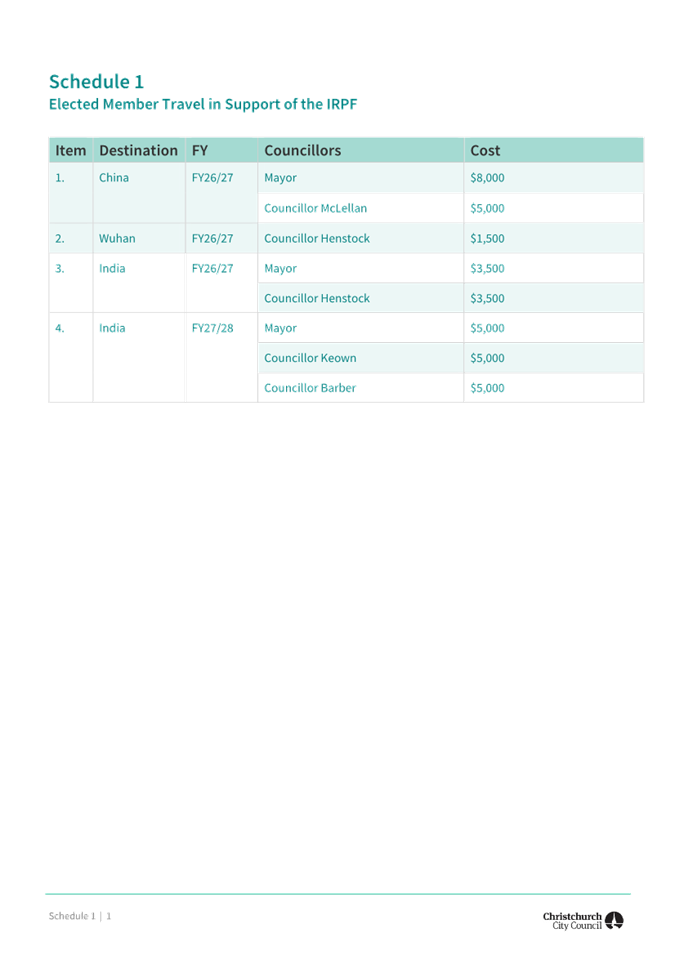
|
13. Hagley Park & Botanic Gardens - No
Stopping & Mobility Park Parking Restrictions - Update
|
|
Reference Te Tohutoro:
|
25/2489271
|
|
Responsible Officer(s) Te Pou Matua:
|
Sahan
Lalpe, Traffic Engineer
|
|
Accountable ELT Member Pouwhakarae:
|
Brent
Smith, General Manager City Infrastructure
|
1. Purpose and Origin of the Report Te Pūtake Pūrongo
1.1 The
purpose of this report is to:
1.1.1 Seek
approval by the Council for the installation of no stopping restrictions at the
Botanic Gardens parking area off Riccarton Avenue; and
1.1.2 Convert
three general car parks into mobility parks at the Botanic Gardens parking area
off Armagh Street.
1.2 This report is considered a minor update following the
Council’s decision which approved the parking meters on Hagley Park on 18
September 2024 (link to the original report[1]).
2. Officer Recommendations Ngā
Tūtohu
That the Council:
1. Receives the information in the Hagley Park & Botanic Gardens
- No Stopping & Mobility Park Parking Restrictions - Update Report.
2. Notes that the decision in this report is
assessed as low significance based on the Christchurch City Council’s
Significance and Engagement Policy.
3. Revokes any previous resolutions in accordance
with Clause 6 (2) of the
Christchurch City Council Traffic & Parking Bylaw 2017, within the Hagley
Park car parking areas described in this report, pertaining to parking or stopping restrictions,
made pursuant to any Bylaw, Local Government Act or any Land Transport Rule, to
the extent that they are in conflict with, or recommended to be removed, in
regard to the parking or stopping restrictions described in Recommendations 4-5
below.
4. Approves, in accordance with clause 7 of the
Christchurch City Council Traffic and Parking Bylaw 2017, that the stopping of
vehicles be prohibited at any time within the Hagley Park Botanic Gardens
parking area as detailed on plan Hagley Park – Riccarton Avenue –
Botanic Car Park, (TG148381 dated 19/01/2026). Attachment A to this report.
5. Approves that in accordance with Clause 7 of
the Christchurch City Council Traffic and Parking Bylaw 2017, and in
accordance with section 12.4 of the Land Transport Rule: Traffic Control
Devices 2004, that the parking of vehicles be reserved for vehicles with an
approved disabled person’s parking permit, prominently displayed in the
vehicle, within the Hagley Park Botanic Gardens parking area as detailed
on plan Hagley Park – Armagh Street – Botanic Car Park,
(TG148381 dated 19/01/2026). Attachment B to this report. This restriction is
to apply at all times.
6. Approves that the above resolutions take
effect when parking signage and/or road markings that evidence the restrictions
described in this staff report are in place (or removed in the case of
revocations).
3. Executive Summary Te Whakarāpopoto Matua
3.1 The
additional no stopping marking restrictions are proposed to primarily
discourage drivers from parking on ‘the Lane’ running along the Te
Kura Hagley Park Tennis Club, Christchurch Pétanque Club and High School
Old Boys Rugby Football Club.
3.2 Drivers
parking along this lane prevents other users from accessing Hagley Park via the
gated entrance by the High School Old Boys Rugby Football Club.
3.3 It
is also proposed to convert existing general car parks at the Botanic Gardens
parking area off Armagh Street to mobility car parks to meet the minimum
requirements of the District Plan for off-street carpark, Table 7.5.1.1[2].
4. Background/Context Te Horopaki
4.1 The
Lane – adjacent to the Botanic Gardens parking area off Riccarton
Avenue.
4.1.1 The
no stopping marking mitigates health and safety issues as currently there is
limited access for emergency services to the Hagley Park sports fields when
cars are parked on this section. Hagley Park, and this parking area are well
used during winter months for sports.
4.1.2 Staff
also note that Te Kura Hagley Park Tennis Club (TKHP) have previously raised
concerns regarding visitors leaving their club and nearly being hit by cars as
there is limited visibility with cars parking along this section.
4.1.3 In
addition, service vehicles (e.g. mowers) have limited access when vehicles are
parked on the Lane, disrupting standard operations of Hagley Park.
4.2 The
additional mobility parking – at the Botanic Car Park off Armagh
Street.
4.2.1 There
are approximately 280-300 car parks in the Botanic Car Park off Armagh Street,
meaning the minimum number of mobility parking spaces is ‘2 for the
first 50 car parking spaces + 1 additional mobility parking space for every
additional 50 car parking spaces or part thereof’.
4.2.2 The
approximation is due to the spaces being unmarked on the gravel surface, some
bays having no wheel stops to guide drivers of the spacing and location of
trees creating spaces that could be used by small cars but are not appropriate
for larger ones to park.
4.2.3 In total seven mobility parks are required as per District Plan. The
proposed plan ensures the minimum mobility park requirement is met at the
Botanic Car Park off Armagh Street.
Options Considered Ngā Kōwhiringa Whaiwhakaaro
4.3 Recommended
Option (no stopping): Installing no stopping restrictions and installing
three mobility parking appropriate signs, see Attachment A.
4.3.1 Option
Advantages
· These changes
address health and safety concerns and provide further accessibility parks.
· Keeps access
to the park clear for other users and authorised personnel that need to access
the interior of Hagley Park from the Riccarton Avenue entrance.
· Prevents
drivers from circumventing the paid parking without consequence.
· Provides a
mechanism for Council staff to appropriately enforce the restriction (e.g.,
through fines or towing offending vehicles).
· Reinforces
existing informal signs and marking.
4.3.2 Option
Disadvantages
· Results in a
change in parking availability for some users.
4.4 Alternative
Options (to no stopping): Maintain the status
quo – do nothing and leave the parking spaces unrestricted.
4.4.1 Option
Advantages
· There are no
advantages for maintaining the existing condition as the health and safety and
accessibility concerns will remain.
4.4.2 Option
Disadvantages
· Does not solve
existing access issues experienced by staff when the lane is blocked by
vehicles.
· There is no
clear mechanism to discourage drivers from parking in this space, by issuing
fines or towing offending vehicles.
· Relies on the
good will of the community to keep this space clear for other users.
· Lack of
accessibility parking.
5. Financial Implications Ngā Hīraunga Rauemi
Capex/Opex Ngā Utu Whakahaere
|
|
Recommended Option
|
Option 2 – Do nothing
|
|
Cost to implement
|
$5,000
to install new signs with line marking
|
$0
|
|
Maintenance/Ongoing Costs
|
Will
be added to and covered by the area maintenance contract
|
$0
|
|
Funding Source
|
Traffic
Operations Team’s ‘Road Marking and Signs’ budget.
|
n/a
|
6. Considerations Ngā Whai Whakaaro
Risks and Mitigations Ngā Mōrearea me
ngā Whakamātautau
6.1 Council
staff have previously communicated with all identified existing users of
Botanic Garden’s parking areas. This includes community and sports groups
operating in the park and all pre-approved parkers -subject to individual
agreements within the Council.
6.2 This
proposal is only seeking to make minor changes as outlined in Attachments A and
B.
6.3 This
proposal does not materially affect the intent of the previously approved
resolution.[3]
Legal Considerations Ngā Hīraunga
ā-Ture
6.4 Clause 4 of the Christchurch City Council Traffic & Parking
Bylaw 2017, (the Bylaw) states that the bylaw is to set out the requirements
for parking and control of vehicular or other traffic on any road or area under
the care, control or management of the Council.
6.5 Other Legal Implications:
6.5.1 Clause 6(2) of the Christchurch City Council Traffic and Parking
Bylaw 2017 provides the Council with the authority to subsequently amend or
revoke any resolution made under this bylaw at any time.
6.5.2 Clause
7 of the Bylaw provides the Council with the legal authority to specify the
areas subject to parking management, including tariffs, and time limits
6.5.3 Clause
8 of the Bylaw provides the Council with the legal authority to specify classes
of vehicles that can use a parking place.
Strategy
and Policy Considerations Te
Whai Kaupapa here
6.6 The
required decisions:
6.6.1 Align
with the Christchurch
City Council’s Strategic Framework.
6.6.2 Are
assessed as low significance based on the Christchurch City Council’s
Significance and Engagement Policy. The level of significance was
determined as this proposal does neither materially affect the intent of the
existing conditions at Hagley Park nor the previously approved resolution:
CNCL/2024/00135
6.6.3 Are
consistent with the Council’s Plans and Policies.
6.7 This
report supports the Council's
Long Term Plan (2024 - 2034):
6.8 Parks, Heritage and Coastal Environment
6.8.1 Activity: Parks and Foreshore
· Level of Service: 6.0.1 All Community Parks are managed and
maintained in a clean, tidy, safe, functional, and equitable manner
(Maintenance) - 90% Maintenance Plan key performance indicators are achieved
Community
Impacts and Views Ngā Mariu ā-Hāpori
6.9 This recommendation is proposed to address previous
feedback related to parking within Hagley Park. The changes are minor and in
line with the previous Council decision. There was no further consultation
regarding these recommendations.
6.10 The
decision affects the Central Ward of Council.
Impact
on Mana Whenua Ngā
Whai Take Mana Whenua
6.11 The decisions do not involve a significant decision in relation
to ancestral land, a body of water or other elements of intrinsic value,
therefore this decision does not specifically impact
Mana Whenua, their culture, and traditions.
6.12 The decision does
not involve a matter of interest to Mana Whenua and will not impact
on our agreed partnership priorities with Ngā Papatipu
Rūnanga.
Climate
Change Impact Considerations Ngā Whai Whakaaro mā te Āhuarangi
6.13 The proposals in
this report are unlikely to contribute significantly to adaptation to the
impacts of climate change or emissions reductions.
7. Next Steps Ngā Mahinga ā-muri
7.1 If
approved, staff will arrange for the new road marking and signs to be installed
as per the Attachments, within this financial year.
Attachments Ngā Tāpirihanga
|
No.
|
Title
|
Reference
|
Page
|
|
a ⇩
|
Hagley Park
off Riccarton Avenue - Botanic Garden - Parking Area
|
26/101901
|
224
|
|
b ⇩
|
Hagley Park
off Armagh Street - Botanic Garden - Parking Area
|
26/101905
|
225
|
In addition to the attached documents, the following background
information is available:
|
Document
Name – Location / File Link
|
|
Not
applicable
|
Signatories Ngā Kaiwaitohu
|
Authors
|
Sahan Lalpe -
Traffic Engineer
Andrew Hensley
- Traffic Engineer
|
|
Approved By
|
Kathy Graham -
Team Leader Traffic Operations
Stephen Wright
- Head of Transport & Waste Management
Rupert Bool -
Head of Parks
Brent Smith -
General Manager City Infrastructure
Andrew
Rutledge - General Manager Citizens and Community
|
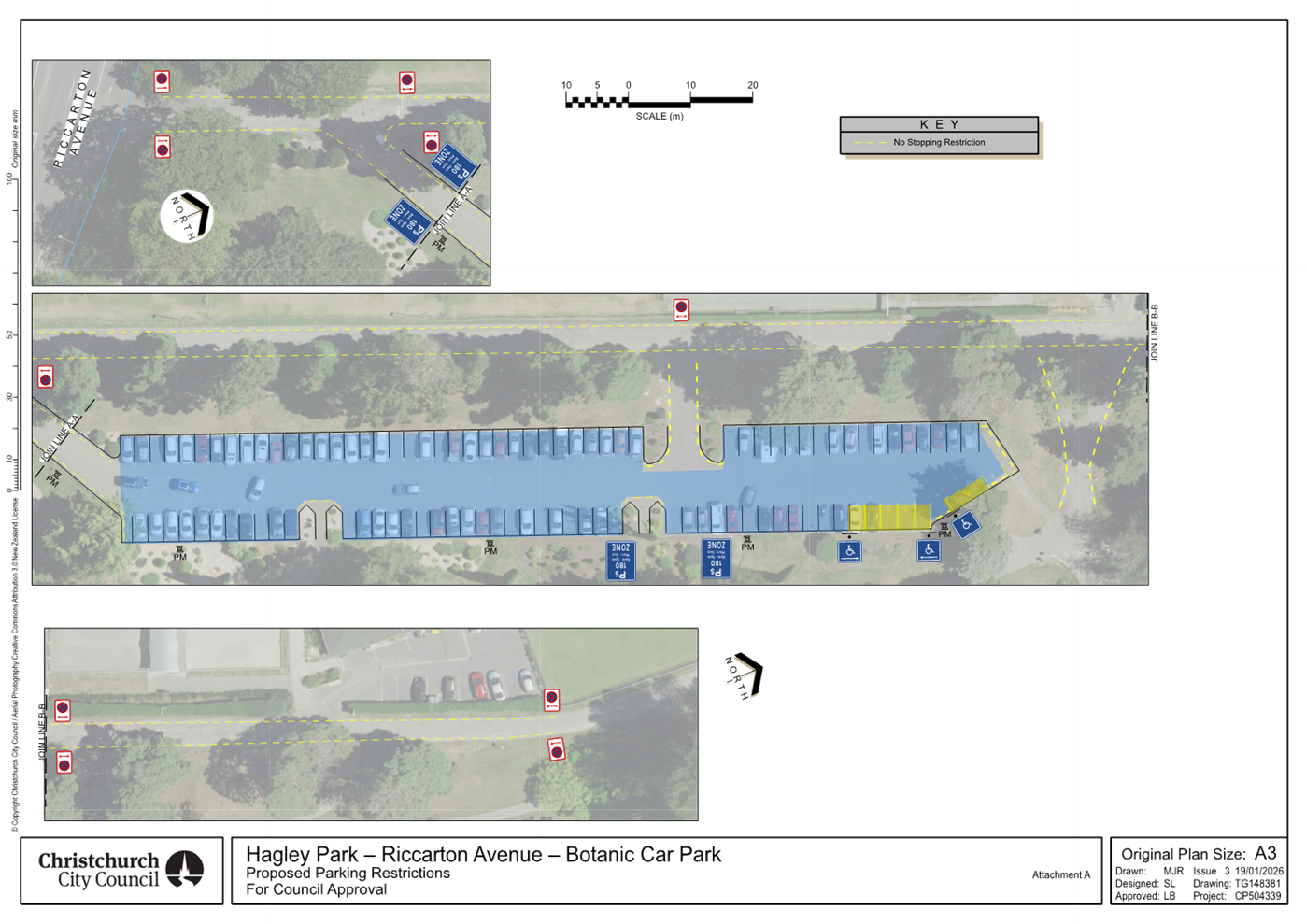
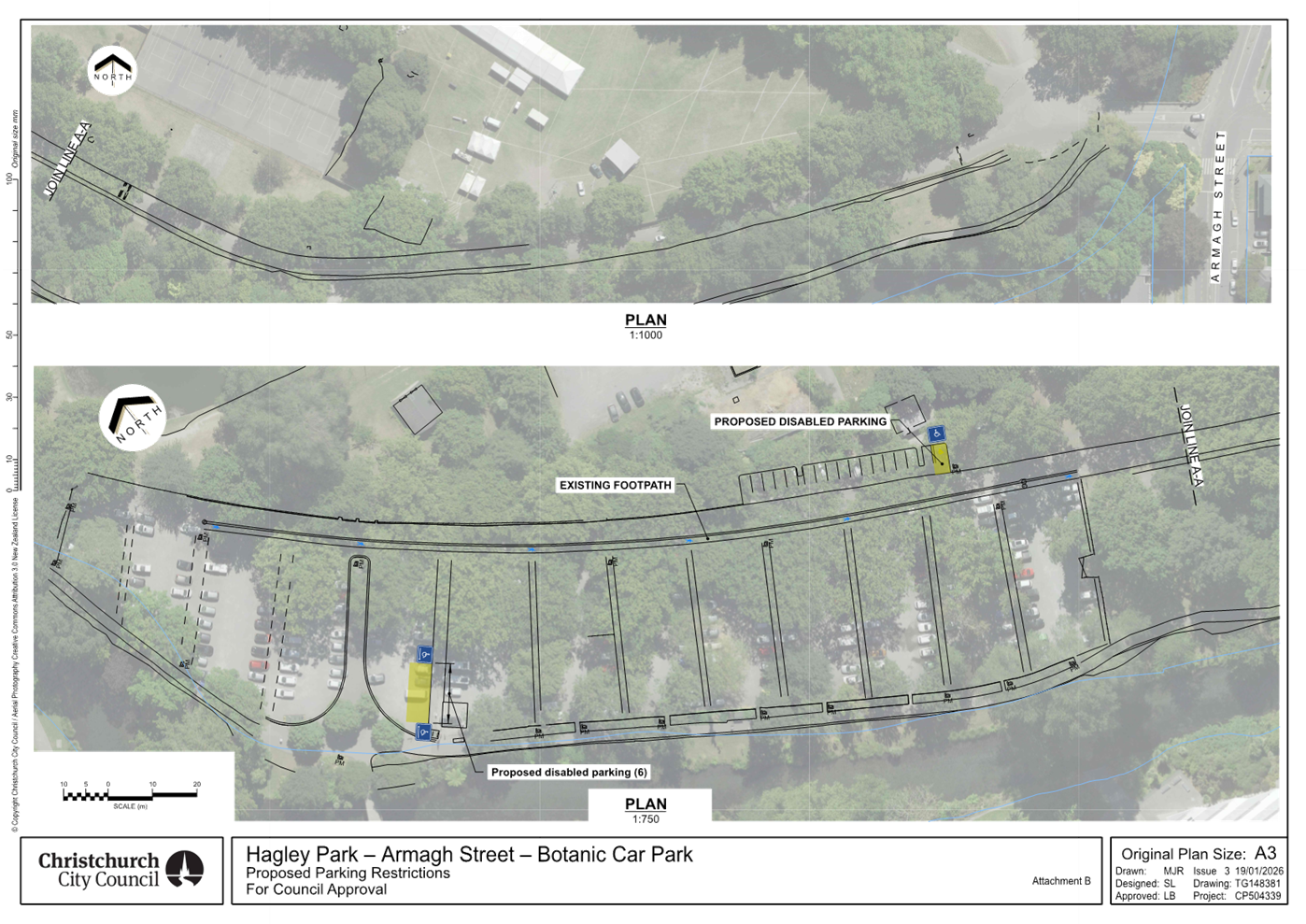
|
14. Biodiversity Fund Allocation - Correction
|
|
Reference Te Tohutoro:
|
26/540557
|
|
Responsible Officer(s) Te Pou Matua:
|
Lynette
Foster, Community Funding Advisor
|
|
Accountable ELT Member Pouwhakarae:
|
Andrew
Rutledge, General Manager Citizens and Community
|
1. Purpose and Origin of the Report Te Pūtake Pūrongo
1.1 The
purpose of this report is to correct the name of the applicant in a previous
resolution made by the Council.
1.2 At
its meeting on 4 March 2026, the Council approved a grant to Marie Neal of the
Banks Peninsula Conservation Trust. The application for funding should
have come from the organisation – Banks Peninsula Conservation Trust and
not from the application contact person.
1.2.1 The
link to the decision in the meeting minutes CNCL/2026/00031, Item 14,
resolution 9 can be found here:
· https://christchurch.infocouncil.biz/Open/2026/03/CNCL_20260304_MIN_10810_AT.PDF
1.3 The
organisation has agreed to accept this funding and to deliver the
project. It has also agreed to report back on this project and accept all
conditions of the grant funding.
2. Officer Recommendations Ngā Tūtohu
That the Council:
1. Receives the information in the Biodiversity Fund Allocation - Correction Report.
2. Notes that the decision in this report are
assessed as low significance based on the Christchurch City Council’s
Significance and Engagement Policy.
3. Alters the 4 March 2026 Council decision
(CNCL/2026/00031) only in relation to the Biodiversity Fund allocation towards
Kaituna Community Weeding to reflect the grant of $60,000 from the 2025/26
Biodiversity Fund to Banks Peninsula Conservation Trust rather than the
application contact, Marie Neal.
3. Background/Context Te Horopaki
3.1 The
original decision report to the Council can be accessed via this link:
https://christchurch.infocouncil.biz/Open/2026/03/CNCL_20260304_AGN_10810_AT.PDF
Attachments Ngā Tāpirihanga
There are no
attachments to this report.
In addition to the attached documents, the following background
information is available:
|
Document
Name – Location / File Link
|
|
Not
applicable
|
Signatories Ngā Kaiwaitohu
|
Author
|
Lynette Foster
- Community Funding Advisor
|
|
Approved By
|
Rose Crossland
- Acting Community Partnerships Manager
John Filsell -
Head of Community Support and Partnerships
|
|
15. Notice of
Motion - Parker / Gilberthorpes / Waterloo Intersection Signalisation
|
|
Reference Te Tohutoro:
|
26/465918
|
|
Elected Member Te Mema Pōti:
|
Councillor
Peters
|
|
Accountable ELT Member Pouwhakarae:
|
Mary
Richardson – Chief Executive
|
1. Purpose and Origin
1.1 Pursuant to Standing Order 22 of Christchurch City Council’s Standing
Orders, Councillor Peters provided a Notice of Motion outlined in the
recommendation section which is accompanied by the associated Officer advice.
2. Recommendations Ngā Tūtohu
Councillor Peters
Notice of Motion:
That the Council:
1. Pauses any further work on the Parker Street,
Gilberthorpes Road, and Waterloo intersection as part of the South Express MCR
and asks staff to report to Council on options to enhance the safety and
effectiveness of the intersection, including full signalisation, in time for
consideration as part of the 2027-37 Long-Term Plan.
Officer
Recommended Alternative:
That
the Council:
1. Pauses any further work on the permanent
design of the Parker Street, Gilberthorpes Road, and Waterloo intersection as
part of the South Express MCR and asks staff to report to Council on options to
enhance the safety and effectiveness of the intersection, including full
signalisation, in time for consideration as part of the 2027-37 Long-Term Plan.
2. Requests staff bring interim options to the
Council regarding the safety and usability of the intersection for pedestrians
and cyclists, to allow users of the South Express MCR a safe route ahead of
permanent changes.
3. Resource Impact of the Notice of Motion
3.1 An
initial decision to pause the current works is unlikely to have a significant
impact on staff resource. Overall, however, there would be considerable time
and cost implications for this change.
Initial Pause
3.2 Council
Officers are engaged in ongoing discussions with KiwiRail regarding the scope
of the level crossing works to be designed and priced. This is mostly done by a
single Project Manager, who is also working on several other projects. The
immediate resource implications of an initial decision to pause the current
works would likely be small as staff would cease progressing permanent design
works.
3.3 Should
the Council wish to look at an interim option to improve pedestrian and cycle
use of the intersection ahead of the permanent works, this could be pursued
(and is recommended by staff). An outline scheme design has been assessed, so
the initial task would be to seek the Council’s approval for this change.
The resource implication for this would be relatively small and partially
offset by the pause to the permanent works.
Providing Options, including full
signalisation
3.4 There would be a significant time and cost implication for this
change.
3.4.1 Further investigations and design work would be required. This would
involve staff time from across the Transport, and Professional and Technical
Services Units, including Project Management, Designers, Traffic Operations and
Real Time Operations teams.
3.4.2 Further engagement with KiwiRail would be required to undertake a
revised Level Crossing Safety Impact Assessment (LCSIA) based on the proposed
design. As signalisation may change the flows and types of traffic using the
level crossing it is likely that this would trigger a complete redesign of the
level crossing upgrade, with associated cost and resource impacts.
3.4.3 Re-designing the intersection would require new Safe System
Assessments at the scheme and detailed design stages for which external
consultants would be engaged.
· If the Council
pursued an alternative design, this would also require a partial revocation of
the currently approved scheme design.
3.4.4 Considering the substantial re-design of the intersection, it is
likely that external consultants would be engaged to complete further studies
and investigations.
3.5 Direct costs would be incurred through the construction costs
associated with fully signalising the intersection, an increase to the current
project estimate.
3.6 Should the proposed design progress, the construction of the
cycleway through this intersection would be delayed, potentially for 12 to 24
months.
4. Background/Context Te Horopaki
Project Progress
4.1 The MCR route was designed to travel along Waterloo Road, through
the intersection with Parker Street and Gilberthorpes Road. The scheme
design was approved by Council 22 July 2019.
4.1.1 The
design is available on Page 42 of the Agenda: https://christchurch.infocouncil.biz/Open/2019/07/ITEC_20190722_AGN_3834_AT.PDF
4.2 Traffic
resolutions for this intersection have not yet been presented to the Council.
This will be done once the full design has been completed, ahead of procurement
and construction.
Intersection
Assessment
4.3 As a result of consultation, the Greater Hornby Residents’
Association requested at a meeting on site an assessment of the
intersection. The intention was to highlight how unsafe the intersection was
deemed to be and form the basis to support the full signalisation of the
intersection.
4.4 The
intersection assessment report was presented to the Community Board and
Residents’ Association in May 2023. This report identified and assessed
four options to address safety issues at this intersection. Full signalisation
of the intersection was rated second of these four options.
· The intersection assessment is
available as Attachment A.
· The
intersection scoring assessment is available as Attachment B.
4.4.1 The
assessment states traffic modelling shows signalisation may divert vehicles
away from the intersection on account of the delay caused by the lights.
However, as the intersection currently feels unsafe, signalisation may attract
additional traffic, creating a higher crash risk if diversion does not occur.
4.4.2 The
option to signalise the intersection would maintain the existing traffic flows,
with only minor changes. However, the option was noted to not align with the
district plan.
4.4.3 Signalisation was noted as a high-cost option which would require
the realignment and widening of the rail crossing, as well as the cost of
signal infrastructure. The cost of this would be higher than a standard
signalisation and in 2021, this was estimated to be in excess of $2m.
Network Context
4.5 The
intersection is made up of five arms.
4.5.1 Moffet
Street is a local street with an average daily traffic count of 1550 vehicles.
This street is intended to be closed as a cul-de-sac as part of the South
Express cycleway design.
4.5.2 The
other roads in the intersection are collector roads, classified as urban
connectors. Their average daily traffic counts are as follows:
· Waterloo Road
(western approach) 3300
vehicles
· Waterloo Road
(eastern approach) 3810
vehicles
· Gilberthorpes
Road (northern approach) 6075
vehicles
· Parker Street
(southern approach) 5375
vehicles
4.6 In
mid-2025, the Council and KiwiRail completed a significant upgrade to the level
crossing at Halswell Junction Road.
4.6.1 The
preferred route for vehicles accessing Waterloo Business Park is therefore via
the State Highway and Halswell Junction Road. While this has not been modelled
at this stage, it is reasonable to assume that the introduction of signals at
Waterloo/Gilberthorpes may act as an attractor for heavy vehicles to short-cut
away from the preferred route.
4.7 Staff
receive and respond to hybris and Snap, Send, Solve tickets relating to this
intersection. Between March 2023 and March 2026, 19 tickets had been received
specifically regarding this intersection. Some of these are duplicates, and may
ask for information rather than raise concerns.
4.8 Statistically,
the existing intersection has a low history of medium to serious incidents
resulting in injury, making it a low priority for capital spend against the
safety improvement budgets.
4.8.1 During
the period 2016-2025, there were 11 reported crashes within a 50m radius of the
centre of this intersection. Of these:
· 0 were Fatal
· 1 was Serious (loss of control
right-turning at Parker/Foremans)
· 2 were minor injury (Both
related to cars not stopping fully at stop sign on Waterloo Road)
4.8.2 Using
the KiwiRAP assessment methodology in 2024, this was
ranked as the 644th most dangerous Council-owned intersection.
5. Officer Advice
Any Current Related Work Underway / Achievability of
the Notice of Motion
5.1 The design for the South Express cycleway passes through this intersection and is currently at detailed design stage.
5.1.1 To complete the intersection design co-ordination with the KiwiRail
level crossing is required. KiwiRail informed the Council of the estimate in
mid-2024, however, this was high so discussions remain ongoing.
5.1.2 Staff of both organisations agreed to a priority list of level
crossing upgrades, to ensure focus was kept on the next project. This is now
the third priority for delivery, after Scruttons Road and Radcliffe Road.
Therefore progress in recent months has been limited.
5.2 The Council and KiwiRail are reviewing the project scope, with
consideration of a “Minimal Viable Product” that addresses only the
increased risk that the Council’s project is generating.
5.2.1 This would be expected to reduce the estimate but would not address
pre-existing issues with the level crossing.
5.3 Once the level crossing scope review is complete, the cycleway
design will be reassessed to ensure alignment with the revised scope before
progressing to the Council for approval, procurement and construction.
Financial Implications / Capex and Opex Funding
Sources
5.4 The
financial implications of the initial pause would be relatively low, however,
the associated budgets for this project would need to be delayed.
5.5 The
investigation and delivery of interim measures are estimated to cost around
$200-300k. It should be noted that much of this cost would be in the closure of
Moffett Street, which is a key part of the current permanent design.
5.6 Based on other recent projects and the nature of the crossing, it is
likely that the signalisation element would require around $3m of CAPEX funding
over and above the current project budgets.
5.6.1 There
may also be further additional funding required for the level crossing,
however, it will not be possible to confirm this until a new Level Crossing
Safety Impact Assessment (LCSIA) has been completed. This could be significant.
5.6.2 The introduction of signals will have an ongoing OPEX impact for
communication and power.
Other Considerations (e.g. Risks, impacts on Mana
Whenua, climate change, accessibility, Annual Plan/Long Term Plan implications)
5.7 The LCSIA for the level crossing was assessed based on the South
Express cycleway scheme design. Should the design of this intersection change,
a revised LCSIA would be required.
5.8 Any new scheme design would require the Council to revoke, in part,
its previous resolution approving the current scheme design.
6. Legal Advice
6.1 There is no legal reason to decline the Notice of Motion.
Signatories Ngā
Kaiwaitohu
|
Officer
Advice Provided by
|
Natasha
Wells – Project
Manager, Transport
Jacob Bradury
– Manager Planning & Delivery Transport
Ron Lemm
– Manager Legal Service Delivery
|
|
Approved
By
|
Mary
Richardson – Chief Executive
|
Attachments Ngā Tāpirihanga
|
No.
|
Title
|
Reference
|
Page
|
|
a ⇩ 
|
Intersection
Assessment
|
21/1161617
|
234
|
|
b ⇩
|
Intersection
Scoring Assessment
|
26/598490
|
260
|
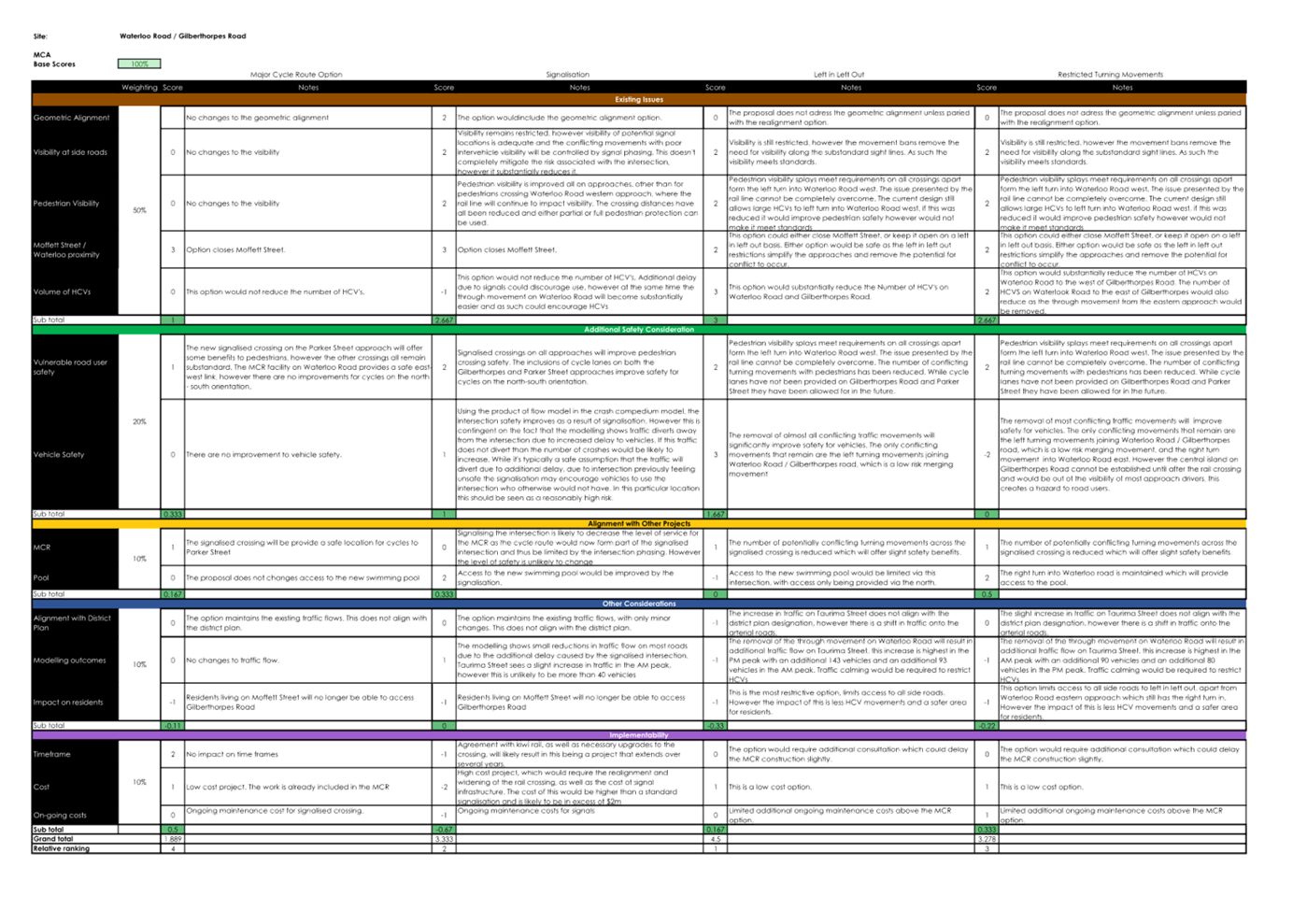
|
16. Mayor's
Monthly Report
|
|
Reference Te Tohutoro:
|
26/472436
|
|
Report of Te Pou Matua:
|
Phil
Mauger, Mayor
|
1. Purpose of Report Te Pūtake
Pūrongo
1.1 The
purpose of this report is for the Mayor to report on external activities he
undertakes in his city and community leadership role; and to report on outcomes
and key decisions of the external bodies he attends on behalf of the Council.
1.2 This
report is compiled by the Mayor’s office.
2. Mayors Recommendations Ngā
Tūtohu o Te Koromatua
That the Council:
1. Receives the information in the Mayor’s
Monthly report.
Attachments Ngā Tāpirihanga
|
No.
|
Title
|
Reference
|
Page
|
|
a 
|
Mayor's
Monthly Report March 2026 (Under Separate Cover – To Be Circulated
Separately)
|
26/511269
|
|
|
17. Resolution to Exclude the Public
|
Section
48, Local Government Official Information and Meetings Act 1987.
Note: The
grounds for exclusion are summarised in the following table. The full wording from
the Act can be found in section
6 or section
7, depending on the context.
I move that the public be excluded from the
following parts of the proceedings of this meeting, namely the items
listed overleaf.
Reason for passing this resolution: a good
reason to withhold exists under section 7.
Specific grounds under section 48(1) for
the passing of this resolution: Section 48(1)(a)
Note
Section 48(4) of the Local Government
Official Information and Meetings Act 1987 provides as follows:
“(4) Every resolution to exclude the
public shall be put at a time when the meeting is open to the public, and the
text of that resolution (or copies thereof):
(a) Shall
be available to any member of the public who is present; and
(b) Shall
form part of the minutes of the local authority.”
This resolution is made in reliance on
Section 48(1)(a) of the Local Government Official Information and Meetings Act
1987 and the particular interest or interests protected by Section 6 or Section
7 of that Act which would be prejudiced by the holding of the whole or relevant
part of the proceedings of the meeting in public are as follows:
|
ITEM NO.
|
GENERAL SUBJECT OF EACH MATTER TO BE CONSIDERED
|
SECTION
|
SUBCLAUSE AND REASON UNDER THE ACT
|
PUBLIC INTEREST CONSIDERATION
|
Potential Release Review Date and
Conditions
|
|
18.
|
Public Excluded Council Minutes - 4 March 2026
|
|
|
Refer to the previous public excluded reason in the agendas for
these meetings.
|
|
|
19.
|
2026 Draft Waste Management and Minimisation Plan
|
s7(2)(b)(ii), s7(2)(h)
|
Prejudice Commercial Position, Commercial Activities
|
There is considerable public interest in the Waste Management and
Minimisation Plan. However, this will be largely satisfied during the public
consultation process. By discussing this matter publicly at this stage, it
could predjuidce the commercial position of the Council which outweighs the
public interest.
|
1 July 2027
Upon confirmation that the Waste Management and Minimisation Plan
has been adopted.
|
|
20.
|
Open Space Provision and Acquisition of Vacant Land
|
s7(2)(h), s7(2)(i)
|
Commercial Activities, Conduct Negotiations
|
This information is being withheld to enable the Council to engage
in negotiations and commercial activities which would otherwise be
disadvantaged if the information were made public at this time. The Council's
ability to engage in commercial negotiations without prejudice outweighs the
public interest.
|
1 August 2026
Upon the review and approval of the Head of Facilities and
Property and Head of Parks.
|
Karakia Whakamutunga
Kia whakairia te tapu
Kia wātea ai te ara
Kia turuki whakataha ai
Kia turuki whakataha ai
Haumi e. Hui e. Tāiki e
Actions Register Ngā Mahinga
When decisions are made at meetings, these
are assigned to staff as actions to implement. The following lists
detail any actions from this meeting that were:
·
Open at the time the agenda was generated.
·
Closed since the last ordinary meeting agenda
was generated.
Open Actions Ngā Mahinga Tuwhera
|
REPORT TITLE/AGENDA SECTION
|
MEETING DATE
|
ACTION DUE DATE
|
UNIT
|
TEAM
|
|
Amendments to the Register of
Delegations
|
17 September 2025
|
27 March 2026
|
Legal & Democratic Services
|
Legal Services
|
|
Heathcote Express Major
Cycleway - Truscotts Road Detailed Traffic Resolutions
|
20 August 2025
|
30 March 2026
|
Transport & Waste
|
Traffic Operations
|
|
Annual Plan 2025/26
|
24 June 2025
|
31 March 2026
|
Transport & Waste
|
Asset Planning
|
|
Annual Plan 2025/26
|
24 June 2025
|
31 March 2026
|
Transport & Waste
|
Management
|
|
Annual Plan 2025/26
|
24 June 2025
|
31 March 2026
|
TW
|
Asset Planning Water & Wastewater
|
|
Infrastructure Amendments -
Parks
|
25 June 2024
|
31 March 2026
|
Parks
|
Parks & Recreation Planning
|
|
Koukourarata Port Levy - Bach
on Public Land ( Road Reserve)
|
16 April 2025
|
31 March 2026
|
F&P Unit
|
Property Consultancy
|
|
Manchester Street Bus Gate
Trial
|
20 August 2025
|
31 March 2026
|
Transport & Waste
|
Management
|
|
New Footpaths Programme
|
17 September 2025
|
31 March 2026
|
Transport & Waste
|
Management
|
|
Notice of Motion -
Feasibility of free overnight parking at Parakiore Recreation and Sport
Centre
|
16 July 2025
|
31 March 2026
|
RS&E
|
Management
|
|
Councillors' proposed
amendments - Infrastructure and Regulation
|
14 February 2024
|
1 April 2026
|
TW
|
Asset Planning Water & Wastewater
|
|
Climate Change Portfolio Lead
Report
|
3 July 2024
|
30 April 2026
|
SP&R
|
Coastal Hazards
|
|
Hearings Panel Report to the
Council on the Dog Control Policy and Dog Control Bylaw 2025
|
3 September 2025
|
30 April 2026
|
Regulatory Compliance
|
Regulatory Compliance
|
|
Dedication of Local Purpose
Reserve (Road) 3 R Tulett Park Drive Casebrook
|
4 February 2026
|
6 May 2026
|
F&P Unit
|
Property Consultancy
|
|
Environmental Partnership
Fund
|
4 February 2026
|
6 May 2026
|
Parks
|
Management
|
|
Notice of Motion -
Investigation into the viability of a clearway on Memorial Avenue
|
4 February 2026
|
6 May 2026
|
Transport & Waste
|
Asset Planning
|
|
Notice of Motion -
Investigation into the viability of a clearway on Memorial Avenue
|
4 February 2026
|
6 May 2026
|
Transport & Waste
|
Management
|
|
Waipuna Halswell Hornby
Riccarton Community Board: Representation on Committees and External
Organisations, 2025–2028
|
4 February 2026
|
6 May 2026
|
CS&P
|
CS&P - Governance (Hal-Hor-Ric)
|
|
Grant an Easement for
Utilities Over a Council Reserve
|
10 April 2024
|
8 May 2026
|
F&P Unit
|
Property Consultancy
|
|
Hearings Panel Report to the
Council on the Dog Control Policy and Dog Control Bylaw 2025
|
3 September 2025
|
9 May 2026
|
Parks
|
Parks & Recreation Planning
|
|
Hearings Panel report on the
Gloucester Street "Streets for People" Trial
|
2 October 2024
|
15 May 2026
|
Transport & Waste
|
Project Management
|
|
Annual Plan 2025/26
|
24 June 2025
|
18 May 2026
|
Corporate Services Management
|
Corporate Services Management
|
|
Beach Hospitality Limited -
Landlord Consent to Improvements and Request for Further Lease
|
2 April 2025
|
29 May 2026
|
F&P Unit
|
Property Consultancy
|
|
Ōtākaro-Avon
Stormwater Management Plan
|
19 June 2024
|
29 May 2026
|
TW
|
Asset Planning Water & Wastewater
|
|
Tsunami Alerting System
Review
|
18 June 2025
|
29 May 2026
|
CS&P
|
CDEM
|
|
Annual Plan 2025/26
|
24 June 2025
|
31 May 2026
|
Planning & Consents
|
Management
|
|
2025/2026 Biodiversity Fund
Allocation
|
4 March 2026
|
3 June 2026
|
CS&P
|
Partnerships & Planning
|
|
2025/26 Capital Endowment
Fund - March 2026
|
4 March 2026
|
3 June 2026
|
CS&P
|
Partnerships & Planning
|
|
Bus stop upgrades on
Gloucester and St Asaph Streets
|
4 March 2026
|
3 June 2026
|
Transport & Waste
|
Traffic Operations
|
|
Cashmere - Penruddock
Roundabout
|
4 March 2026
|
3 June 2026
|
Transport & Waste
|
Asset Planning
|
|
Discretionary Response Fund
March 2026
|
4 March 2026
|
3 June 2026
|
CS&P
|
Partnerships & Planning
|
|
Environmental Partnership
Fund - Correction to report
|
4 March 2026
|
3 June 2026
|
CS&P
|
Partnerships & Planning
|
|
Ōtākaro Avon River
Corridor Regeneration Committee - draft Terms of Reference
|
4 March 2026
|
3 June 2026
|
Citizens & Community Management
|
Citizens & Community Management
|
|
Pihipihi Lane: Name
Correction
|
4 March 2026
|
3 June 2026
|
Transport & Waste
|
Traffic Operations
|
|
Walking Access Act 2008 -
Request to be a Controlling Authority
|
4 March 2026
|
3 June 2026
|
Legal & Democratic Services
|
Legal Services
|
|
Acquisition of Land 657 Pages
Road Christchurch, Pages Road Bridge Renewal Project
|
5 March 2025
|
4 June 2026
|
F&P Unit
|
Property Consultancy
|
|
Spreydon, Somerfield,
Waltham, Beckenham CRAF - Lyttelton Street safety improvements
|
6 August 2025
|
26 June 2026
|
Transport & Waste
|
Project Management
|
|
Spreydon, Somerfield,
Waltham, Beckenham CRAF - Selwyn Street pedestrian and cycle safety
improvements
|
6 August 2025
|
26 June 2026
|
Transport & Waste
|
Project Management
|
|
Spreydon, Somerfield,
Waltham, Beckenham CRAF - Strickland Street/Somerfield Street safety
improvements
|
10 September 2025
|
26 June 2026
|
Transport & Waste
|
Project Management
|
|
66E Hills Rd - Sale of Land
|
16 July 2025
|
30 June 2026
|
F&P Unit
|
Property Consultancy
|
|
Annual Plan 2025/26
|
24 June 2025
|
30 June 2026
|
Parks
|
Planning & Policy
|
|
Other Amendments - Planning,
Property and Miscellaneous
|
25 June 2024
|
30 June 2026
|
F&P Unit
|
Management
|
|
Southshore South New Brighton
Earthquake Legacy Project
|
29 August 2019
|
30 June 2026
|
TW
|
Asset Planning Water & Wastewater
|
|
Welles Street Temporary
Improvements
|
17 September 2025
|
30 June 2026
|
Professional & Technical Services
|
Project Management
|
|
Yaldhurst Memorial Hall
|
25 June 2024
|
30 June 2026
|
F&P Unit
|
Property Consultancy
|
|
Acquisition of Deeds Land
Along with Road Stopping and Amalgamation - Corner Harmans and Voelas Roads
Lyttelton
|
5 February 2025
|
30 September 2026
|
F&P Unit
|
Property Consultancy
|
|
Report Requests
|
25 June 2024
|
31 October 2026
|
Transport & Waste
|
Asset Planning
|
|
27 Hunters Road & 43
Whero Avenue, Diamond Harbour – FENZ and Te Pā o
Rākaihautū Unsolicited Proposals
|
5 June 2024
|
31 December 2026
|
F&P Unit
|
Property Consultancy
|
|
Hearings Panel Report on
Lincoln Road Peak Hour Bus Lane Proposal
|
7 July 2022
|
1 June 2027
|
Transport & Waste
|
Project Management
|
|
Cathedral Square Roading
Network- Worcester Boulevard from Oxford Terrace to Cathedral Square (Area
9B)
|
4 March 2026
|
31 July 2027
|
Transport & Waste
|
Project Management
|
Actions Closed Since the Last Meeting Ngā
Mahinga kua Tutuki nō Tērā Hui
|
REPORT TITLE/AGENDA SECTION
|
MEETING DATE
|
DUE DATE
|
ACTION CLOSURE DATE
|
UNIT
|
TEAM
|
|
Stop Road (airspace) and
Dispose of to Adjoining Landowners
|
5 June 2024
|
16 March 2026
|
24 March 2026
|
F&P Unit
|
Property Consultancy
|
|
Annual Plan 2025/26
|
24 June 2025
|
28 February 2026
|
2 March 2026
|
F&P Unit
|
Property Consultancy
|
|
Proposal from the East
Christchurch Housing Trust to Rent Council Land for Community Housing
|
3 September 2025
|
30 July 2026
|
24 March 2026
|
F&P Unit
|
Management
|
|
Ferry Road bus depot site
|
10 September 2025
|
30 September 2026
|
24 March 2026
|
F&P Unit
|
Management
|
|
Elected Member Appointments
|
3 December 2025
|
4 March 2026
|
3 March 2026
|
CS&P
|
CS&P - Governance (Pap-Inn-Cen)
|
|
Elected Member Appointments
|
3 December 2025
|
4 March 2026
|
12 March 2026
|
Executive Office
|
Executive Office
|
|
Elected Member Appointments
|
3 December 2025
|
4 March 2026
|
13 March 2026
|
CS&P
|
CS&P - Governance (Fen-Wai-Har)
|
|
109 Salisbury Street -
Proposed Parking Restrictions - P5
|
10 December 2025
|
11 March 2026
|
5 March 2026
|
Transport & Waste
|
Traffic Operations
|
|
Antigua Street (Moorhouse to
St Asaph) - Speed Limit Changes
|
10 December 2025
|
11 March 2026
|
17 March 2026
|
Transport & Waste
|
Project Management
|
|
Cashmere / Sutherlands / Hoon
Hay Valley Road - Speed Limit Changes
|
10 December 2025
|
11 March 2026
|
17 March 2026
|
Transport & Waste
|
Asset Planning
|
|
Discretionary Response Fund
Application - MOVE Ōtautahi
|
10 December 2025
|
11 March 2026
|
3 March 2026
|
CS&P
|
Partnerships & Planning
|
|
MCR Nor'West Arc - Speed
Limit Change
|
10 December 2025
|
11 March 2026
|
4 March 2026
|
Transport & Waste
|
Project Management
|
|
South-East Central
Neighbourhood - Speed Limit Change
|
10 December 2025
|
11 March 2026
|
25 March 2026
|
Transport & Waste
|
Project Management
|
|
Te Kaha Surrounding Streets -
Speed Limit Change
|
10 December 2025
|
11 March 2026
|
4 March 2026
|
Transport & Waste
|
Project Management
|
|
Waimakariri Road and
Whitchurch Place - Speed Limit Change
|
10 December 2025
|
11 March 2026
|
17 March 2026
|
Transport & Waste
|
Asset Planning
|
|
Elected Member Appointments
|
21 January 2026
|
22 April 2026
|
12 March 2026
|
Executive Office
|
Executive Office
|
|
Burwood & Mairehau
intersection improvements
|
4 February 2026
|
6 May 2026
|
25 March 2026
|
Transport & Waste
|
Project Management
|
|
Dedication of Local Purpose
Reserve (Road) 3 R Tulett Park Drive Casebrook
|
4 February 2026
|
6 May 2026
|
27 February 2026
|
F&P Unit
|
Property Consultancy
|
|
Hagley Avenue - Clearway
|
4 March 2026
|
3 June 2026
|
6 March 2026
|
Transport & Waste
|
Traffic Operations
|