|
5. Summary
of Submissions Draft Equity and Inclusion Policy
|
|
Reference / Te Tohutoro:
|
23/1787175
|
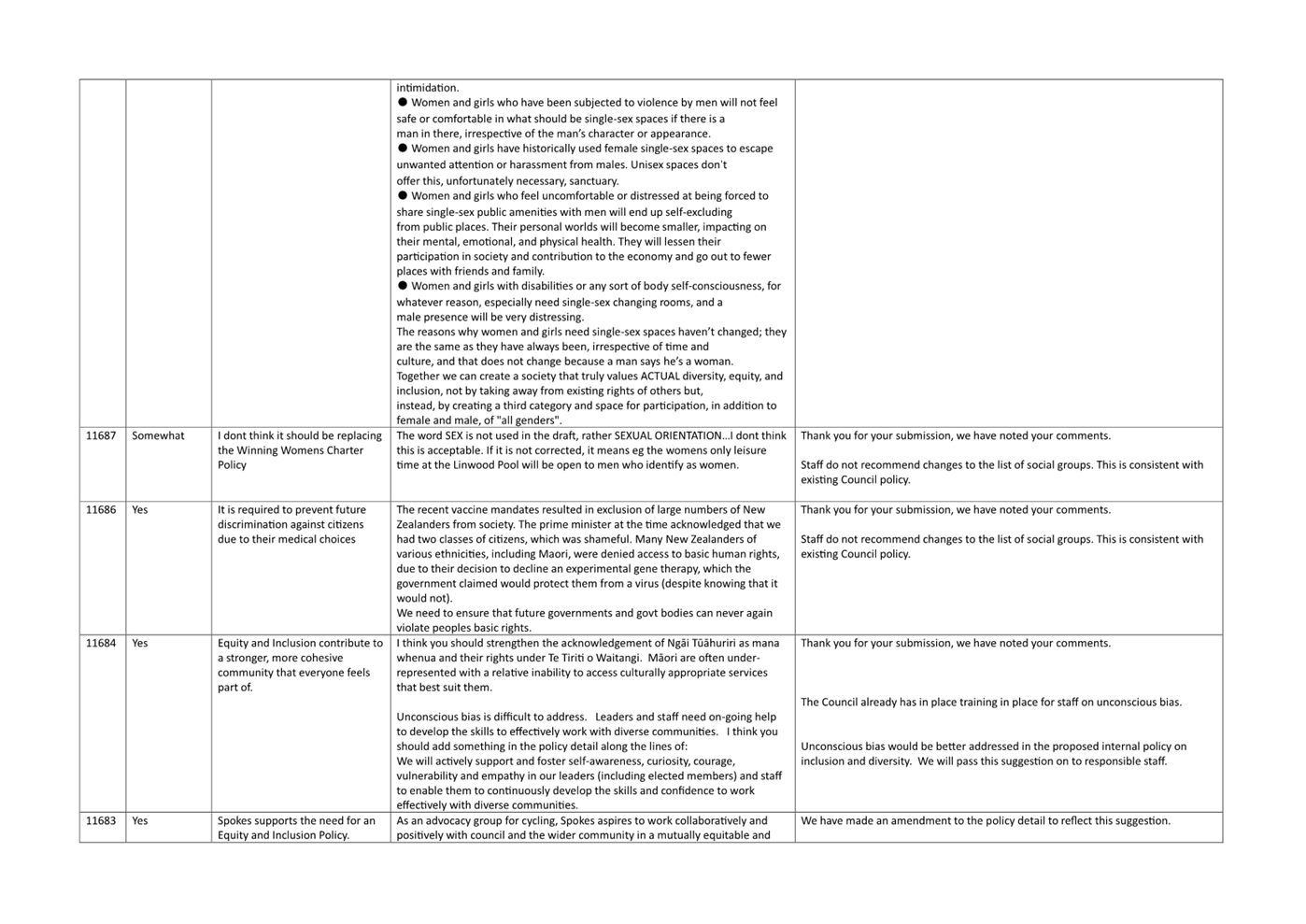
|
Report of / Te Pou Matua:
|
Claire
Appleby-Phillips, Manager Community Planning & Projects
Abraham Larsen, Community Development Advisor
Ellen Cavanagh, Senior Policy Analyst
|
|
Senior Manager / Pouwhakarae:
|
John
Filsell, Head of Community Support and Partnerships
(John.Filsell@ccc.govt.nz)
|
1. Purpose of the Report Te Pūtake Pūrongo
1.1 This report summarises the submissions received during
consultation on the draft Equity and Inclusion Policy (Policy). The report is
intended to support the Hearings Panel in its deliberations on those
submissions.
1.2 The Hearings Panel’s role is to consider all
submissions and to make recommendations to the Council on the final form of the
Policy.
1.3 The decisions in this report are of low significance in
relation to the Council’s Significance and Engagement Policy. The level
of significance was determined on the basis that the purpose is to report back
on submissions received as part of public consultation that has already
occurred.
2. Proposed Officer Recommendations Ngā Tūtohu
That
the Hearing Panel
1. Receives the information within this report,
including attachments, and considers the written and oral submissions made as
part of the public consultation process.
2. Recommends that the Council:
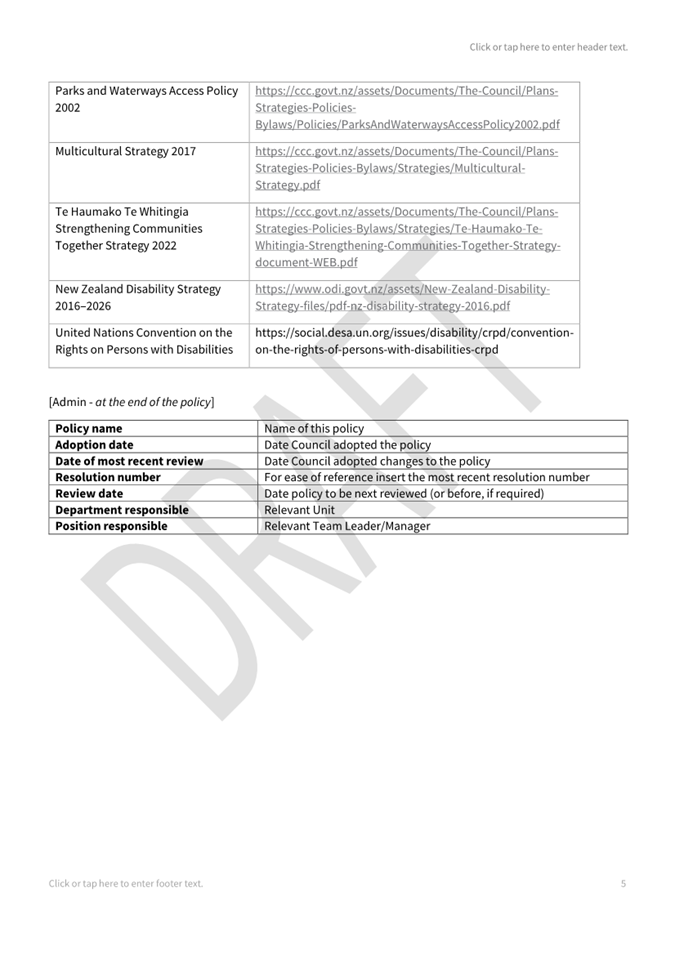
a. Revokes the following polices:
i. Ageing Together Policy 2007
ii. Children’s Policy 1998
iii. Community Van Policy 1990
iv. Early Childhood Education Policy 1998
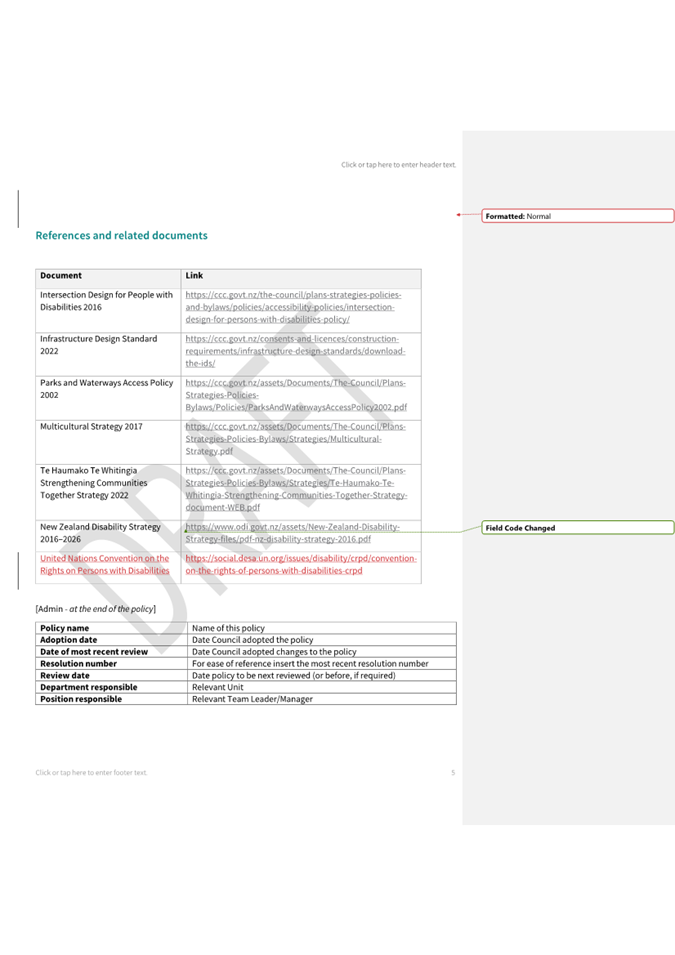
v. Equity and Access for People with Disabilities
Policy 2001
vi. Social Wellbeing Policy 2000
vii. Winning Women Charter Policy 1995
viii. Youth Policy 1998.
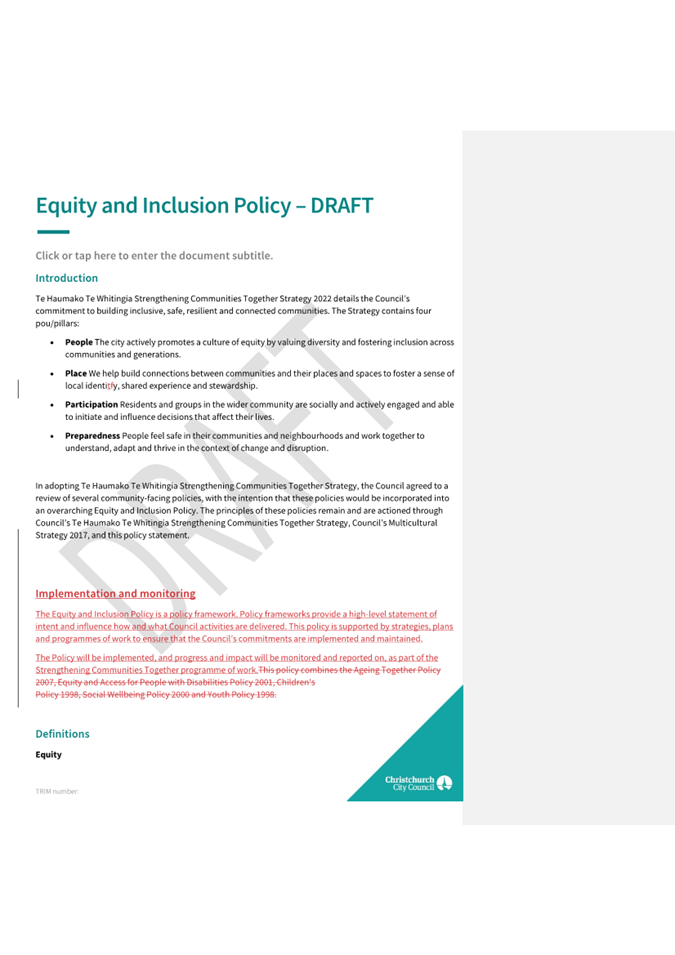
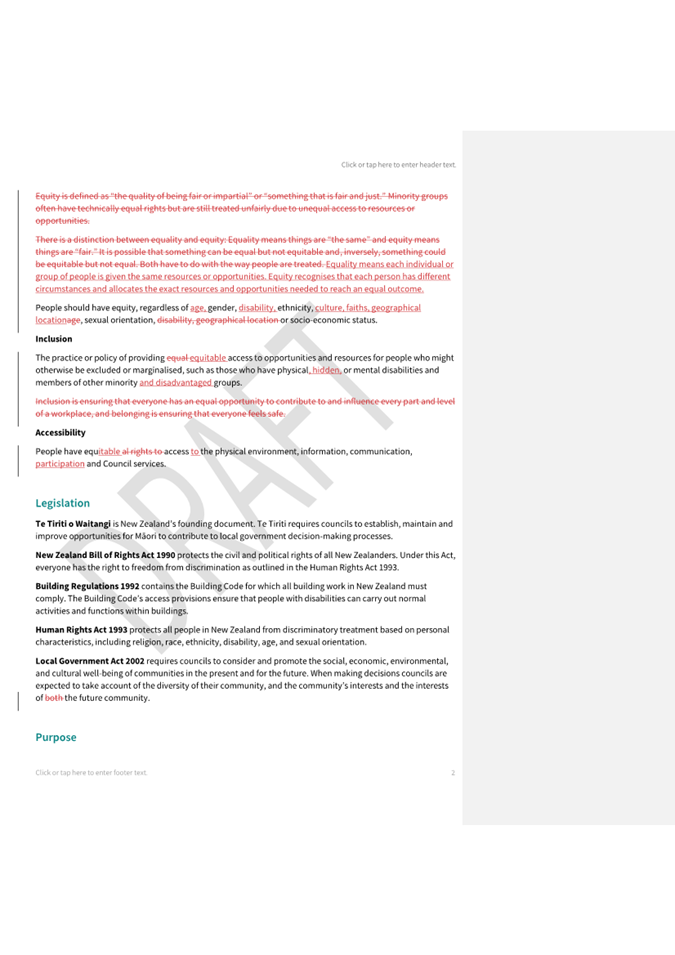
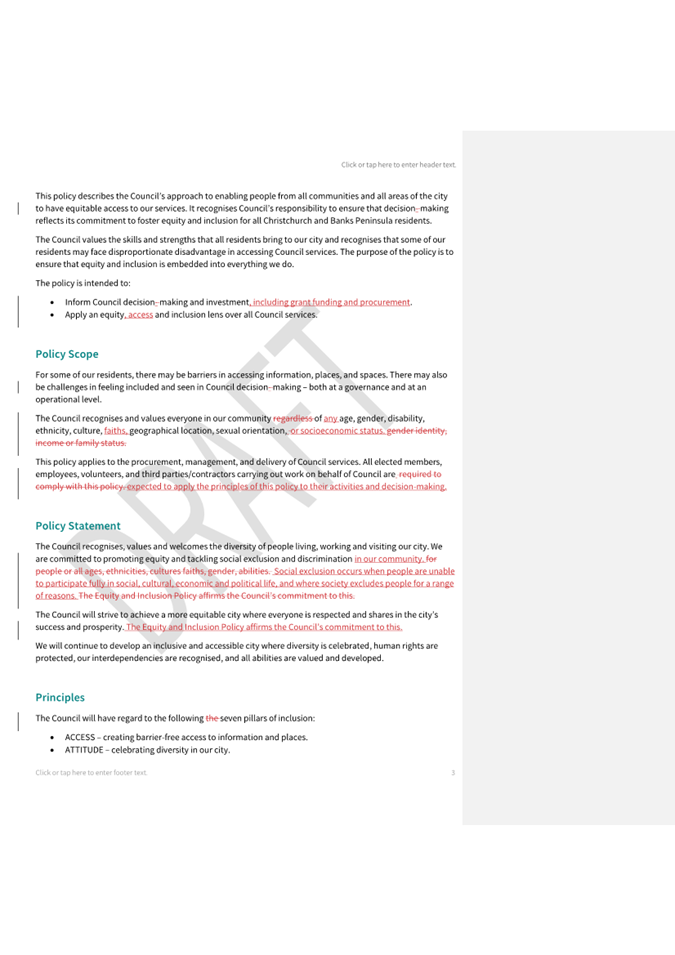
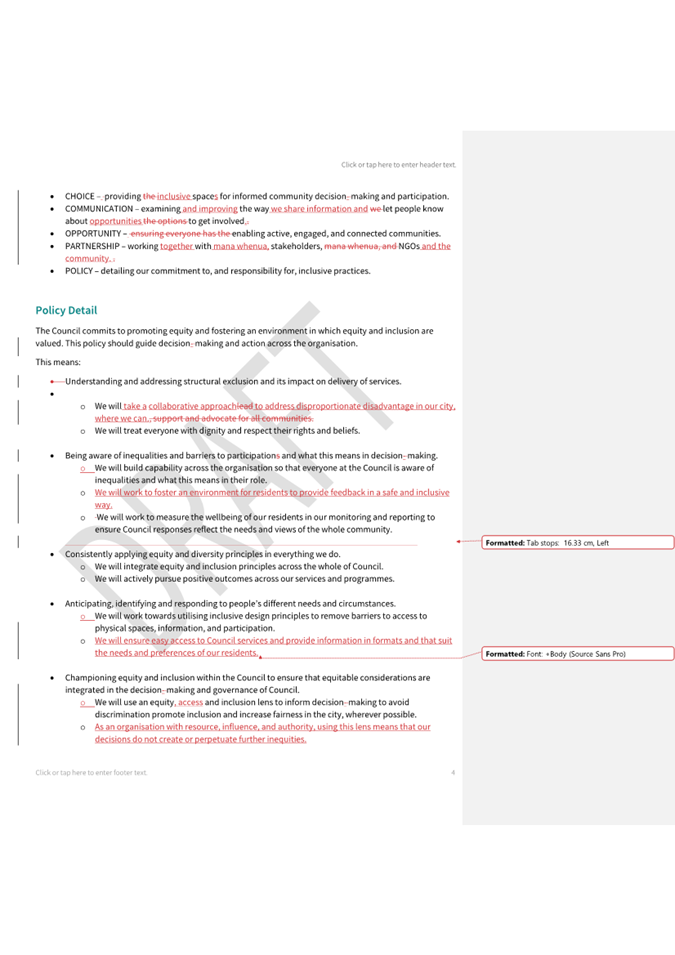
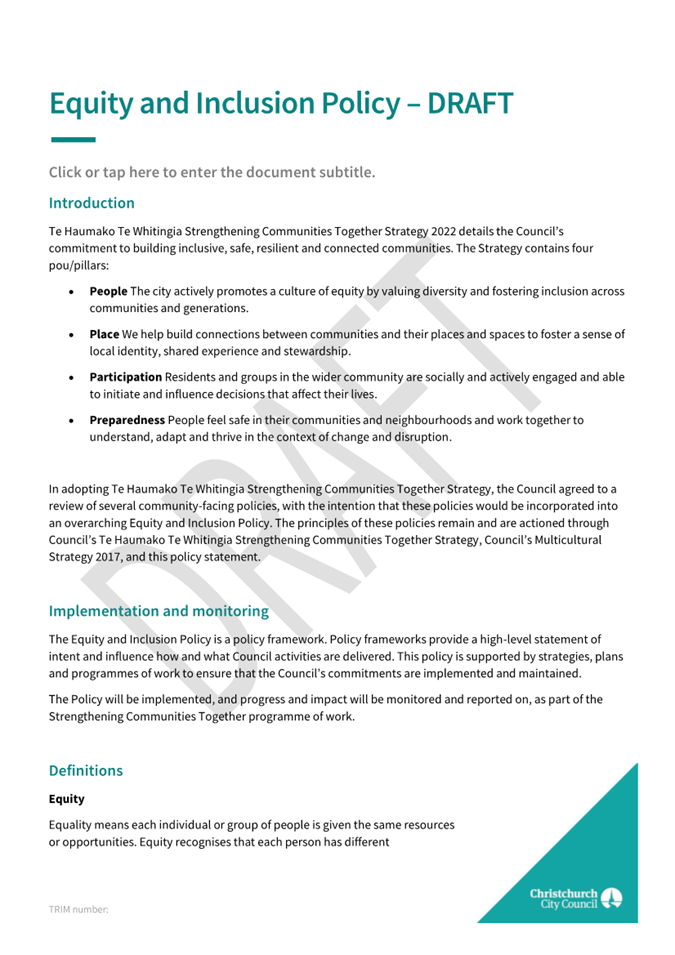
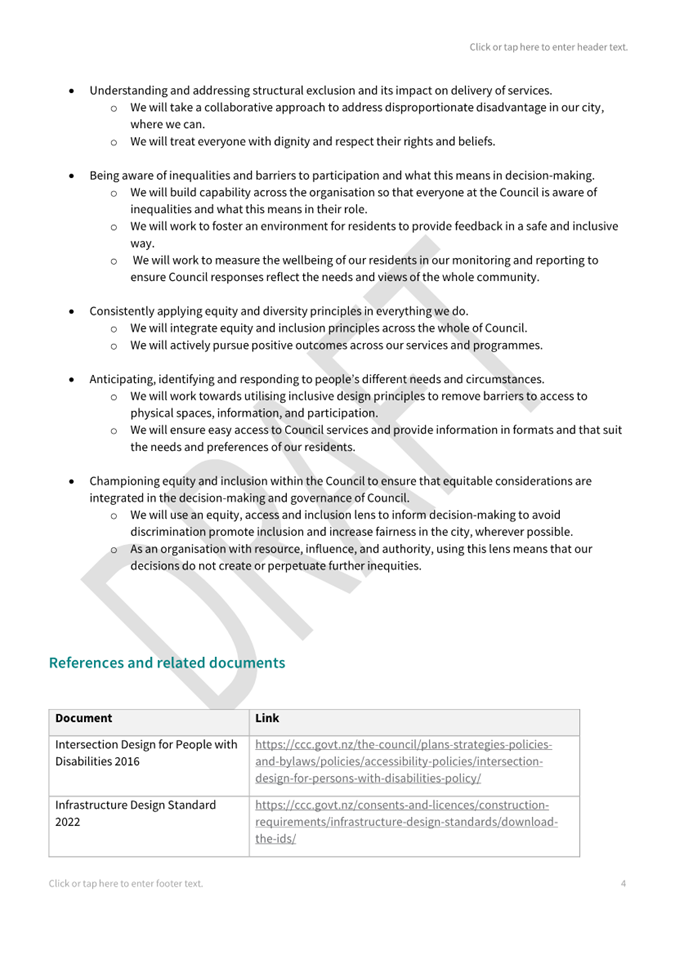
b. Adopts the Equity and Inclusion Policy 2023 in
its final form as set out in Attachment A, subject to any changes
recommended by the Hearing Panel following deliberations.
c. Approves that staff are otherwise authorised
to correct any typographical errors and to make minor changes to the Policy.
3. Background Te Horopaki
3.1 On
6
September 2023 the Council considered and approved the draft Equity and
Inclusion Policy for consultation [CNCL/2023/00108].
3.2 The Council has several community-facing policies that have
been overdue for review for some time. Many are now outdated or obsolete and do
not accurately speak to the Council’s role in the partnering with
communities. The policies are:
3.2.1 Ageing Together Policy 2007
3.2.2 Children’s Policy 1998
3.2.3 Community Van Policy 1990
3.2.4 Early Childhood Education Policy 1998
3.2.5 Equity and Access for People with Disabilities Policy 2001
3.2.6 Social Wellbeing Policy 2000
3.2.7 Winning Women Charter Policy 1995
3.2.8 Youth Policy 1998
3.3 These policies were initially identified for review as part
of a 2018 review of the Council’s external policy register.
3.4 A subsequent review of the external policy register
recommended these policies be considered in the review of the Strengthening
Communities Strategy 2007.
3.5 The Strengthening Communities Strategy 2007 was reviewed
and replaced with the Strengthening
Communities Together Strategy 2022. The
implementation plan for the 2022 Strategy identified that the youth, children,
older persons, disability and other community-facing policies would be
reviewed and replaced with a single policy document.
3.6 Staff
have reviewed the eight existing community-facing policies to determine
potential next steps for them.
3.7 Three
of the policies have been identified as being obsolete and suitable for
revocation:
3.7.1 Community
Van Policy 1990
3.7.2 Early
Childhood Education Policy 1998
3.7.3 Winning
Women Charter Policy 1995.
3.8 The
other five polices have been identified for amalgamation into one new policy,
the draft Equity and Inclusion Policy:
3.8.1 Ageing
Together Policy 2007
3.8.2 Children’s
Policy 1998
3.8.3 Equity
and Access for People with Disabilities Policy 2001
3.8.4 Social
Wellbeing Policy 2000
3.8.5 Youth
Policy 1998
4. Draft Equity and Inclusion Policy
4.1 The
five above-named policies broadly cover: removing barriers to accessing places,
spaces, information, and participation; ensuring our services meet the needs of
the community; and reiterating the value the Council places on the contribution
of different groups in the community.
4.2 Staff
have considered the intent behind the above-mentioned policies and prepared the
draft Equity and Inclusion Policy as a high-level policy framework that
facilitates an equity, access and inclusion lens being put across Council
decision-making. A policy framework is a high-level statement of intent and is
intended to influence how and what Council activities are delivered, as well as
influence other policy and strategy documents.
4.3 The new Policy, the draft Equity and Inclusion Policy,
recognises the Council’s responsibility to ensure that decision-making
reflects our commitment to foster equity and inclusion for all our residents.
The draft Policy describes the Council’s approach to enabling people from
all communities and areas of the city to have equitable access to our services.
4.4 The draft Policy retains the principles and intent
of the old policies but better reflects the Council’s role in community
wellbeing in line with Strengthening Communities Together Strategy. It
does not reflect a new policy direction for the Council.
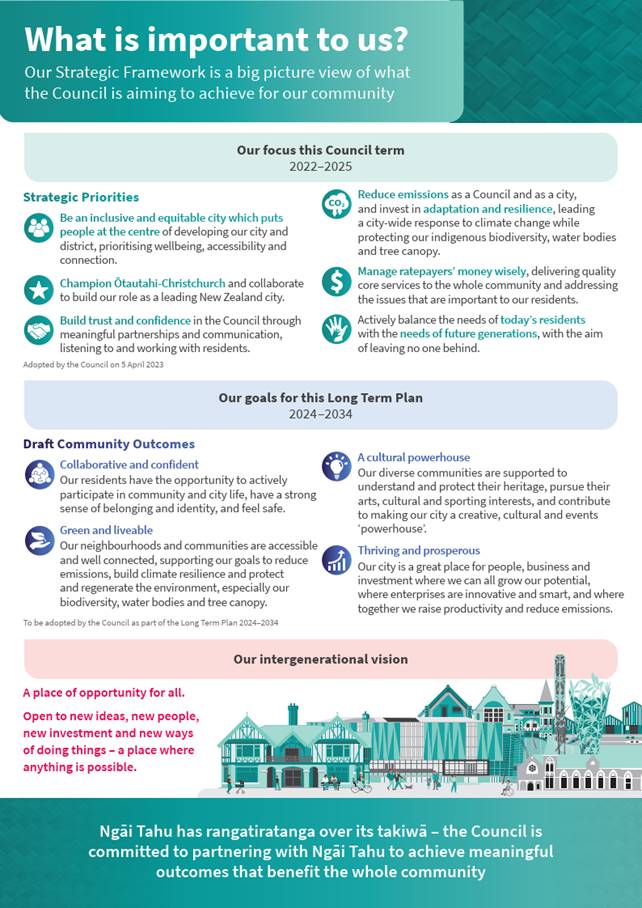
4.5 The draft Policy is also aligned with the Council’s Strategic Framework, specifically the priority to ‘be an inclusive
and equitable city which puts people at the centre of developing our city and
district, prioritising wellbeing, accessibility and connection’.
5. Overview of Amalgamated Policies
Ageing Together
Policy 2007
5.1 The
Ageing Together Policy outlines the Council’s commitment to meeting the
needs of older people in Christchurch. It reiterates the value the Council
places on having opportunities for older people to participate and contribute
to their communities. The Ageing Together Policy also recognises that some
people are more vulnerable and frailer as they age and may need additional
support.
5.2 The
Ageing Together Policy has three goals relating to access to information,
access to places and services, and opportunities for participation.
5.3 It
superseded the Older Persons Policy 1998 which was reviewed to reflect the
Council’s contribution to the Government’s New Zealand Positive
Ageing Strategy 2001. This strategy has now been replaced by the Better Later
Life – He Oranga Kaumātua 2019 to 2034 Strategy.
5.4 The
policy principles are broadly covered by the Strengthening Communities Together
Strategy, particularly around recognition and value of older people and
enabling participation and access to places and spaces.
Children’s Policy 1998
5.5 The
Children’s Policy reflects the Council’s commitment to ensuring
that its policies, planning and programmes impact positively upon the welfare
and well-being of children and their whānau. It includes a table which
categorises Council roles in achieving various outcomes for children. The
policy also reflects the value the Council places on including children in the
decision-making process.
5.6 The
principles of this policy are broadly covered by the Strengthening Communities
Together Strategy, particularly around supporting opportunities for children to
influence decision-making, and enhancing the aspirations of young people.
Equity and
Access for People with Disabilities Policy 2001
5.7 The
Equity and Access for People with Disabilities Policy sets out the
Council’s commitment to removing barriers to participation for people
with disabilities and their whānau. It is a lengthy policy, with nine
broad goal areas and 76 specific provisions for Council activities/services
under these goals.
5.8 The
policy principles are broadly covered by Strengthening Communities Together
Strategy, particularly around enhancing the capacity and aspirations of the
disability community.
5.9 The
Equity and Access for People with Disabilities Policy contains a lot of detail
on ensuring the built environment does not create barriers for people with
disabilities. Staff have undertaken clause-by-clause review of the policy,
which is discussed further in sections 9.18-9.20 of this report.
Social
Wellbeing Policy 2000
5.10 This
is a policy framework that sets out the high-level social outcomes for the
community that the Council is committed to enhancing. These outcomes cover
participation and community engagement, fair distribution of resources,
reducing barriers to access, honouring Te Tiriti o Waitangi and positive
economic outcomes.
5.11 The
outcomes and priorities set out in the Social Wellbeing Policy are covered by
the Strengthening Communities Together Strategy and the Council’s
Strategic Framework.
Youth Policy
1998
5.12 This
is a one-line policy, which states the Council’s commitment to
developing, supporting and promoting initiatives that positively contribute to
the safety and wellbeing of young people, their whānau and
communities.
5.13 The
principles of the Youth Policy are broadly covered by the Strengthening
Communities Together Strategy, particularly around enhancing the capacity and
aspirations of youth.
6. Policies Recommended for Revocation
Community Van Policy 1990
6.1 The
Community Van Policy states the Council will make a van available for community
groups to hire. The Council no longer has a community van available for hire,
meaning this policy is no longer practised. This policy is now 33 years old and
has not been reviewed since it was adopted in 1990.
Early Childhood
Education Policy 1998
6.2 The
Early Childhood Education Policy outlines the Council’s commitment to
promoting equitable access for all children and their whānau to quality
early childhood education in Christchurch. The policy is now 25 years old, has
not been reviewed since it was first adopted, and dates from a time when the
Council was actively involved in early childhood education.
Winning Women Charter Policy 1995
6.3 The
Winning Women Charter Policy adopts the Hillary Commission’s Winning
Women Charter. The charter aimed to improve women’s participation in
sport, fitness and leisure, and recognise their contribution in building
healthy communities.
6.4 Staff
understand this policy was once tied to an external funding source that is no
longer available. The Hillary Commission became SPARC in 2002 and is now known
as Sport New Zealand. This policy has not been reviewed since it was adopted in
1995.
6.5 The
Physical Recreation and Sport Strategy 2002 includes the vision statement
of moving together to provide a city where people participate and enjoy and
have the opportunity to perform and excel in physical recreation and sport.
6.6 Staff
suggest the Hearings Panel recommend the Council resolve to revoke these three
policies when it considers the final Equity and Inclusion Policy.
7. Community Views and Preferences Ngā mariu ā-Hāpori
Public Consultation Te Tukanga Kōrerorero
7.1 As
part of early engagement, staff discussed the drafting of an Equity and
Inclusion Policy with the Digital Equity Advisory Group and the Disability
Advisory Group.
7.2 Public
consultation started on Thursday 14 September 2023 and ran until Friday 3
October 2023. An email was sent to 388 stakeholders, including 32
residents’ associations, 19 rūnanga
organisations, and 266 non-profit organisations.
Community Boards and interest groups were provided with a poster, an
information sheet and a news item to share online. The consultation was posted
on Facebook pages for the Council,
the Christchurch
Indian Group, and the Disabled
Persons Assembly Christchurch and Districts, inviting submissions on the
Council’s Let’s
talk webpage.
7.3 Consultation
documents and posters were delivered to all Christchurch libraries and service
centres on 18 September 2023. Printed submission forms were available on
request at local service centres.
7.4 During
consultation Council staff visited local community sessions with Age Concern,
Disabled Peoples Assembly, Accessibility Advisory Group, Qtopia, and Mana Tipua
- Mana Ora.
8. Summary of
Submissions Ngā Tāpaetanga
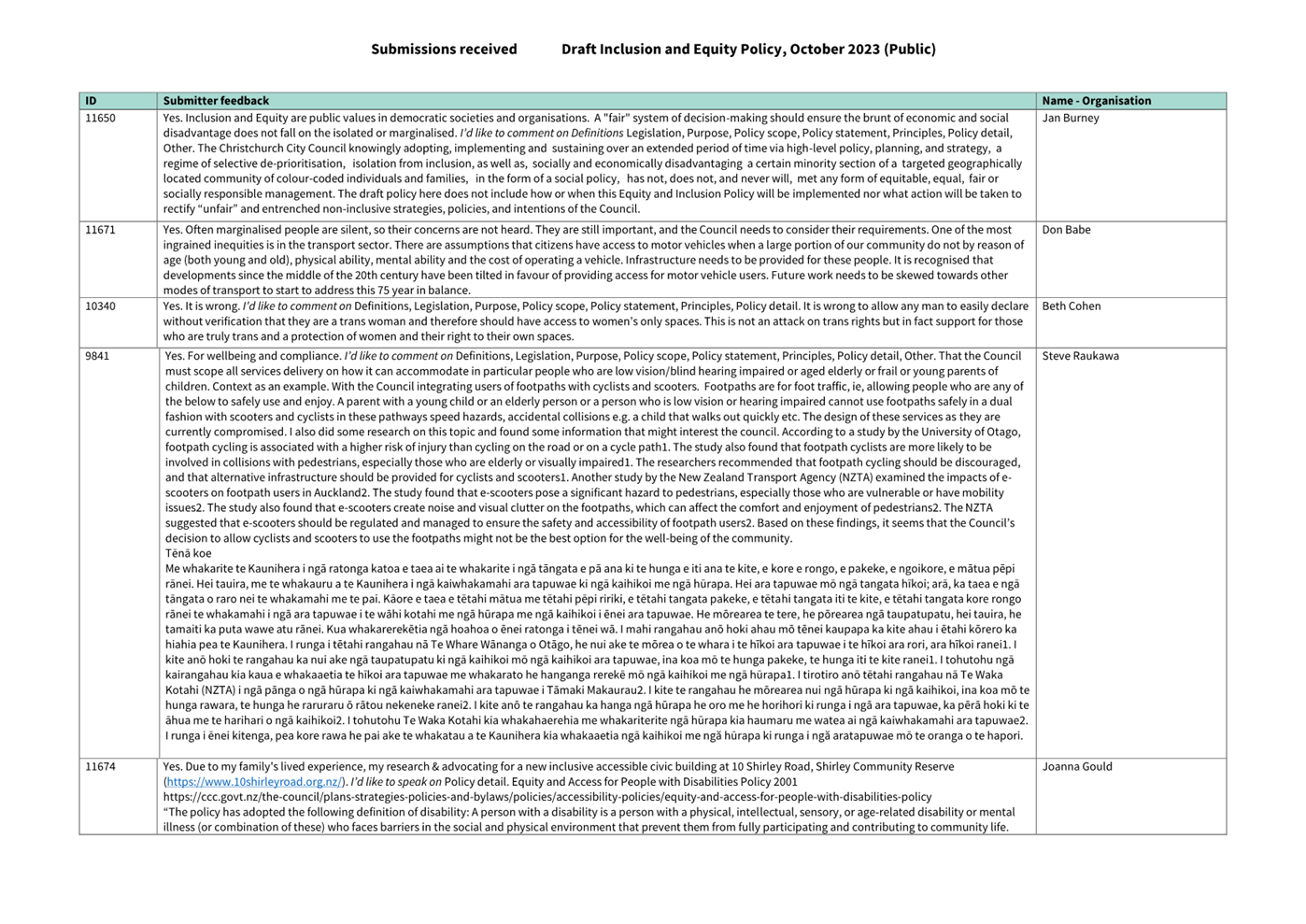
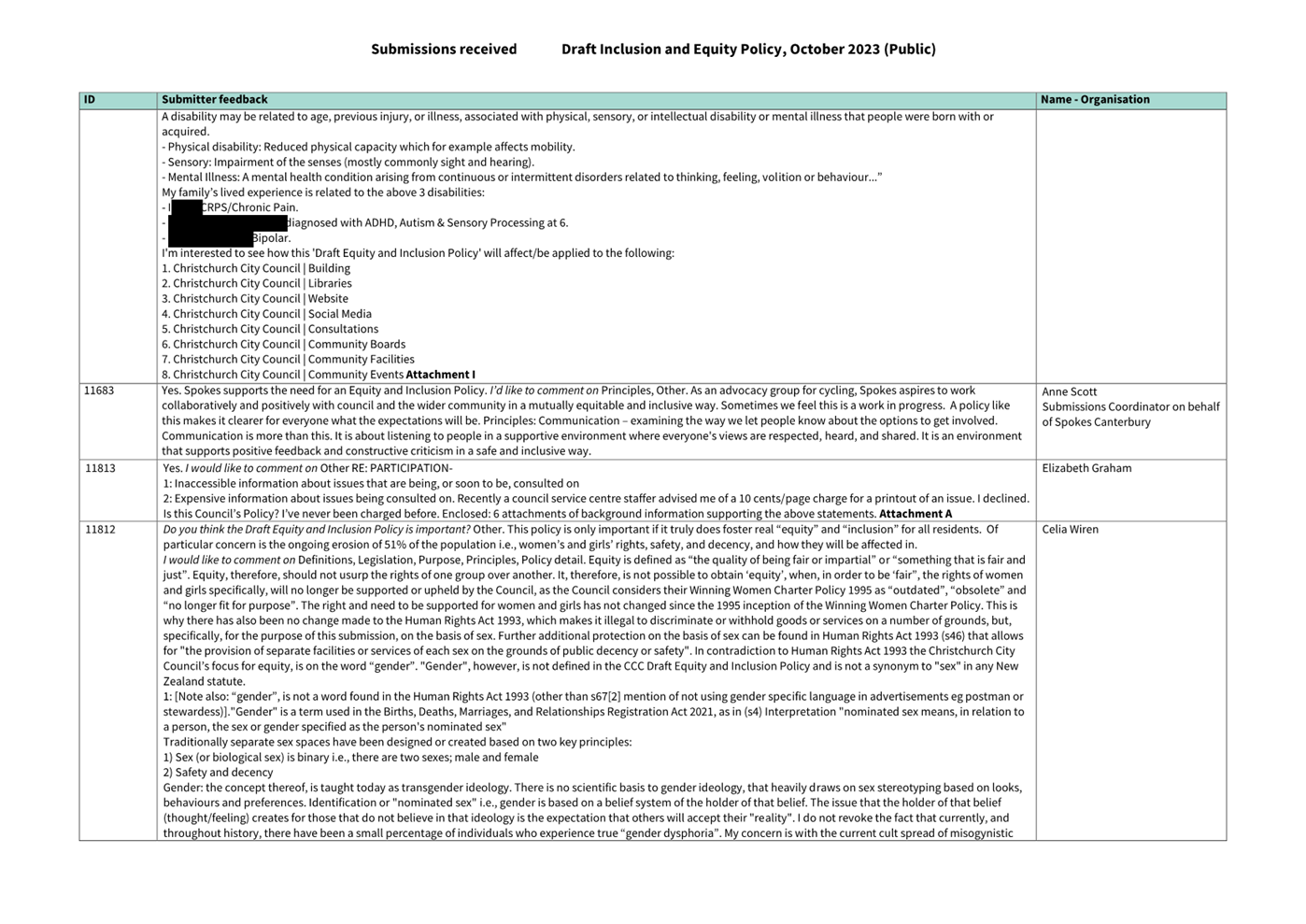
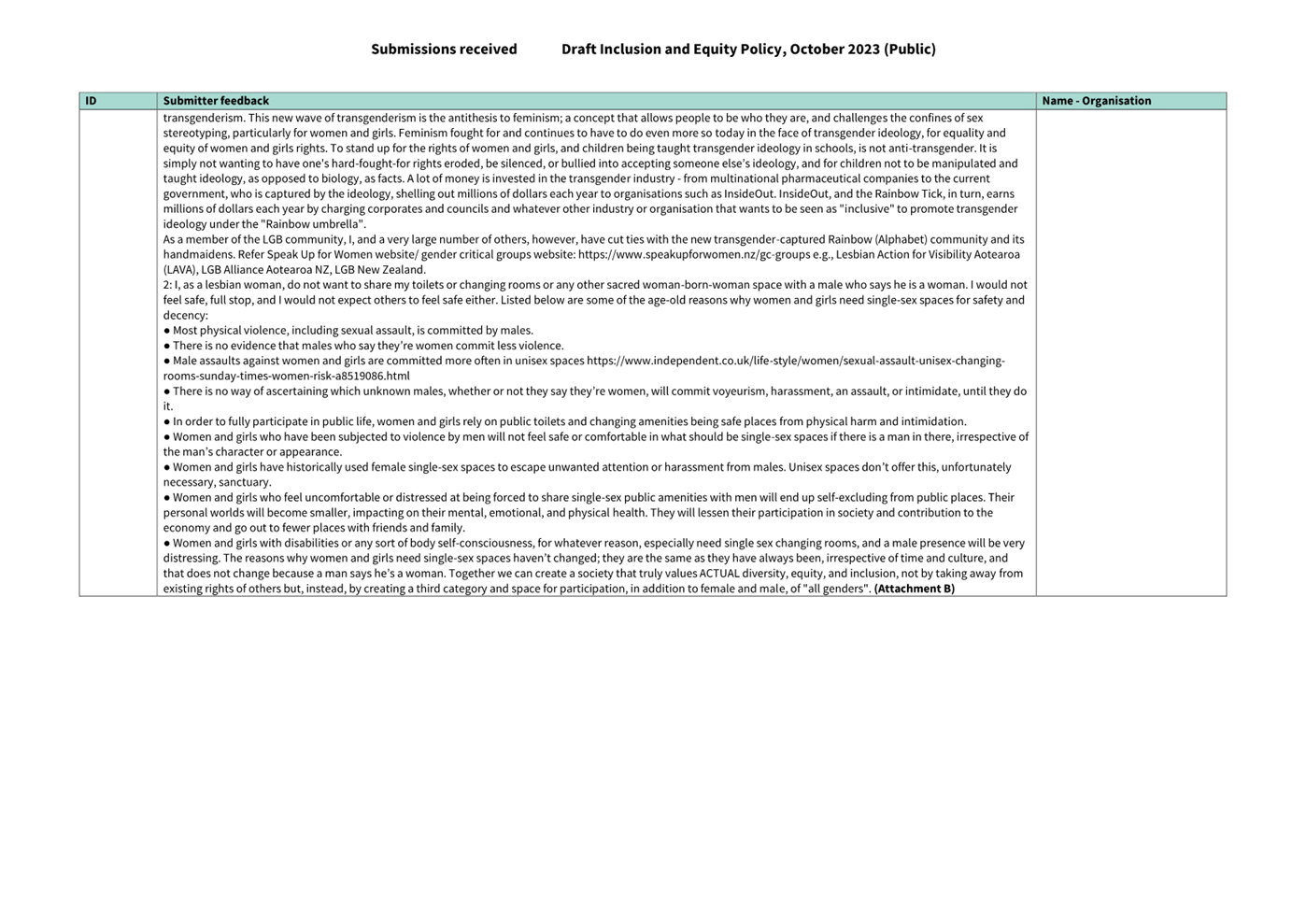
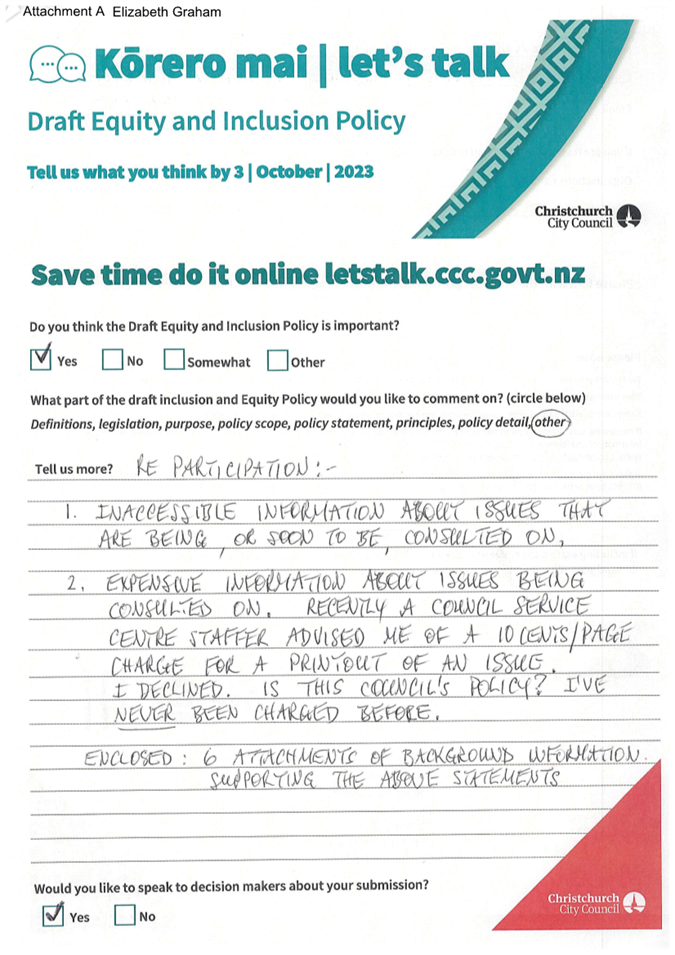
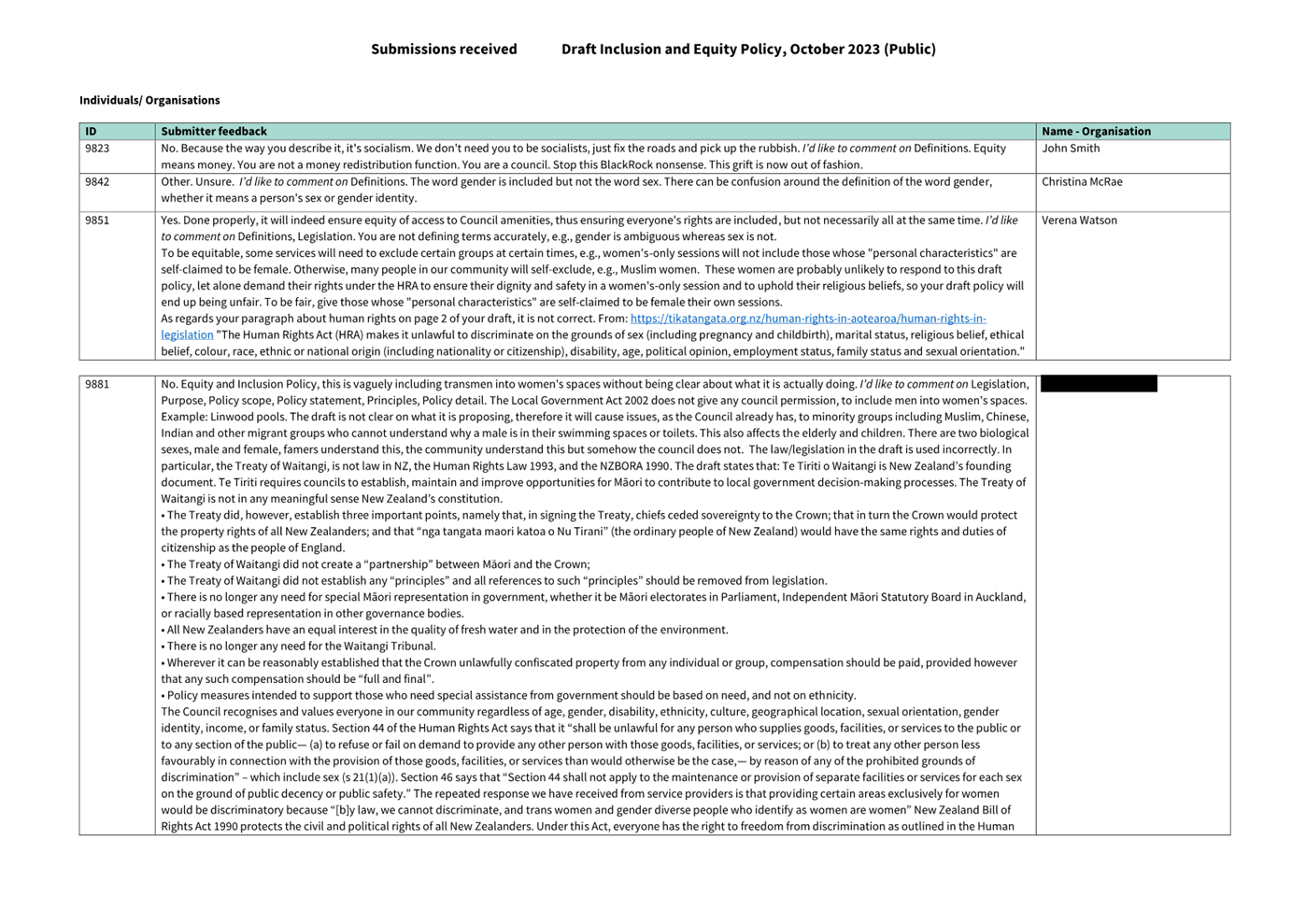
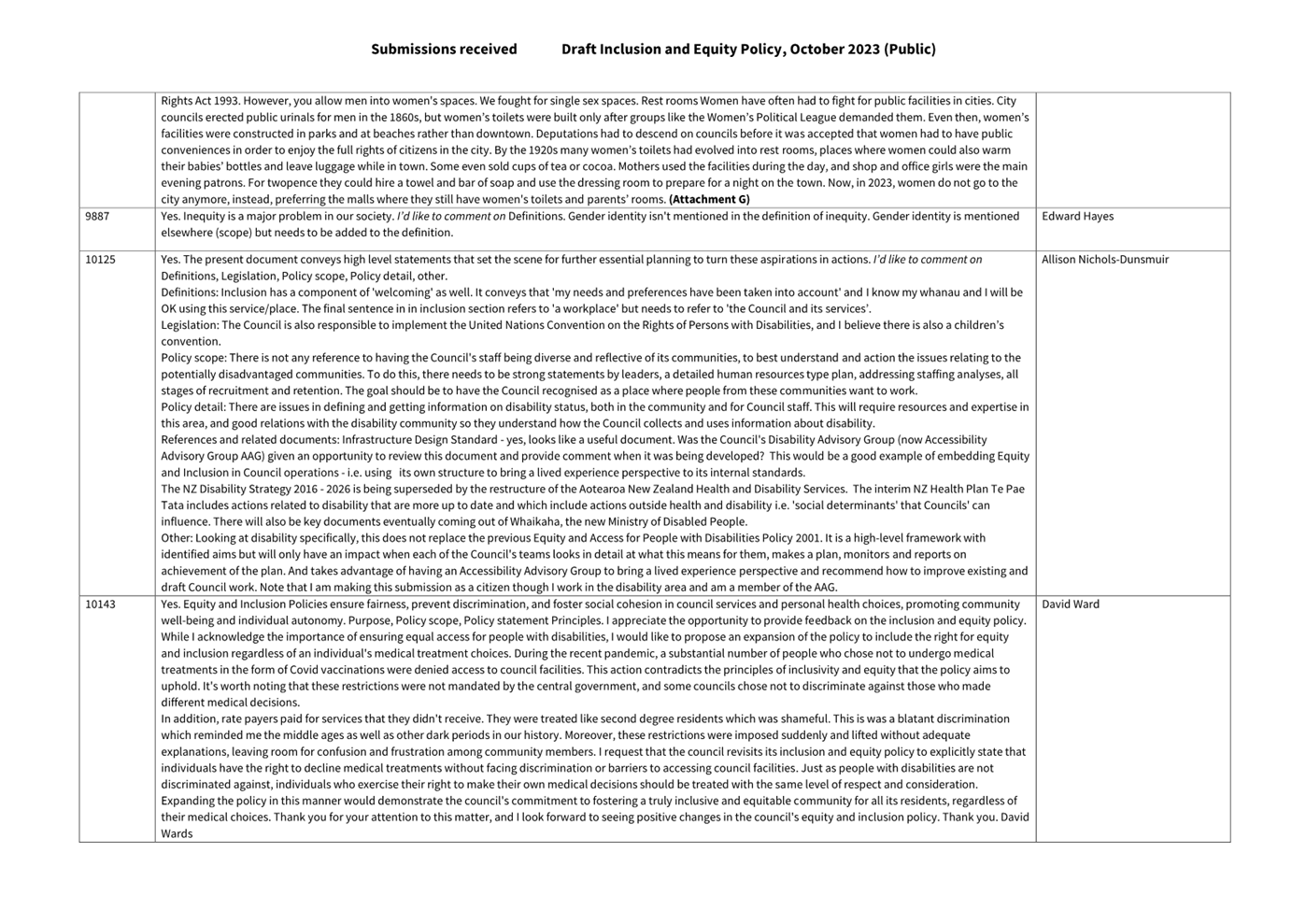
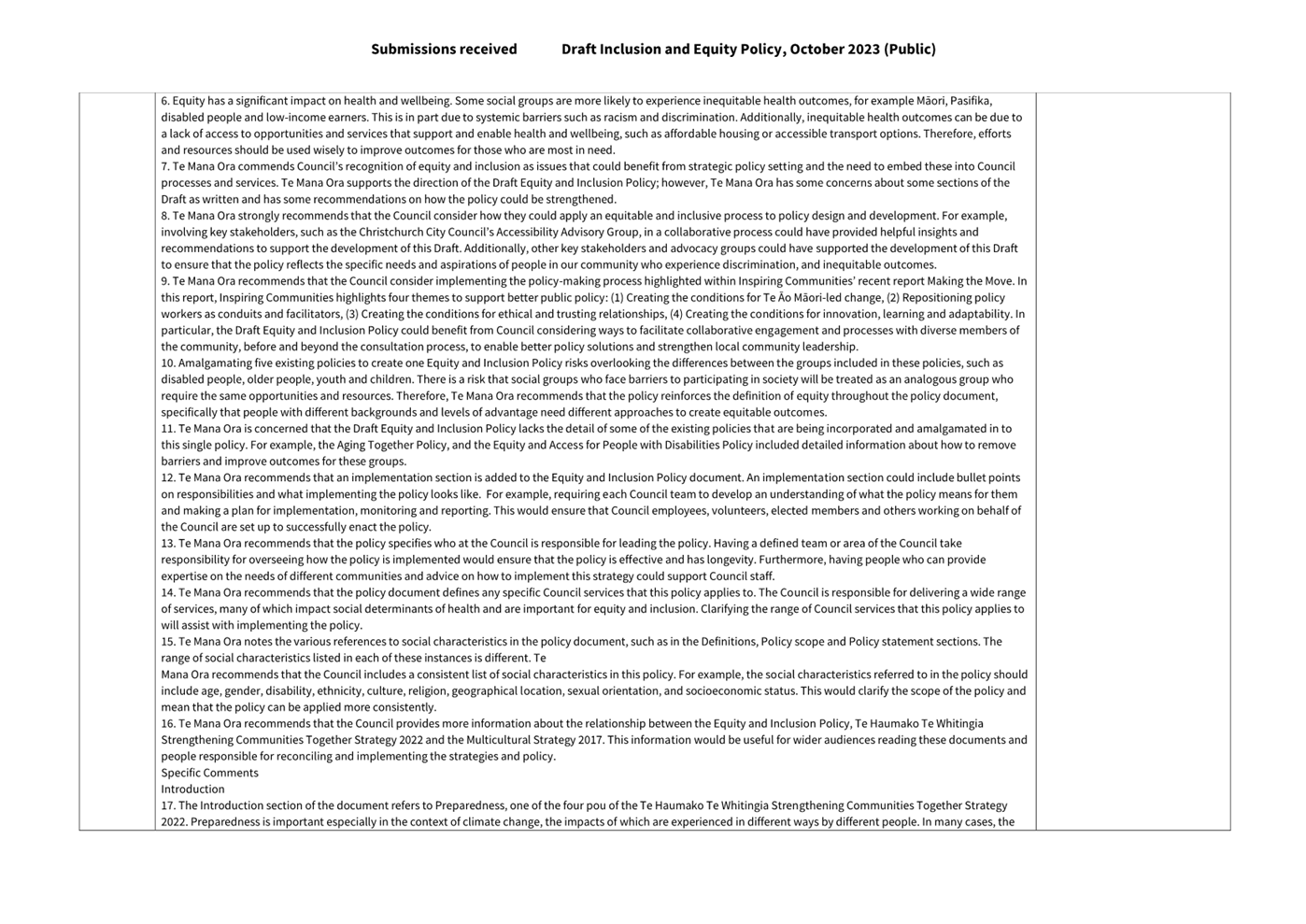
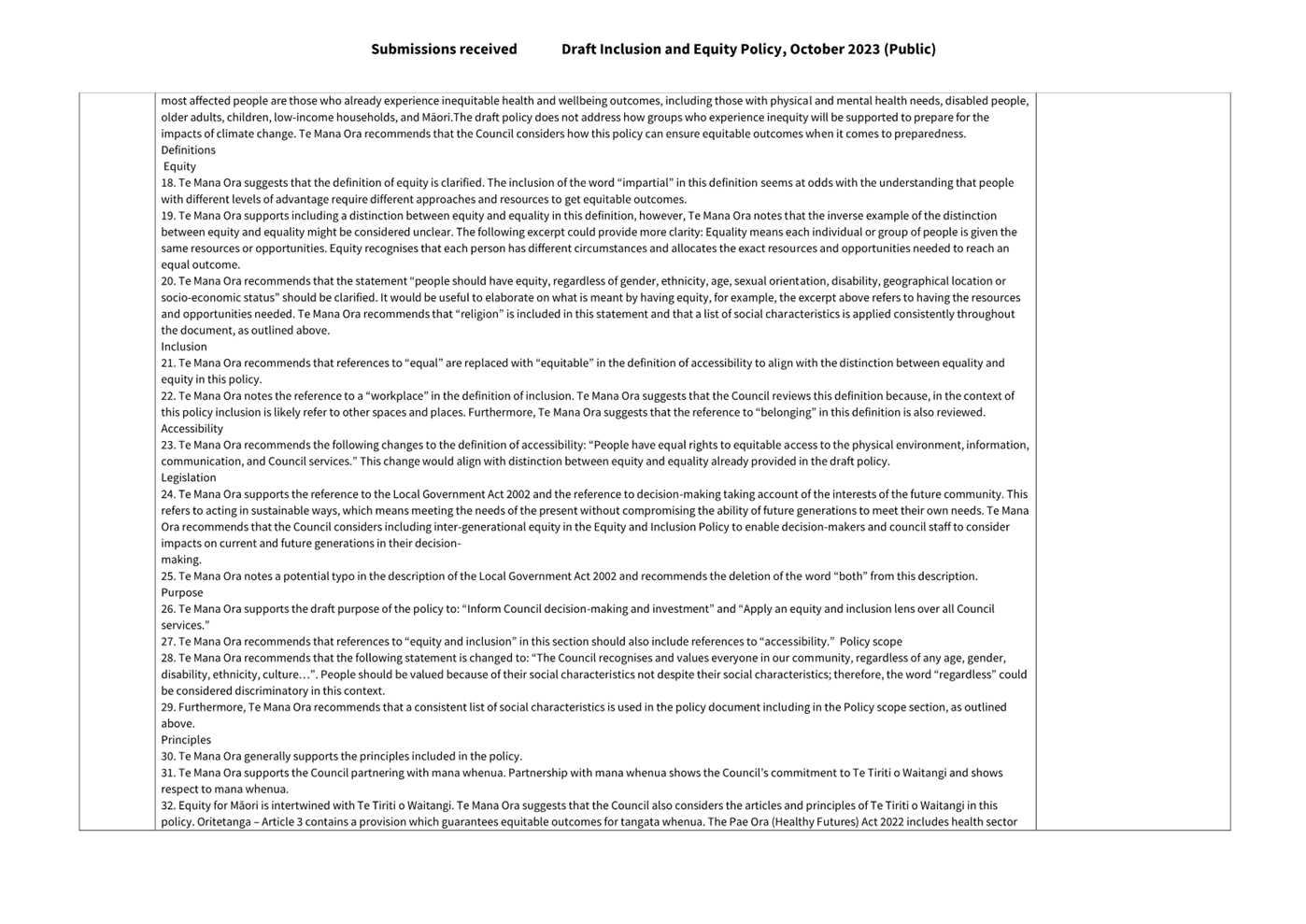
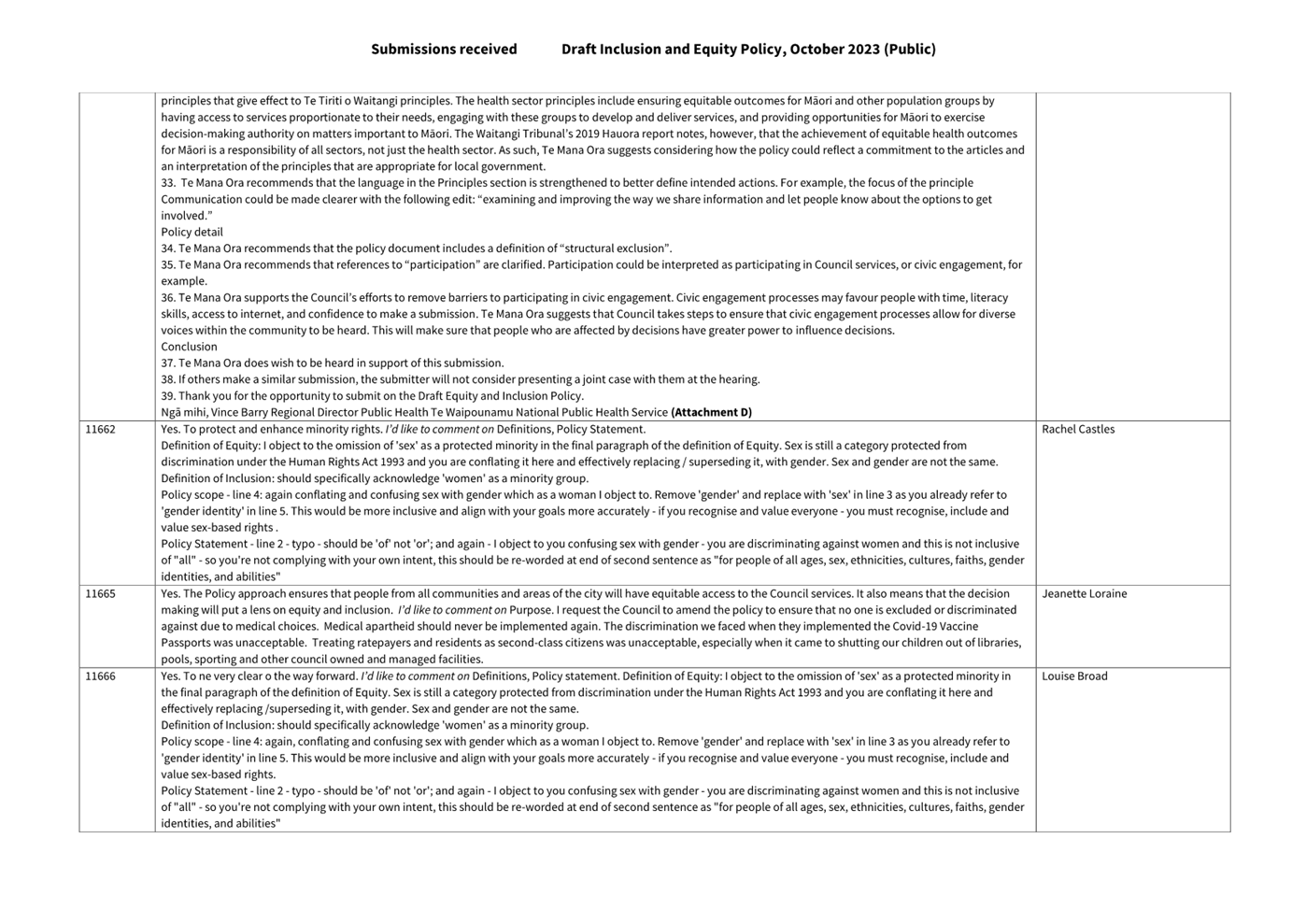
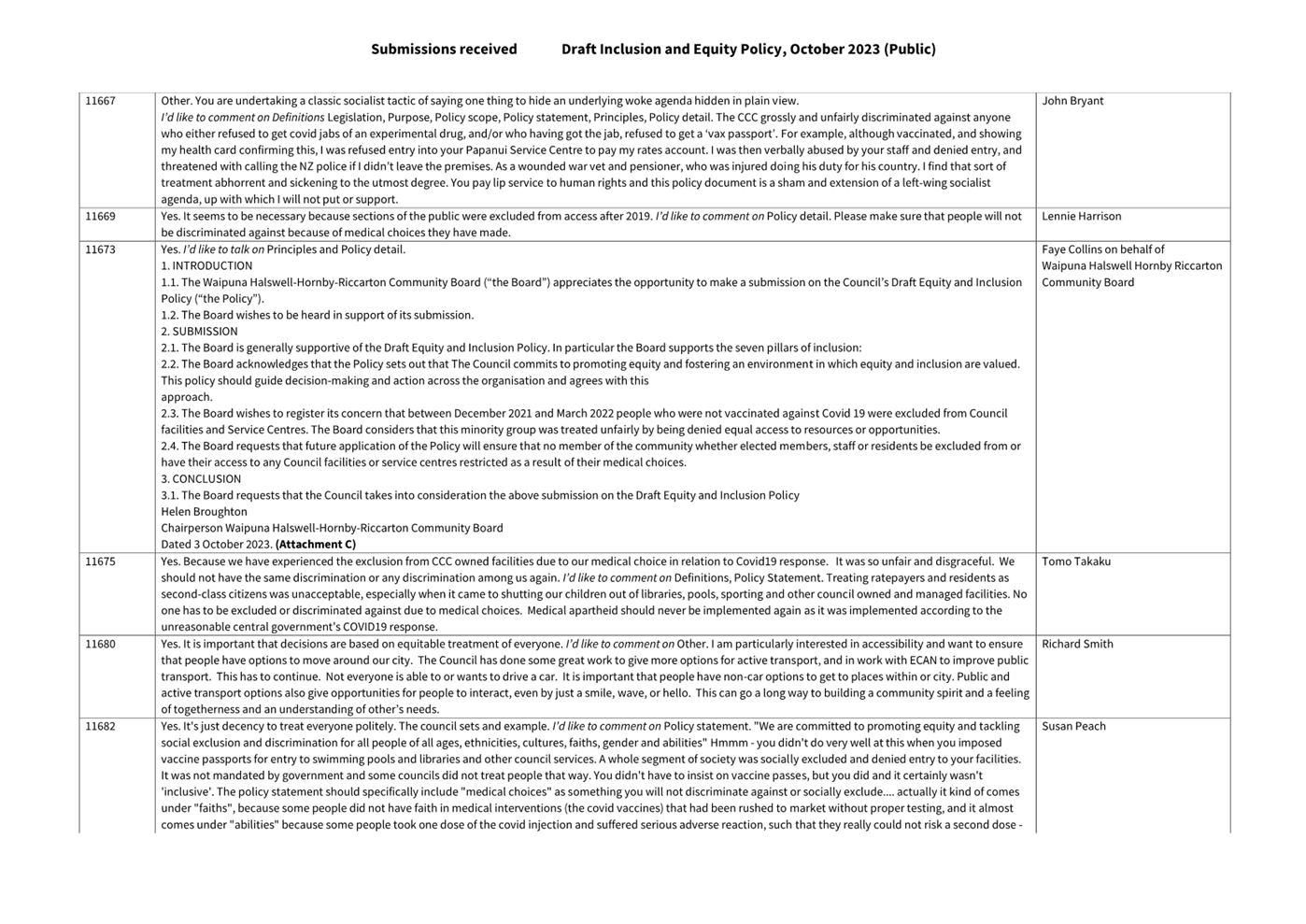
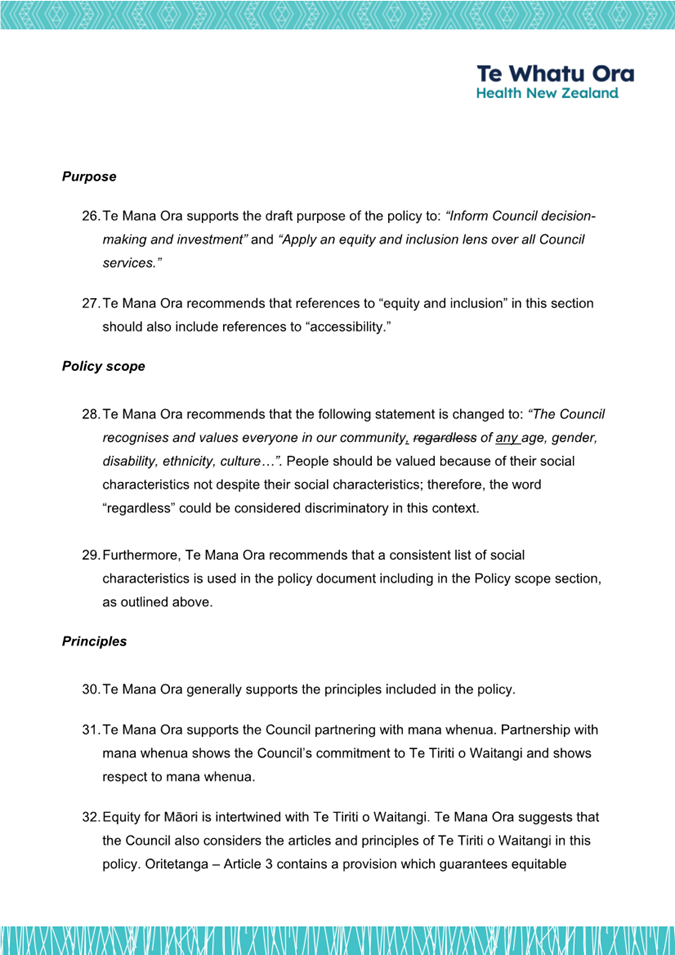
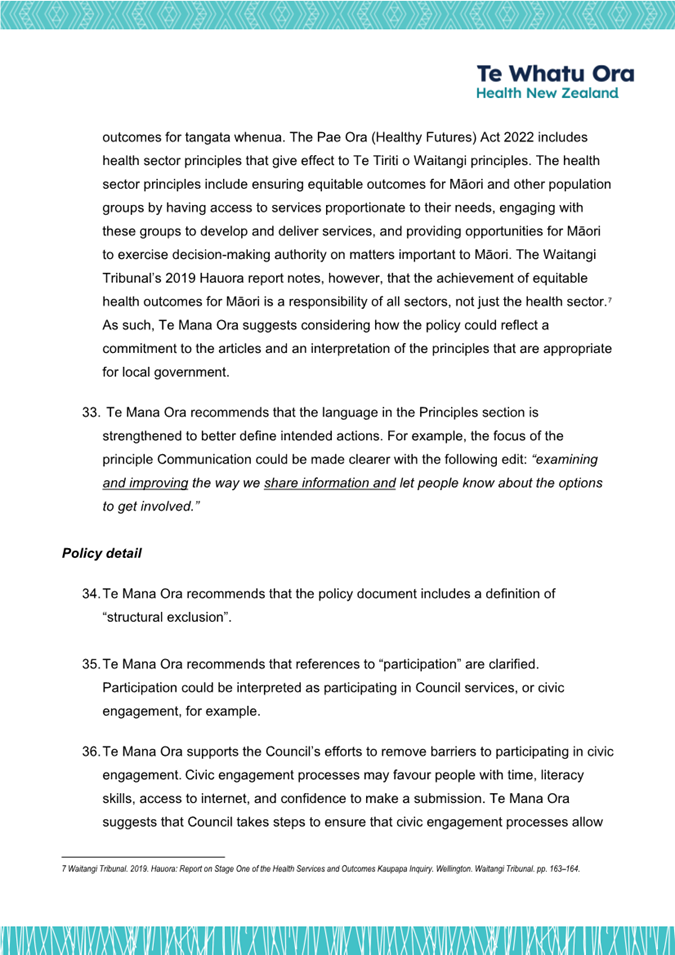
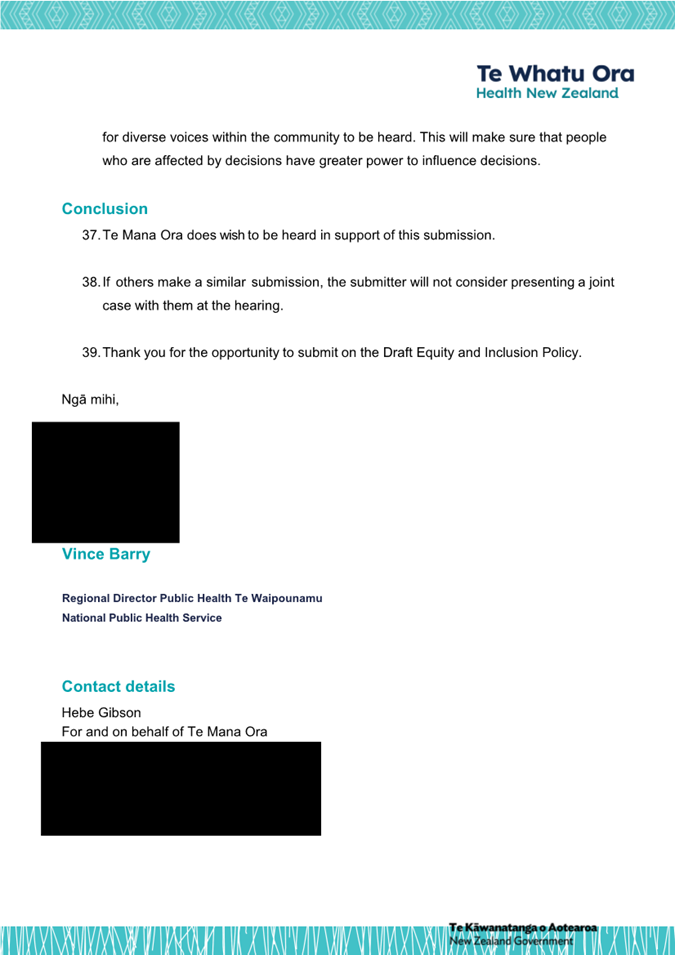
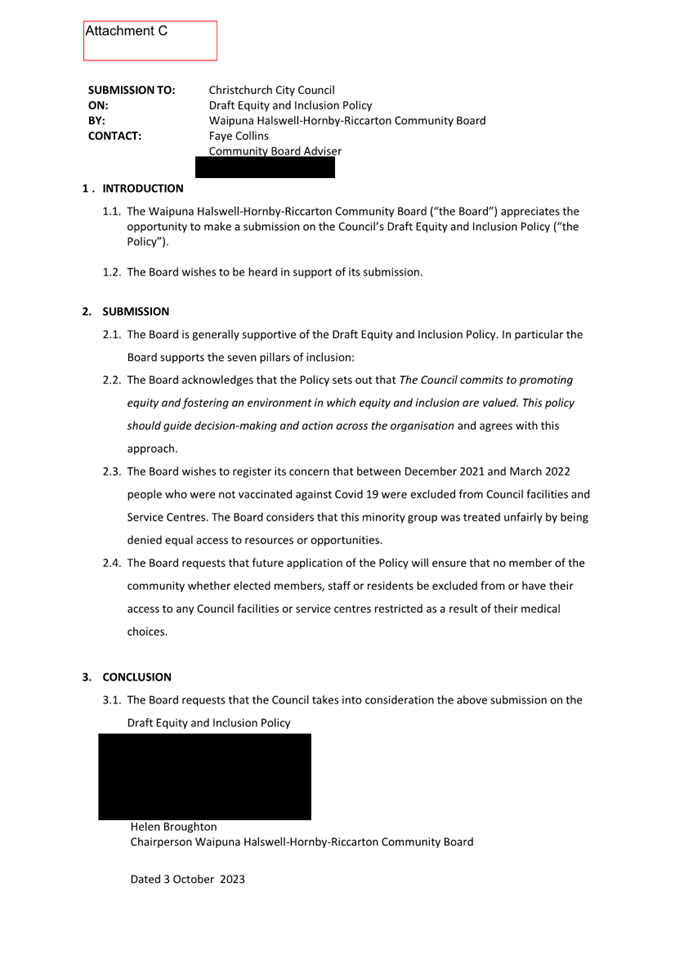
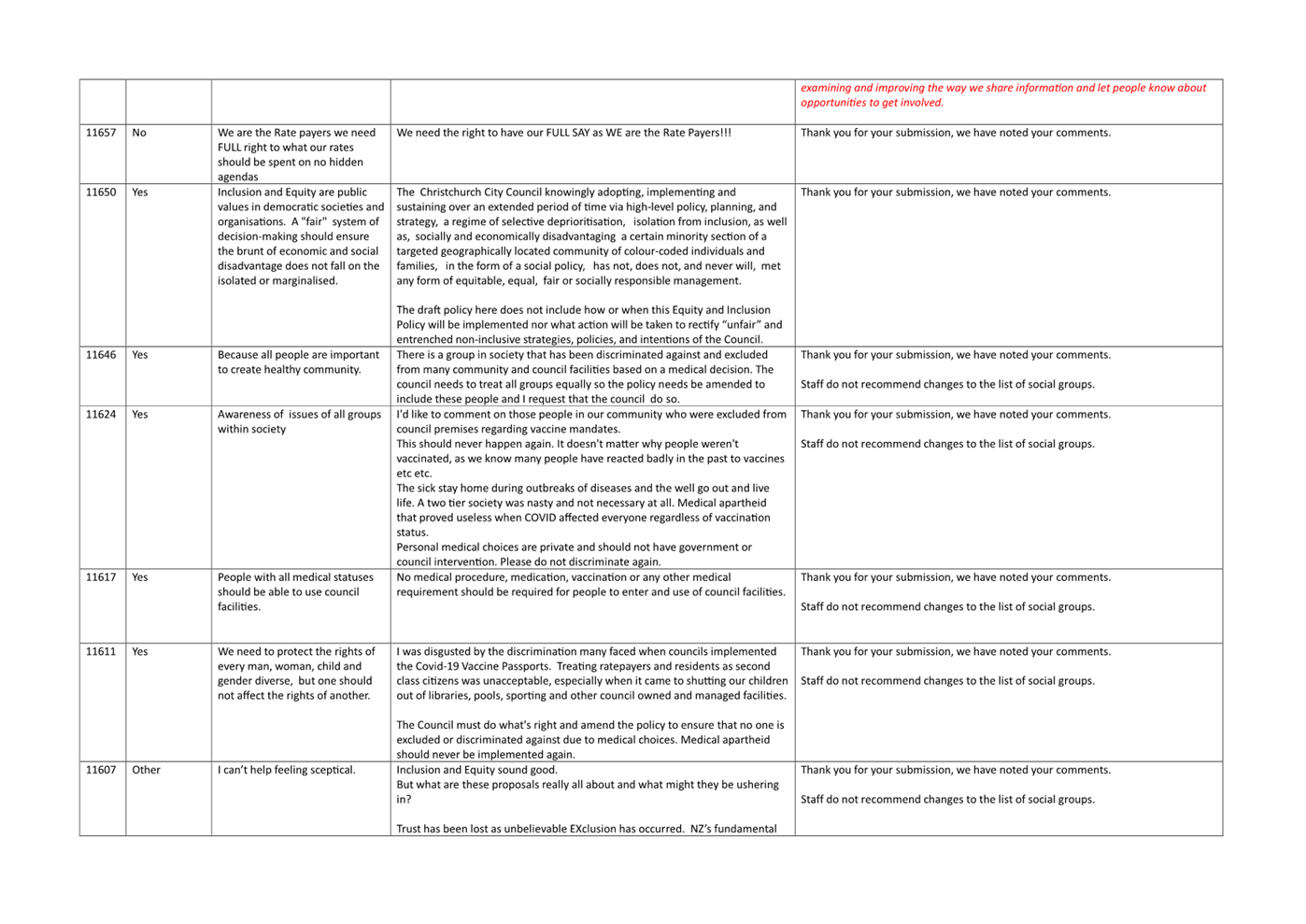
8.1 A total of 50 submissions were received on the draft Policy.
8.2 Submitters were made up of:
8.2.1 Three
Community Boards (Waipuna Halswell-Hornby-Riccarton;
Waimāero Fendalton-Waimairi-Harewood; Waihoro
Spreydon-Cashmere-Heathcote).
8.2.2 Five
organisations (Te Mana Ora, Spokes Canterbury, CCS
Disability Action, Christchurch Methodist Mission and Mana Wāhine
Kōrero).
8.2.3 42
individuals.
8.3 Most
submitters (34 or 68%) agreed that the Draft Equity and Inclusion Policy is
important, five (10%) disagreed, four (8%) said it is somewhat important, and
seven (14%) selected ‘other’ as their response.
8.4 The
parts of the Draft Equity and Inclusion Policy that submitters wanted to
comment on are shown in figure 1.
Figure 1 Topics that submitters wanted to
comment on.
8.5 The
spread of submissions by Community Board areas is shown in Figure 2.
Eight submissions (16%) were received from the Waihoro
Spreydon-Cashmere-Heathcote area, three (6%) from Te Pātaka o
Rākaihautū Banks Peninsula, seven (14%) from Waitai
Coastal-Burwood-Linwood, nine (18%) from Waipapa–Papanui-Innes-Central,
nine (18%) from Waimāero Fendalton-Waimairi-Harewood, and two (4%) from
Waipuna Halswell-Hornby-Riccarton. Twelve submissions (24%) were received from
outside of Christchurch.
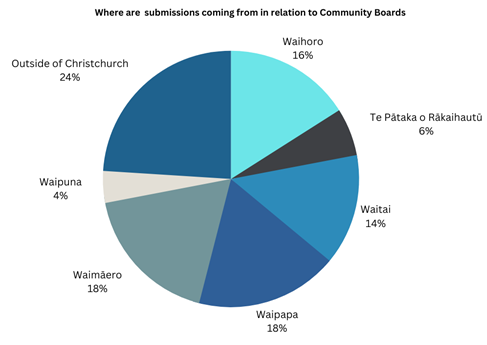
Figure 2 Submissions by Community Board
area
9. Staff Have Drafted Changes to the Policy to
Reflect Feedback Received
9.1 Submitters
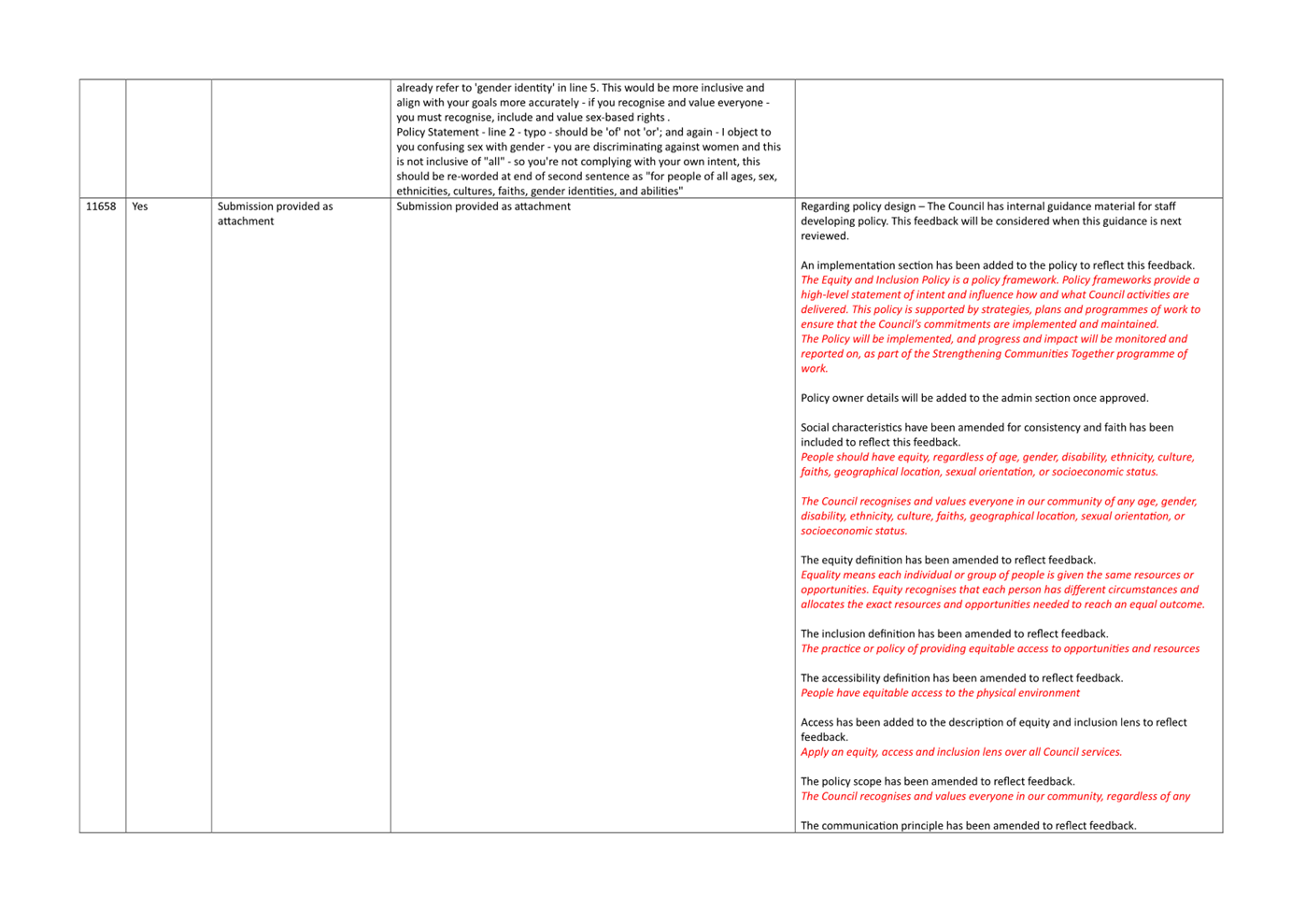
were generally supportive of the Policy, although many submitters suggested
various drafting changes, most of which were minor in nature.
9.2 Staff
have carefully considered each submission and made proposed drafting changes
where appropriate. In proposing these changes staff considered the nature of
the change, whether it is aligned with the principles and intent of the rest of
the Policy, and whether it is aligned with existing Council policies and
strategies – in particular the Strengthening Communities Together
Strategy and abovenamed community-facing policies.
9.3 The
proposed changes to the Policy are summarised below and attached to this report
for the Hearings Panel’s consideration.
9.3.1 Attachment
A shows the draft Policy with proposed changes tracked.
9.3.2 Attachment
B is a clean version of the draft Policy incorporating the proposed changes
contained in Attachment A.
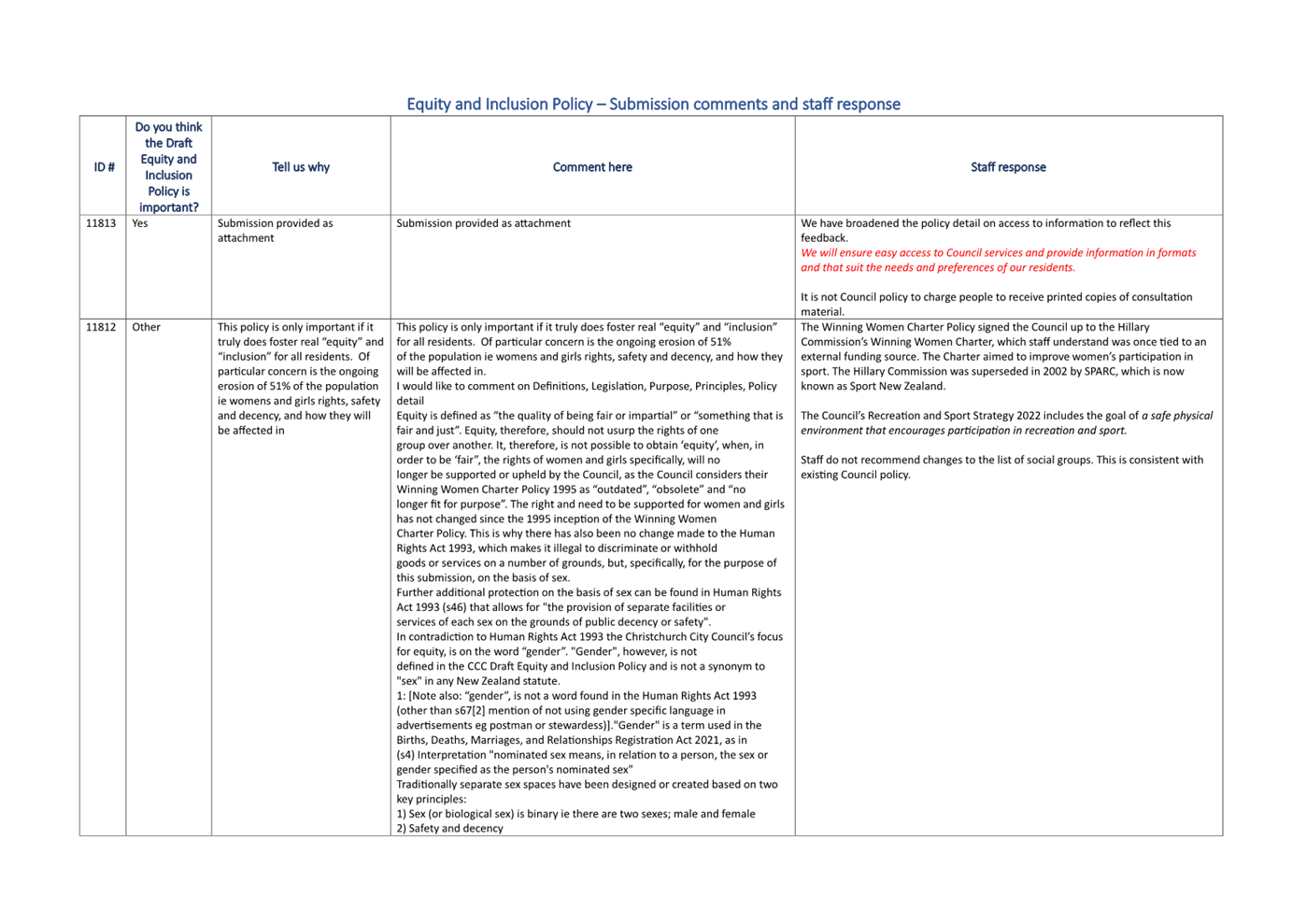
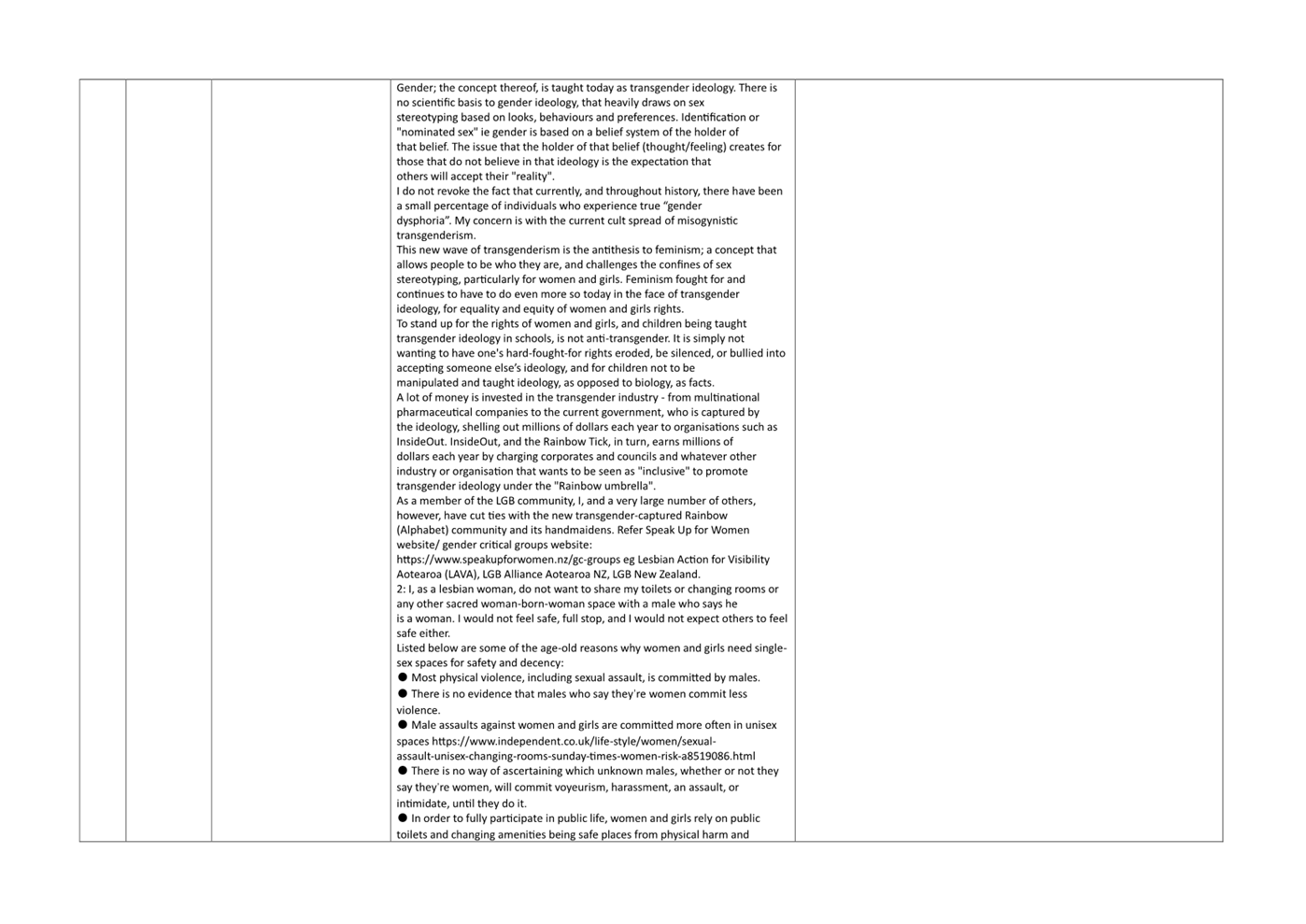
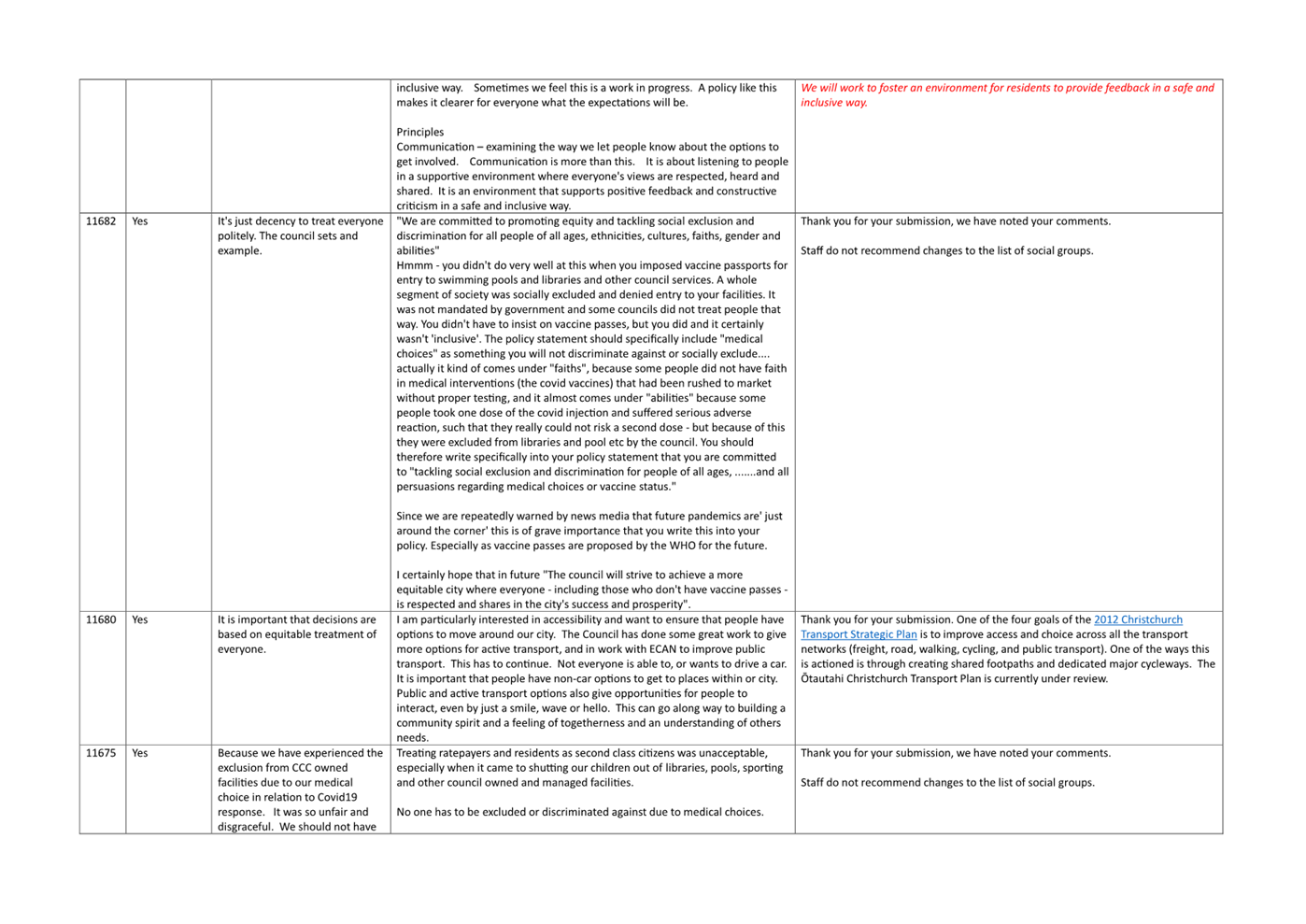
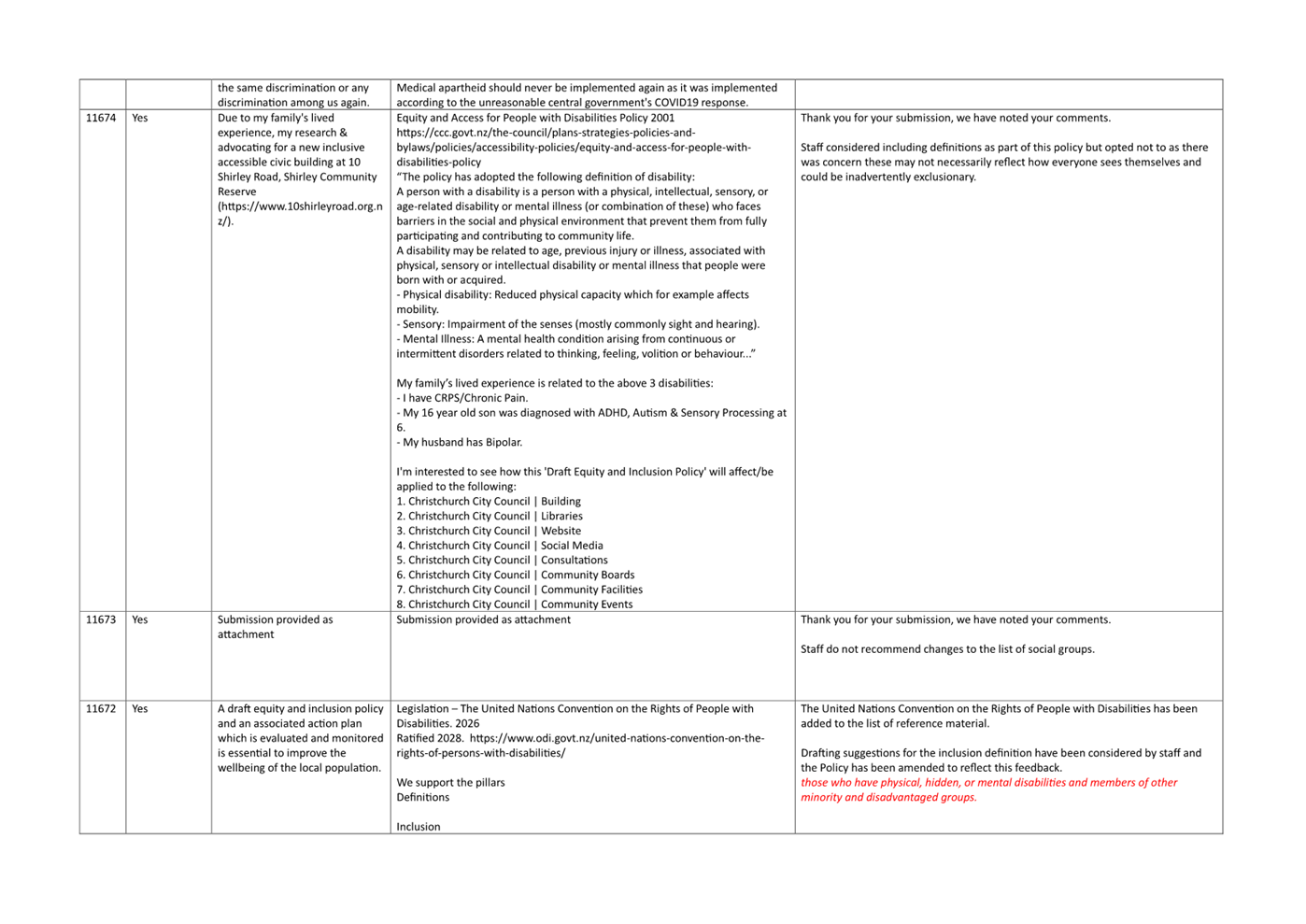
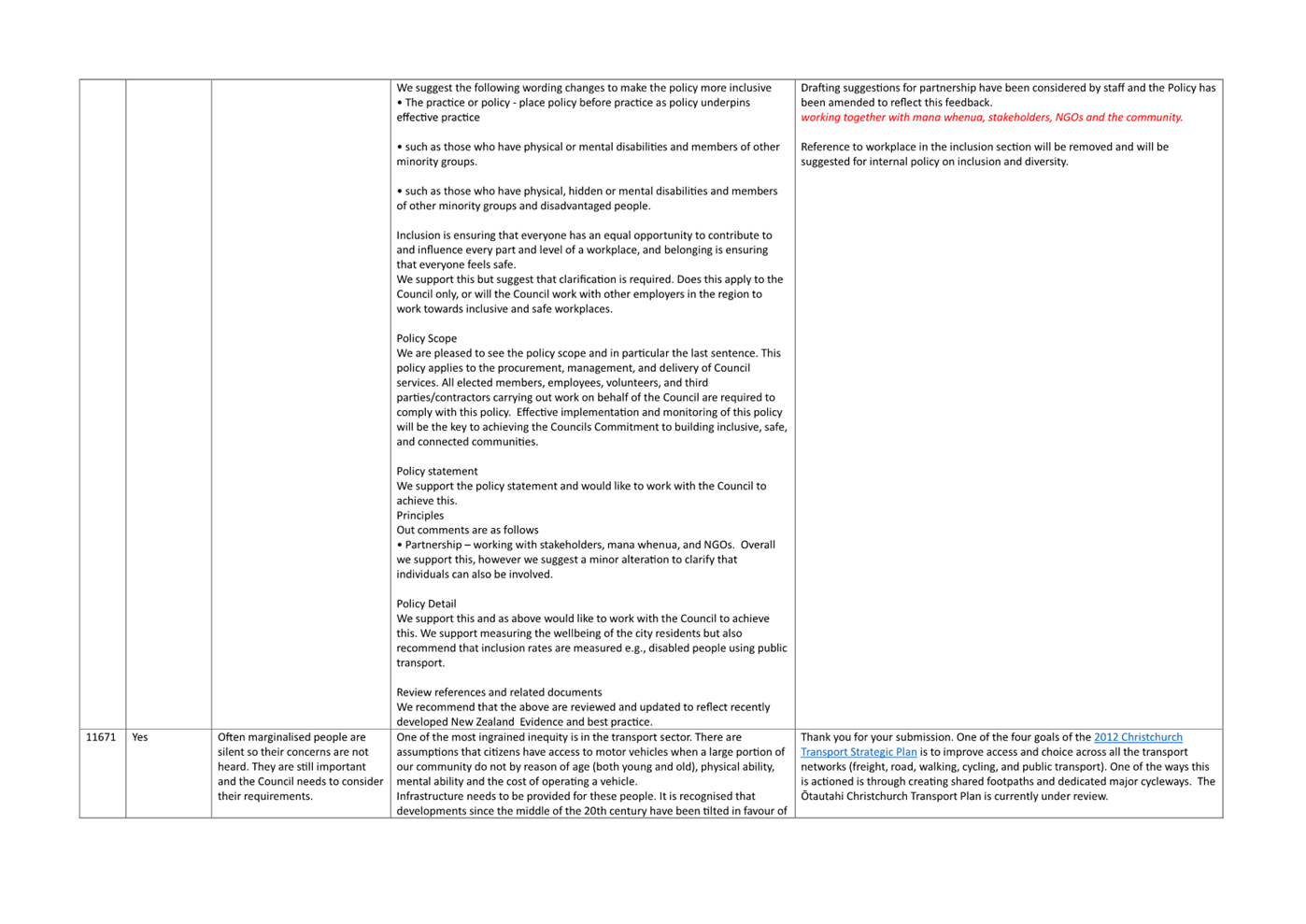
9.3.3 Attachment
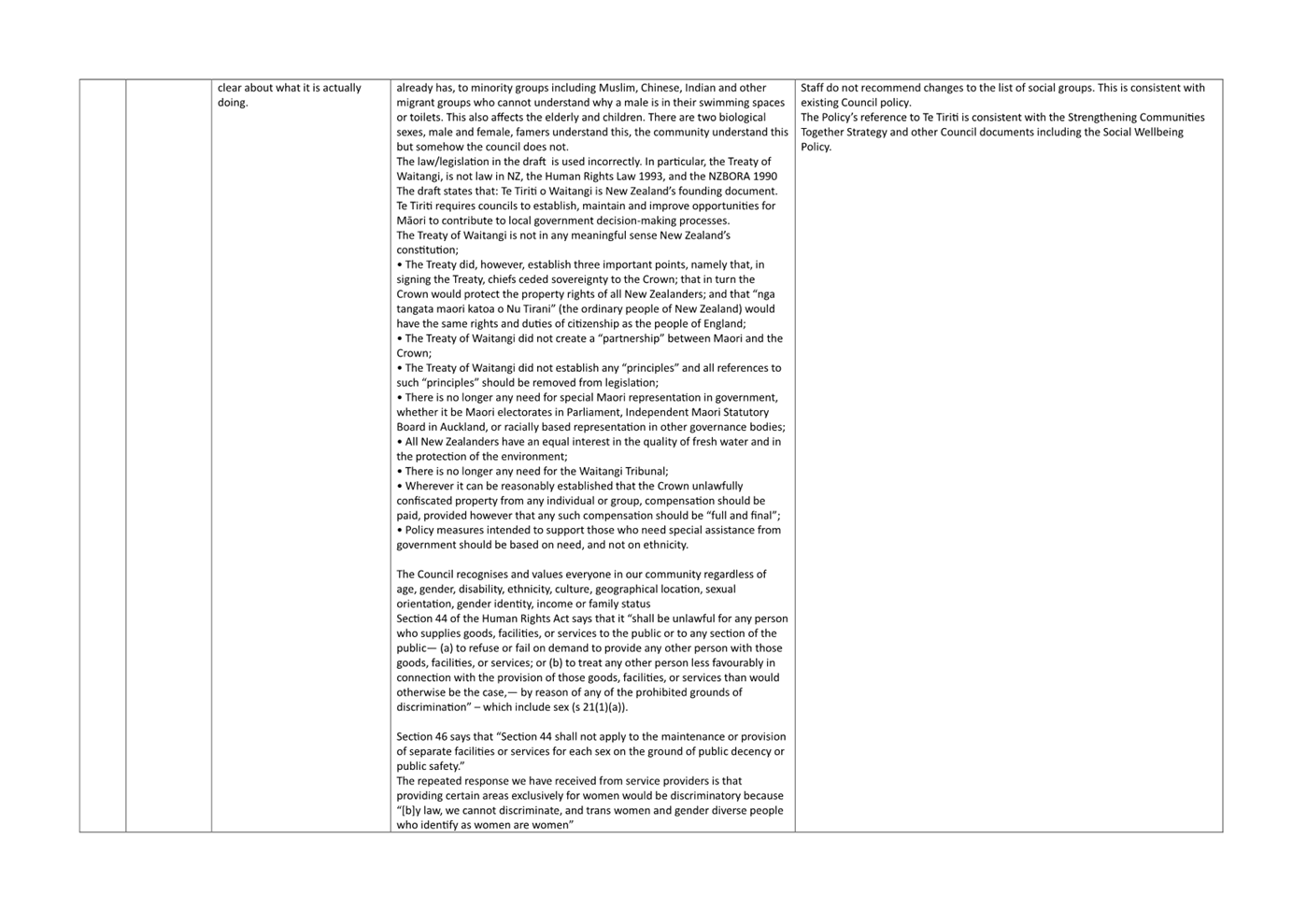
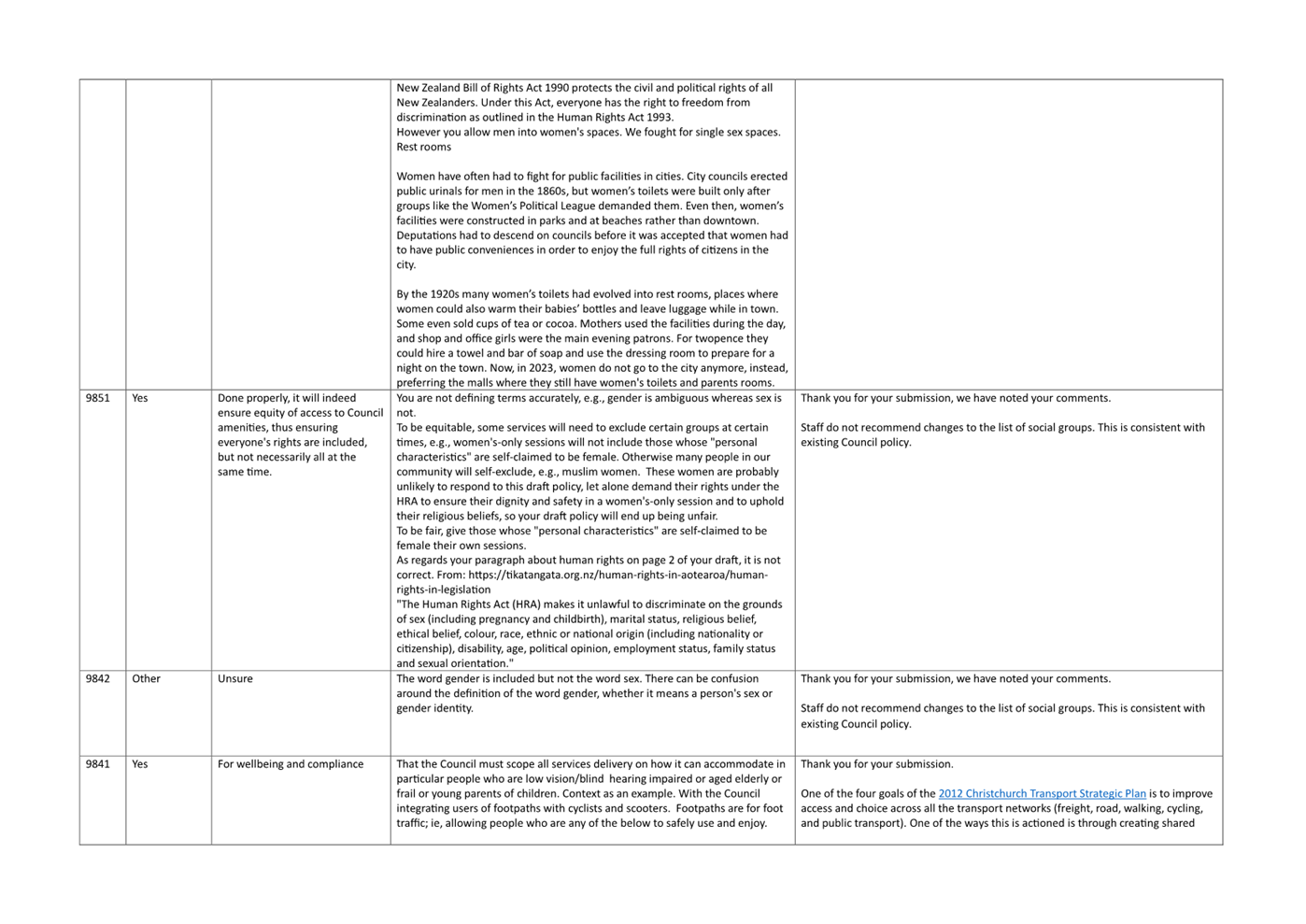
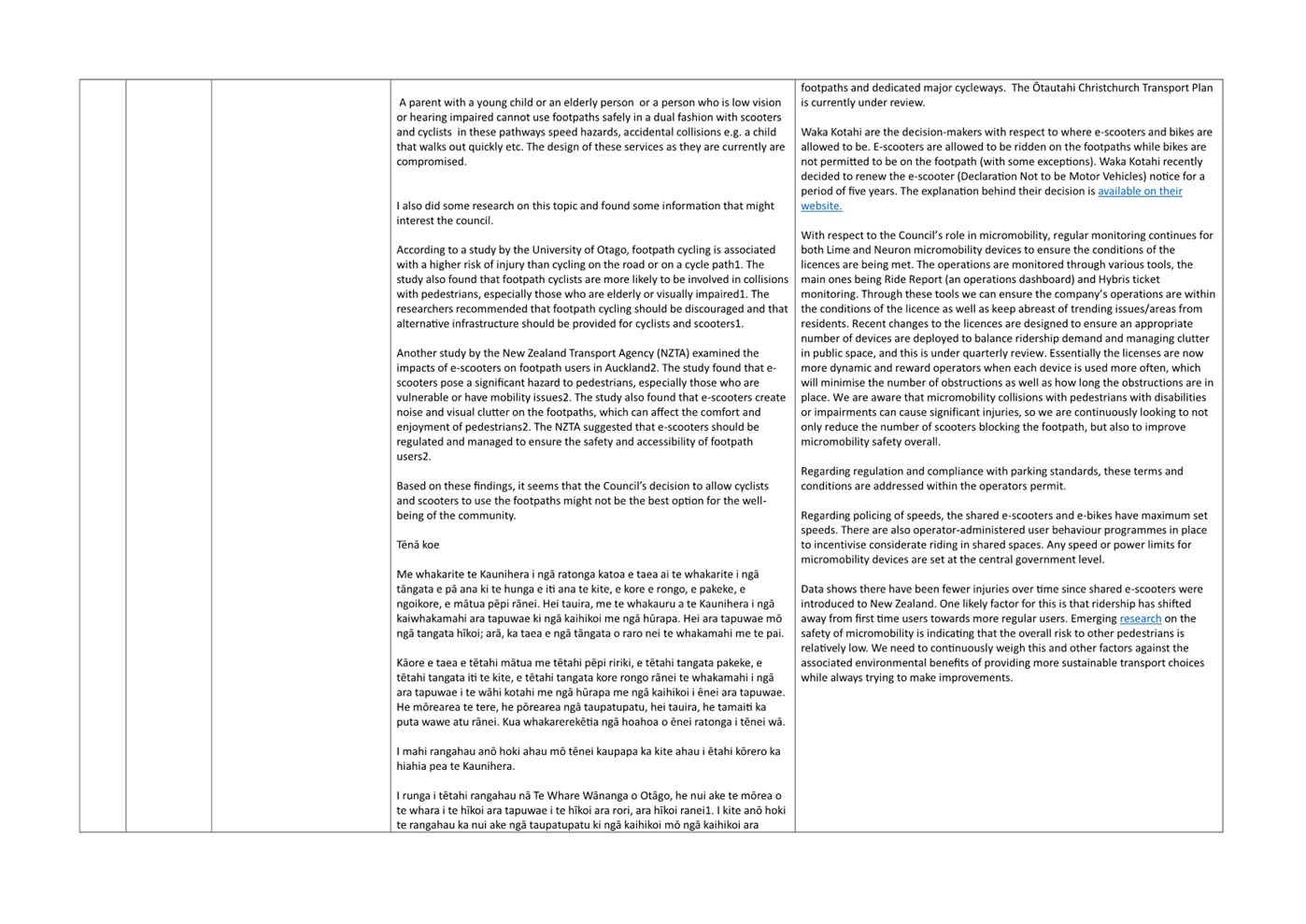
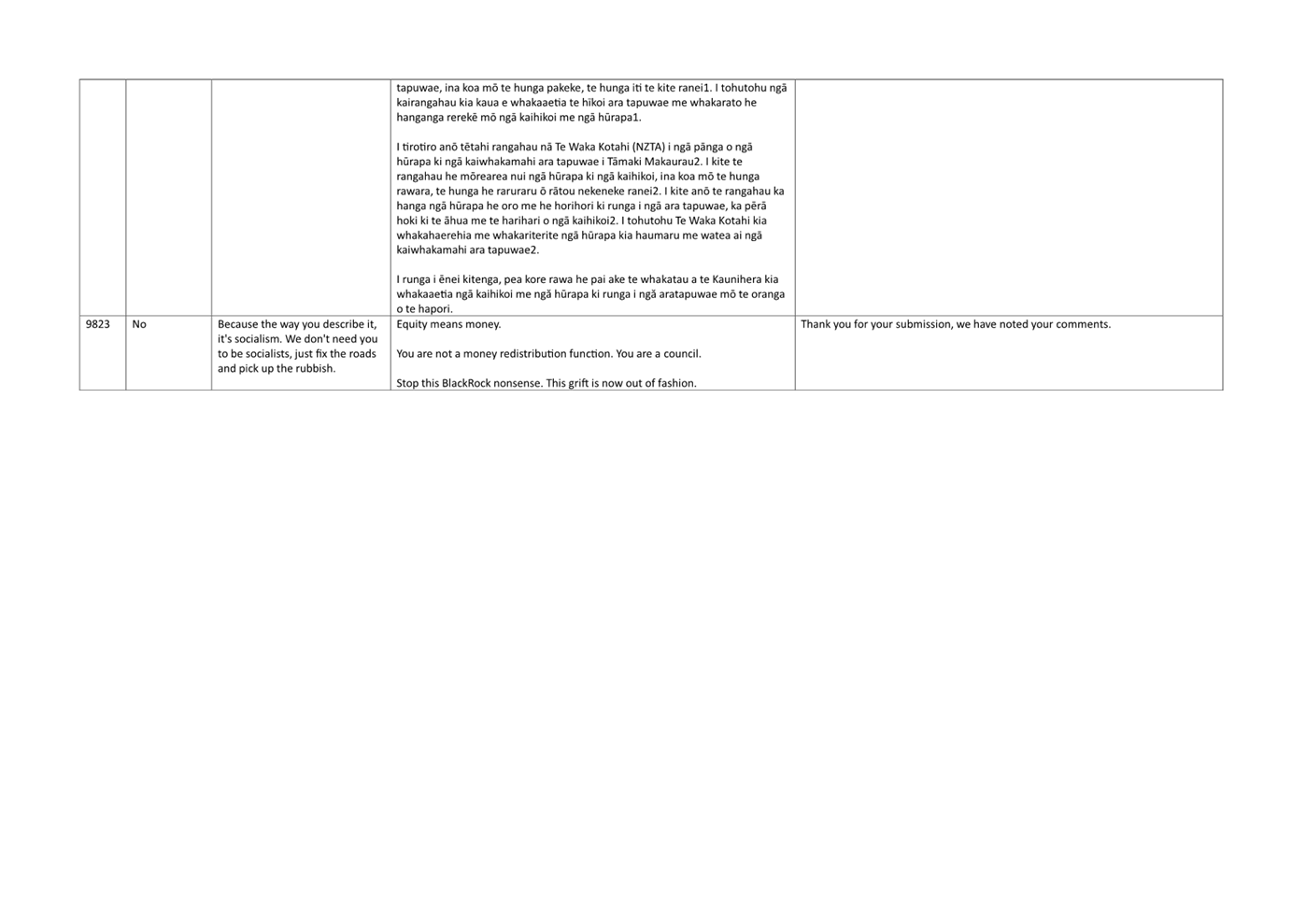
C collates the staff response to each submission and identifies where
changes have been made as a result of the feedback.
Definitions
9.4 Five
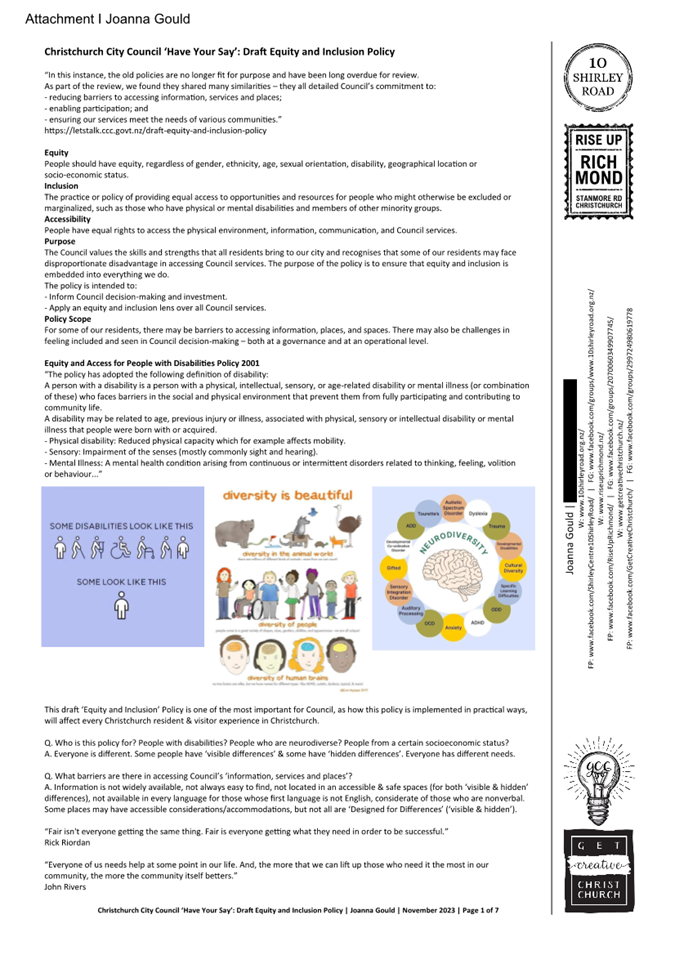
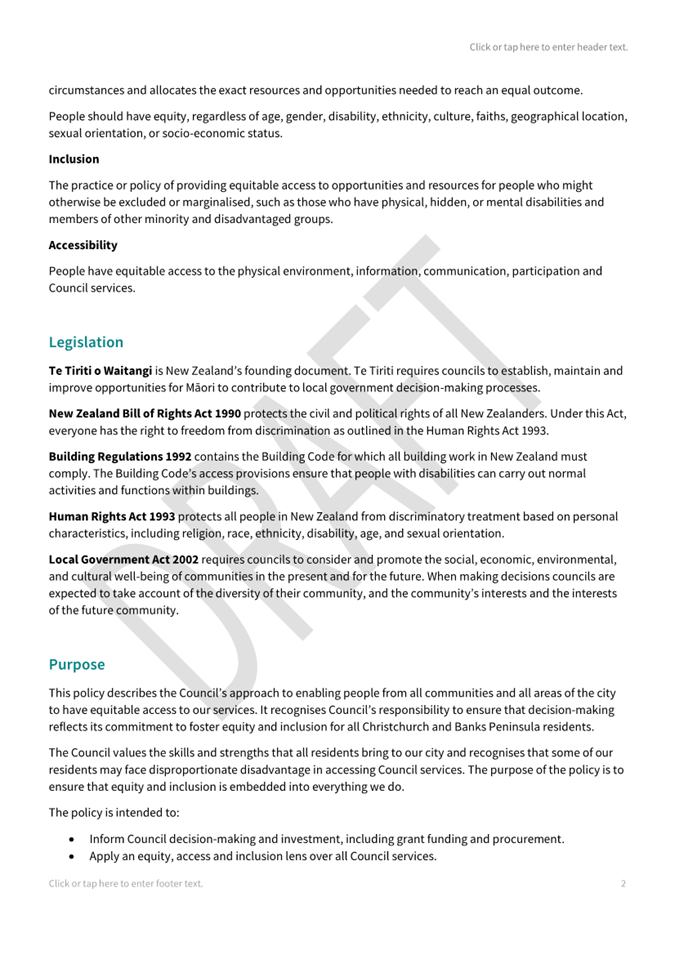
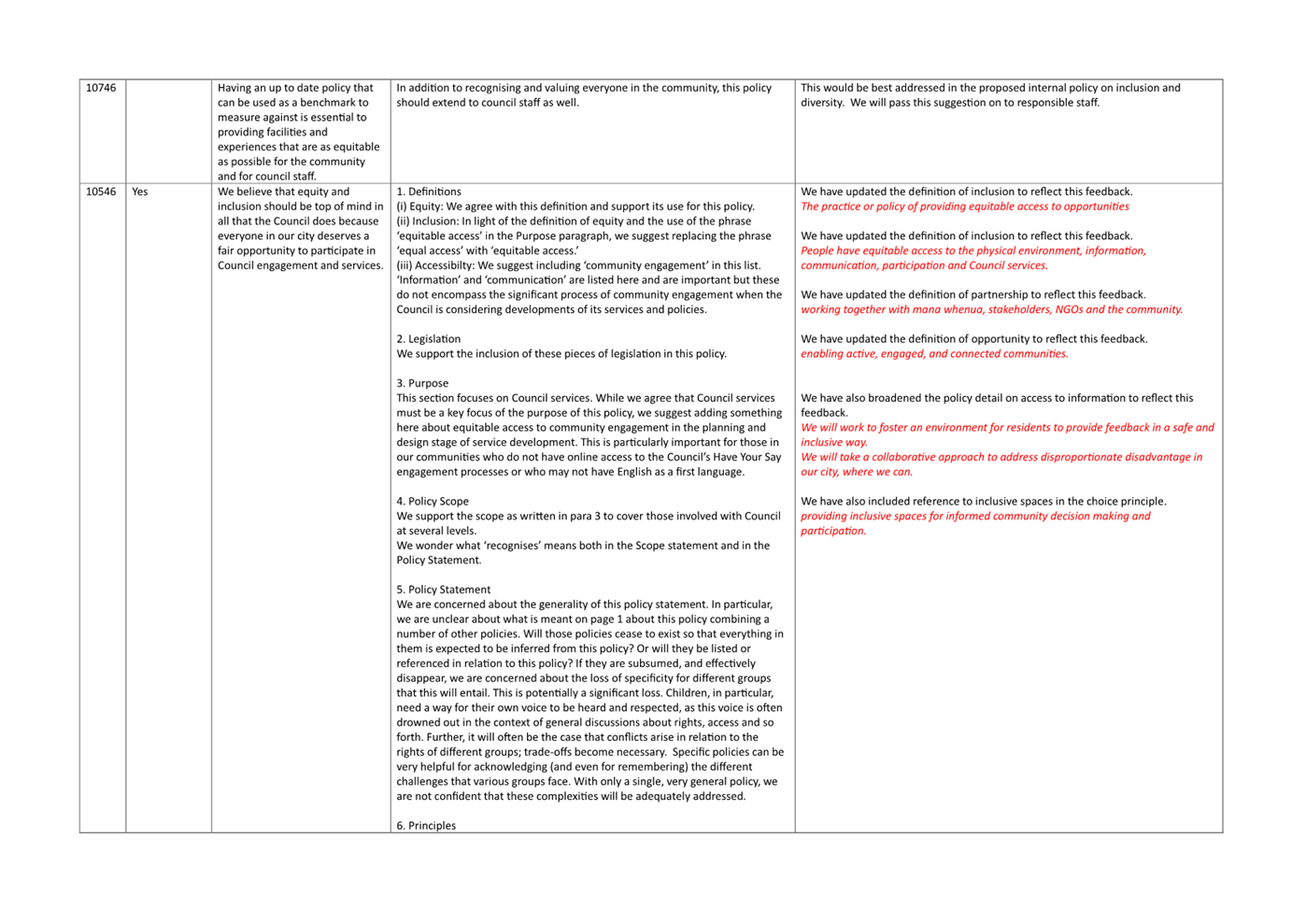
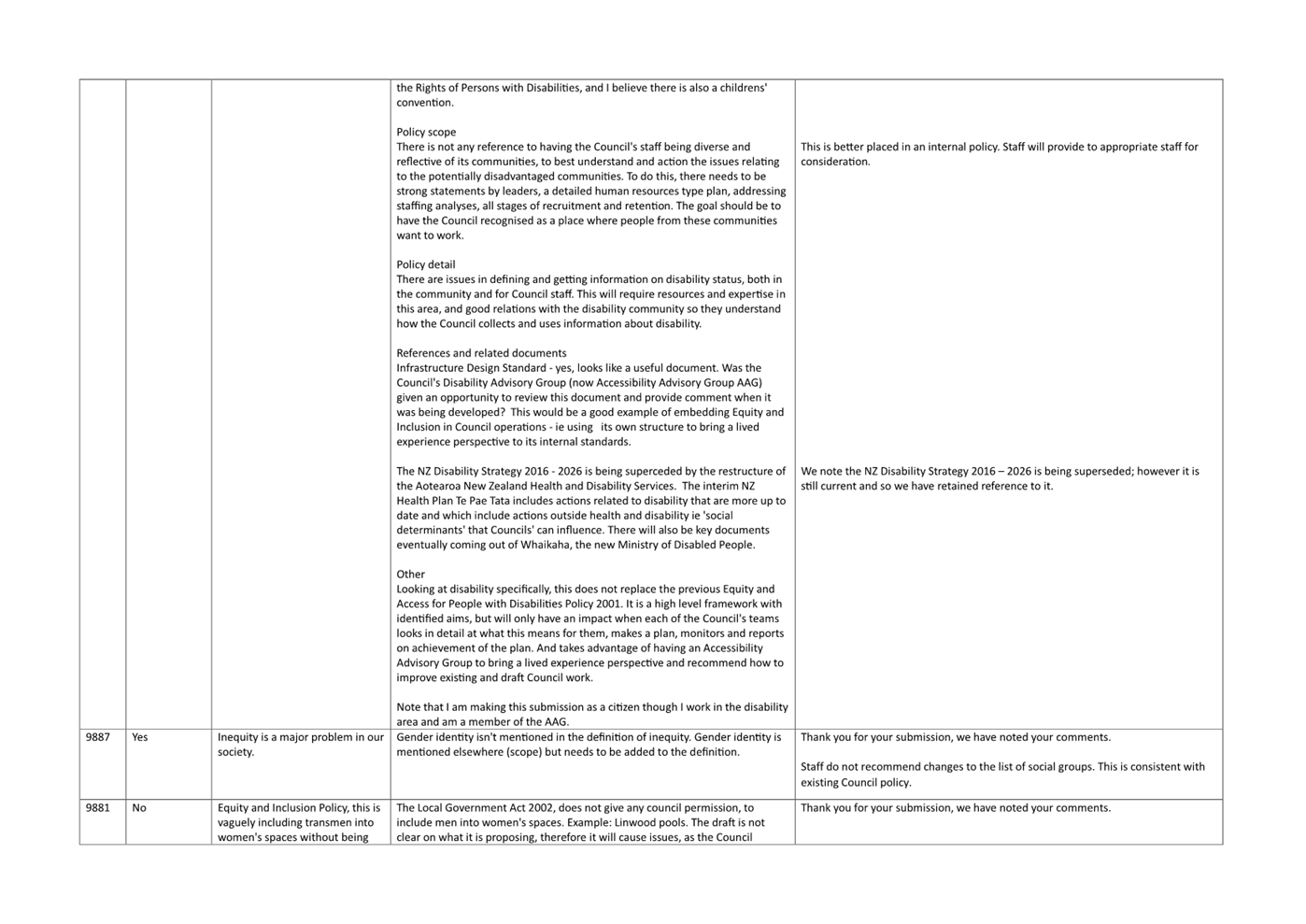
submitters suggested changes to the definitions of equity, inclusion, and
accessibility. Staff propose the following amendments be made to reflect their
feedback:
9.4.1 The definition
of equity be amended to be clearer and more succinct.
9.4.2 The
list of social groups be amended to ensure it is consistent across the
document.
9.4.3 The
definition of inclusion be amended to reference those with hidden disabilities
and disadvantaged groups.
9.4.4 The
accessibility definition be amended to include access to participation and to
reflect the change made to the equity definition.
9.5 Eighteen
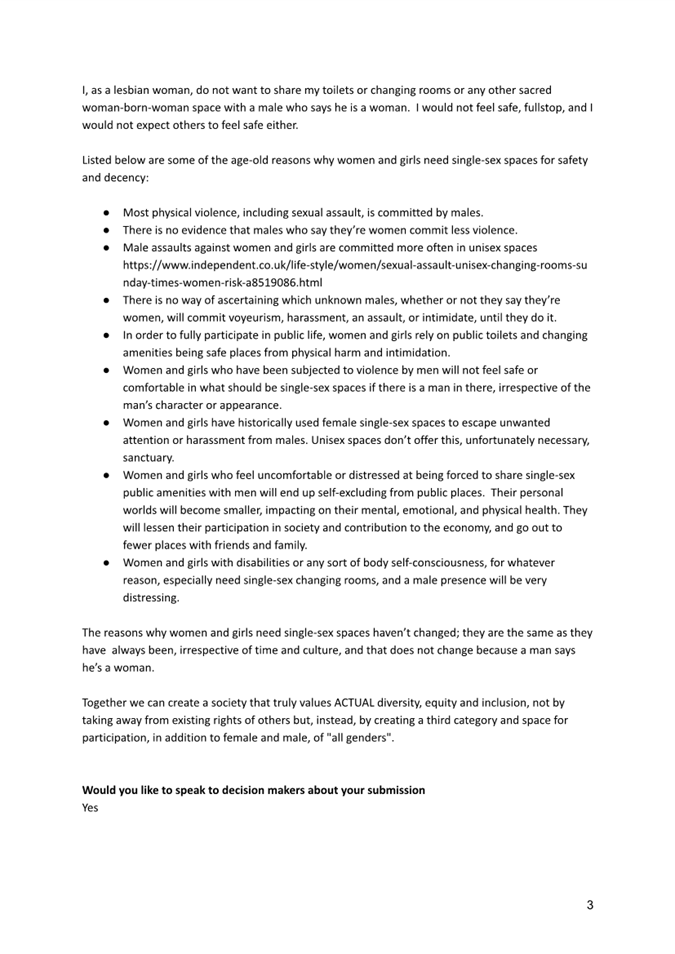
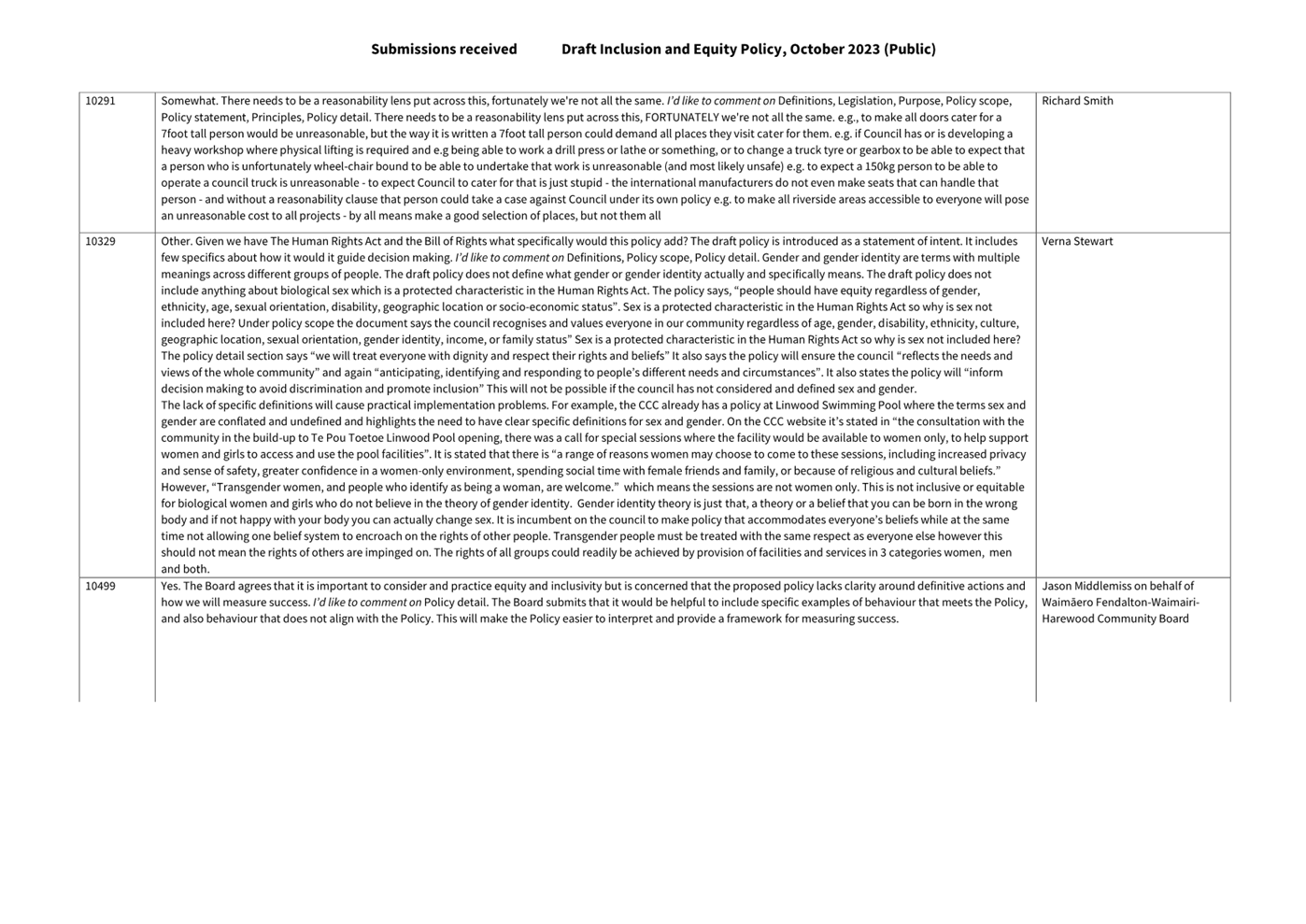
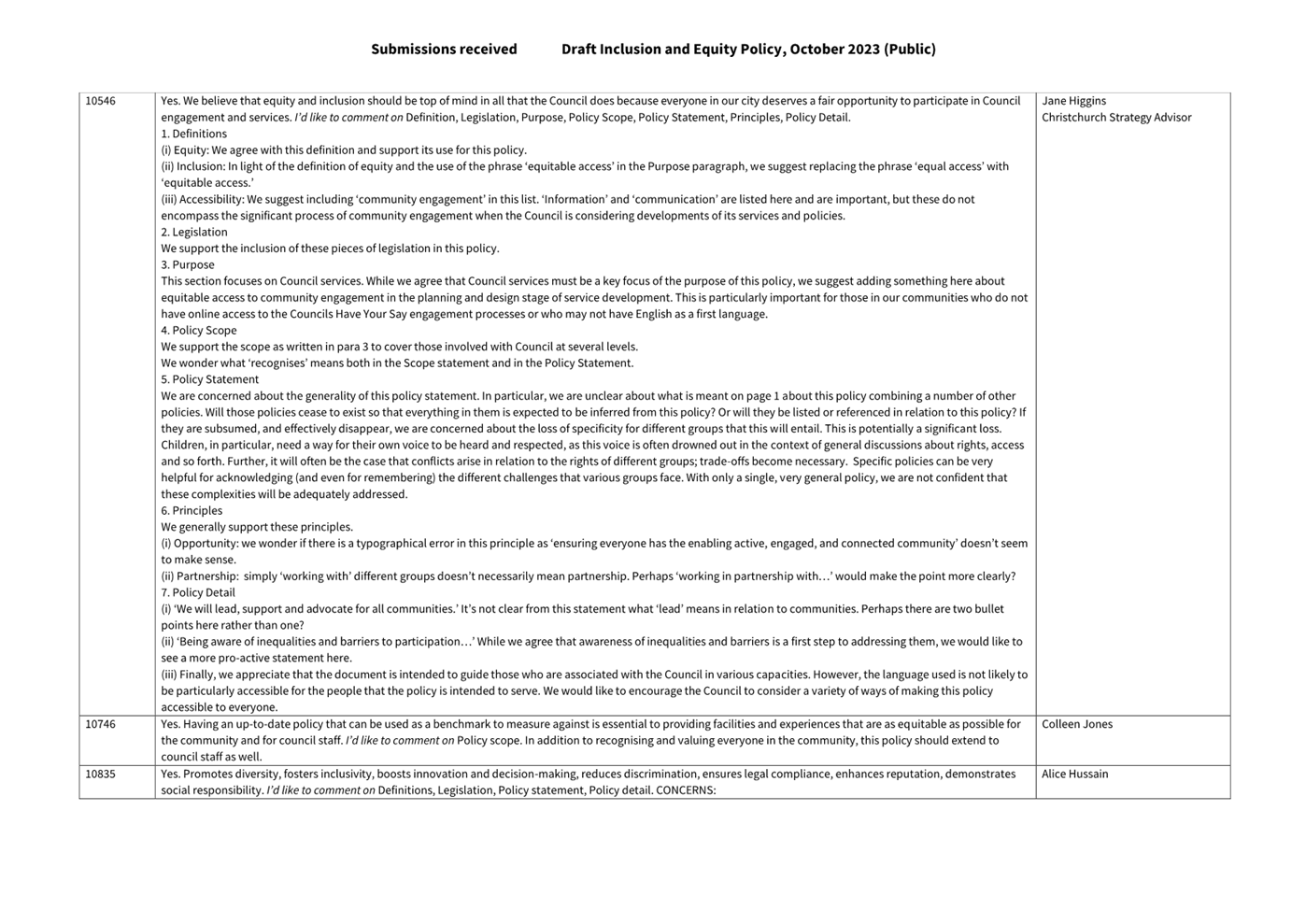
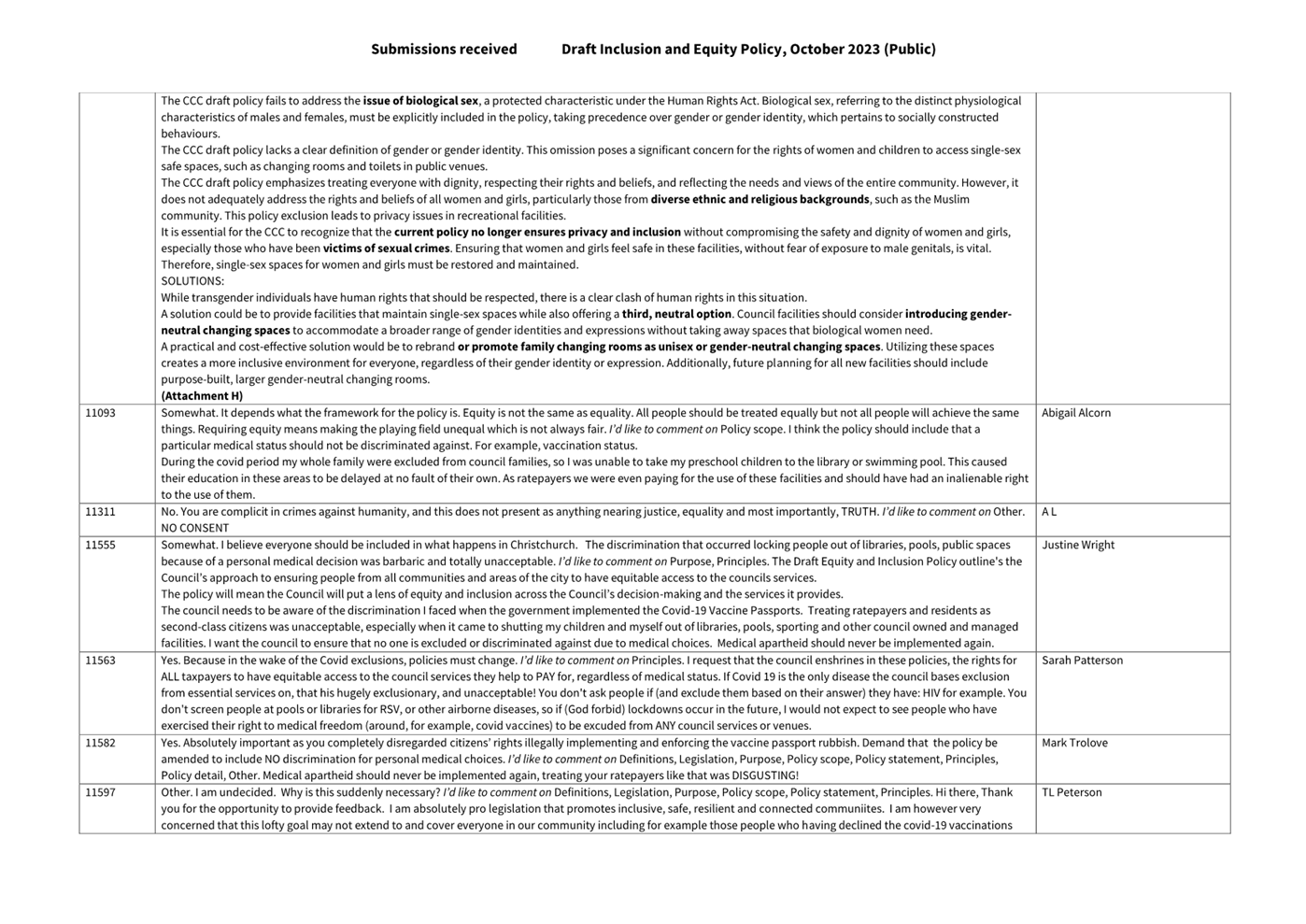
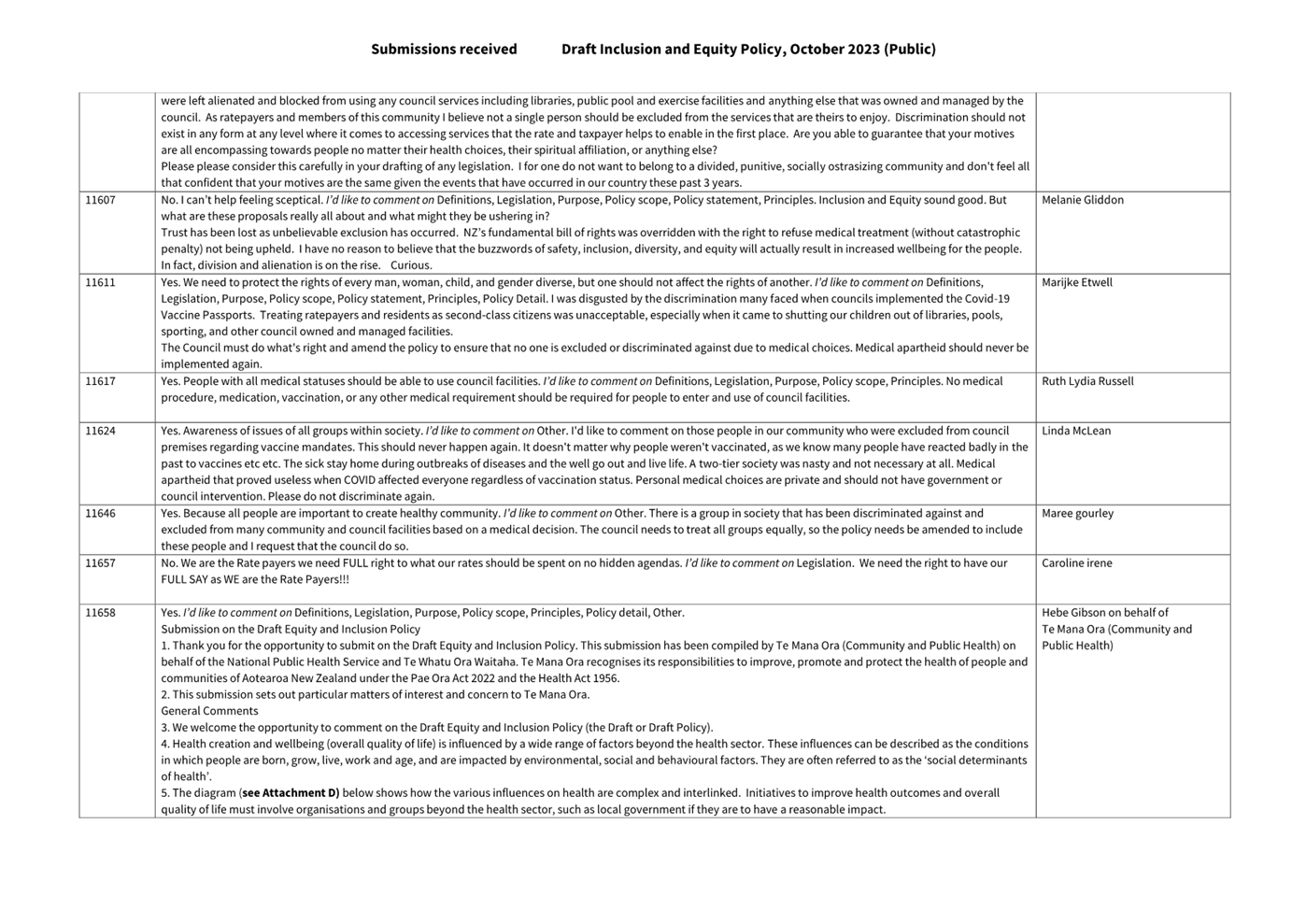
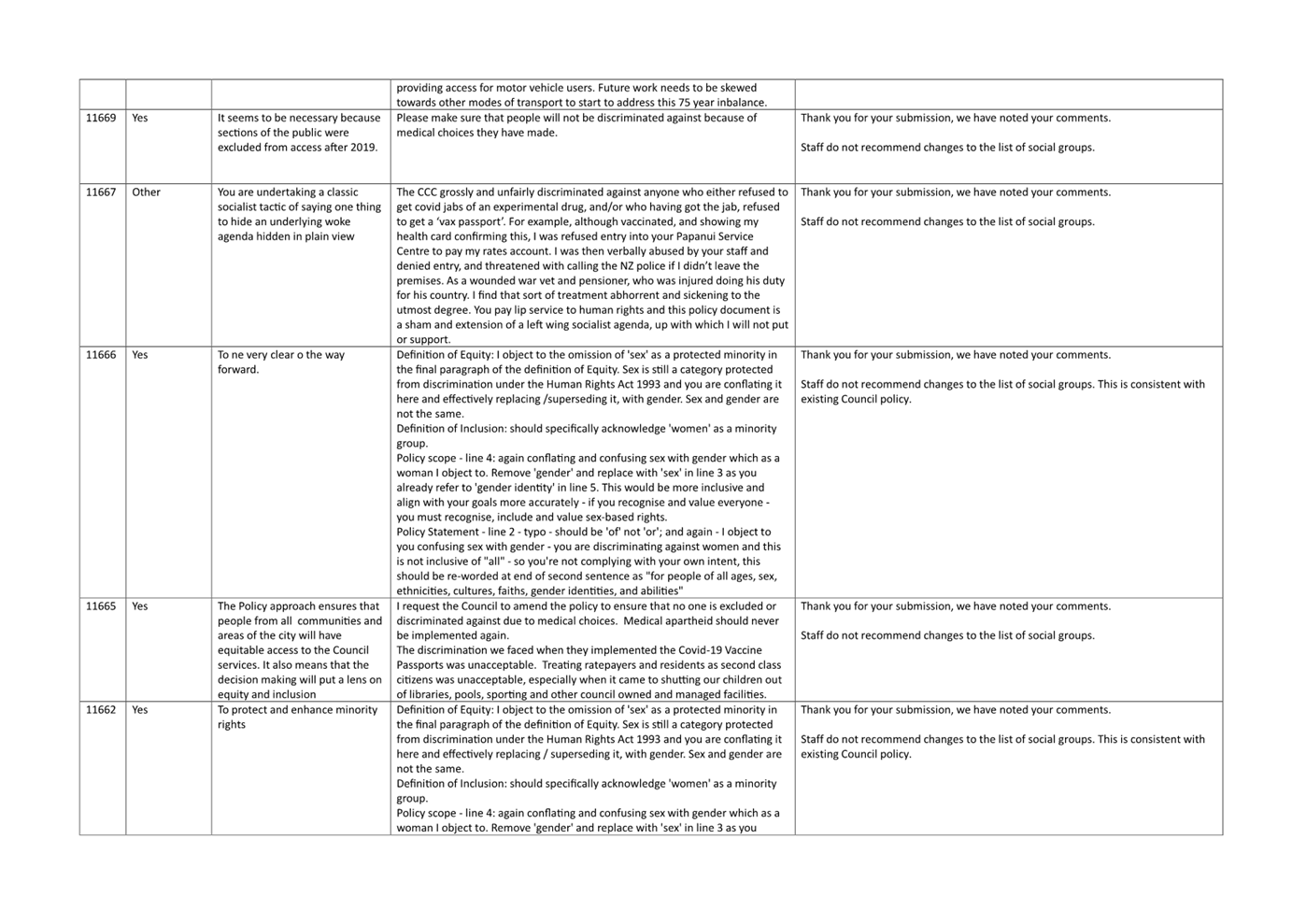
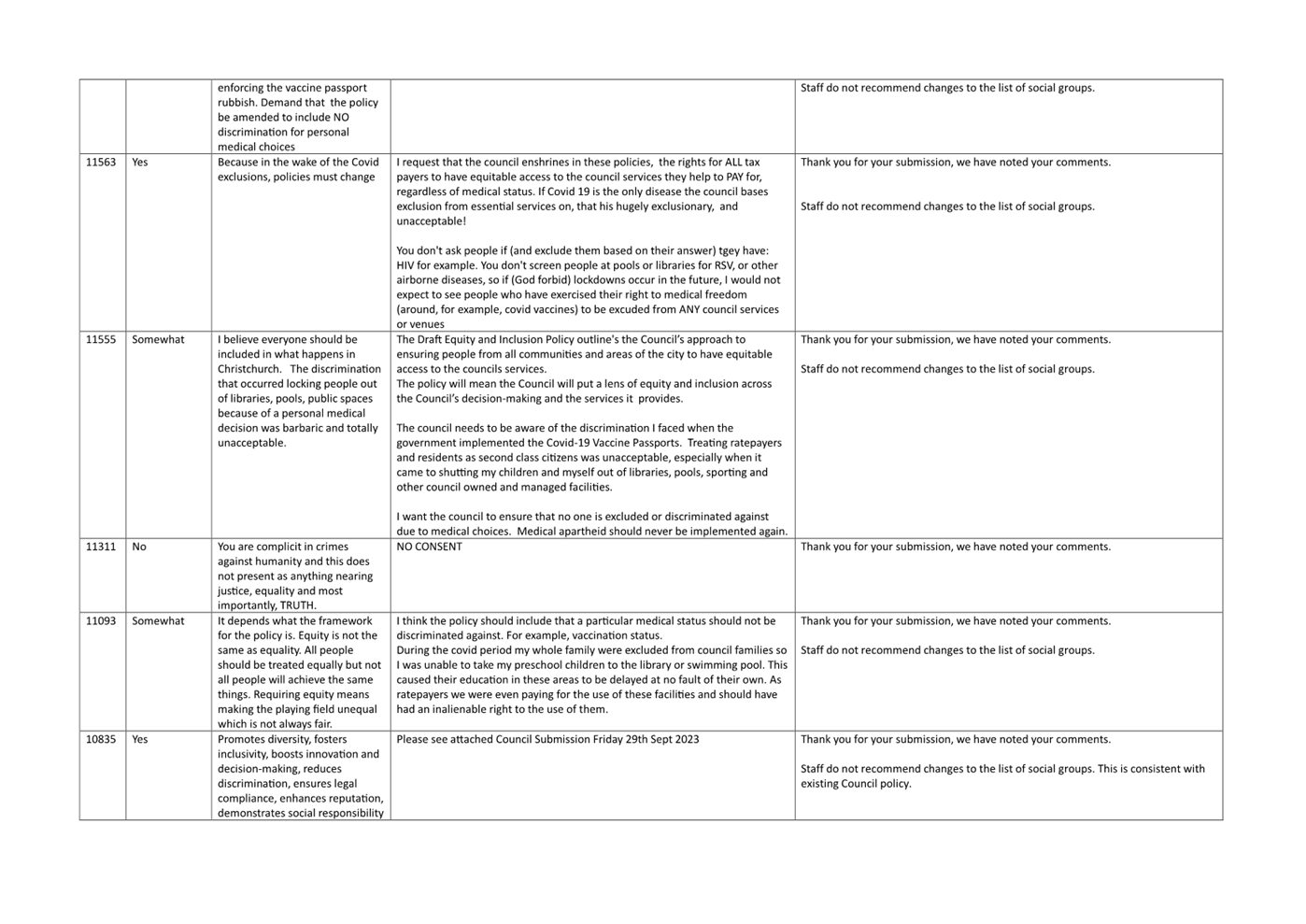
submissions were received asking that the draft Policy be amended to include
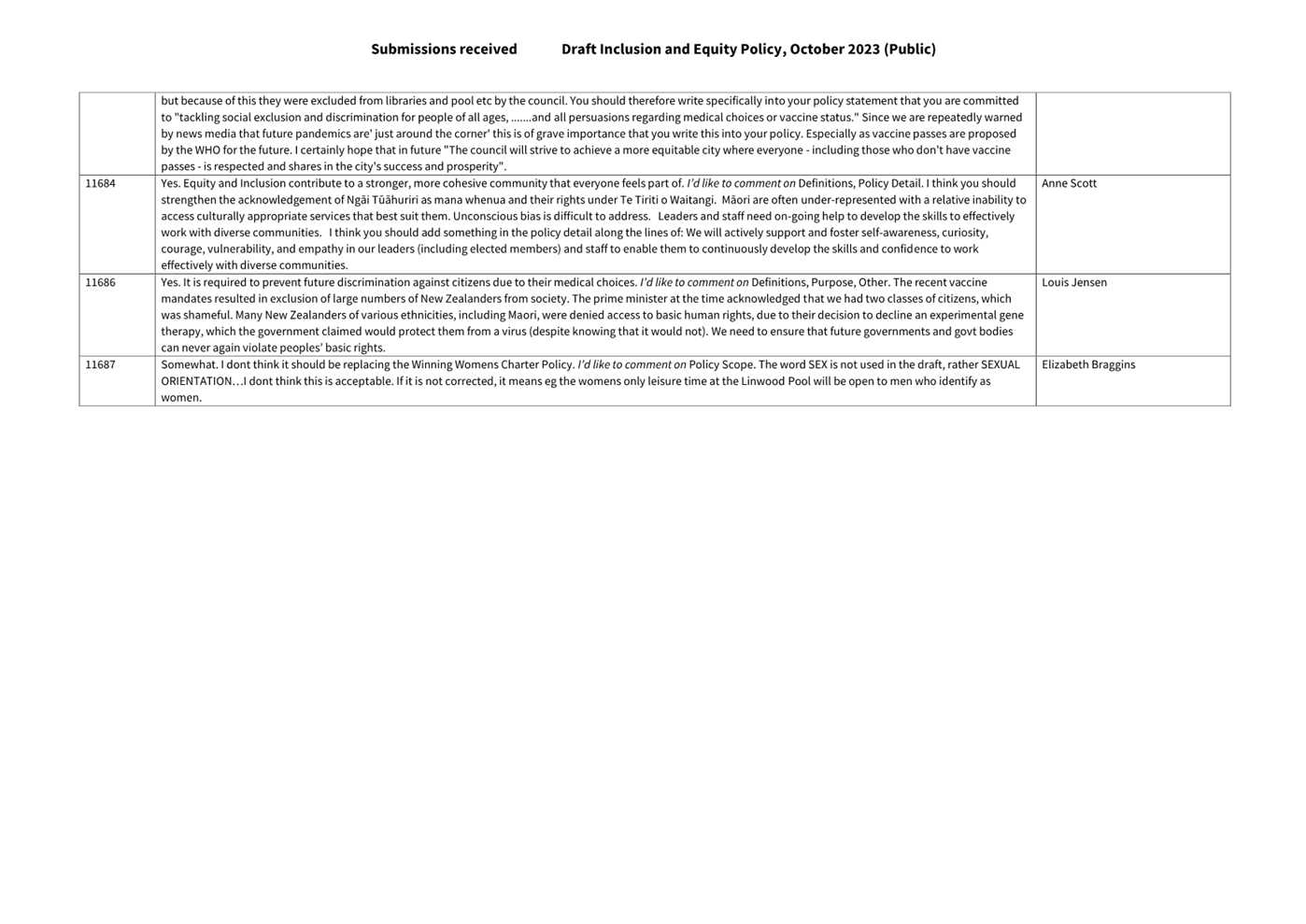
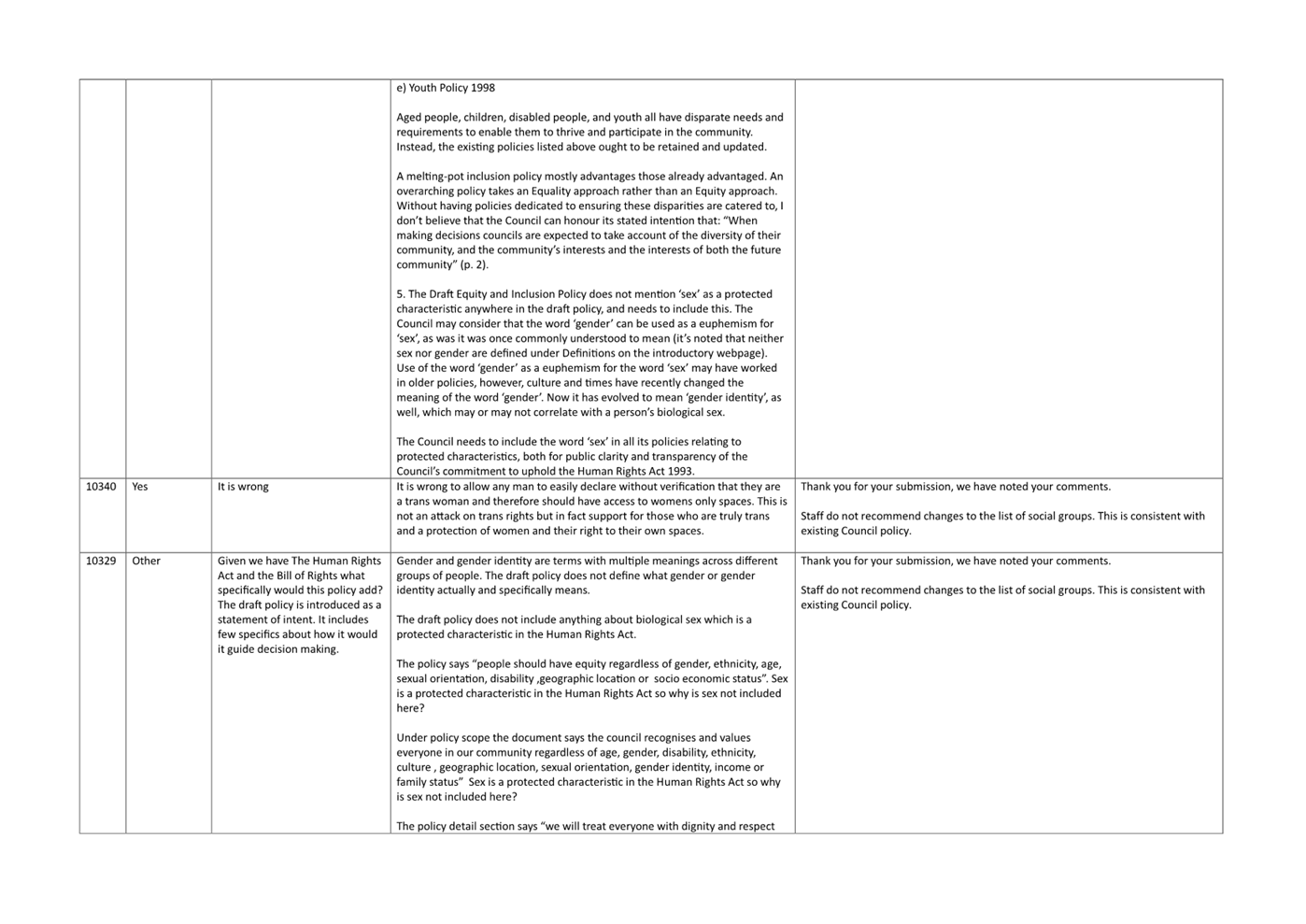
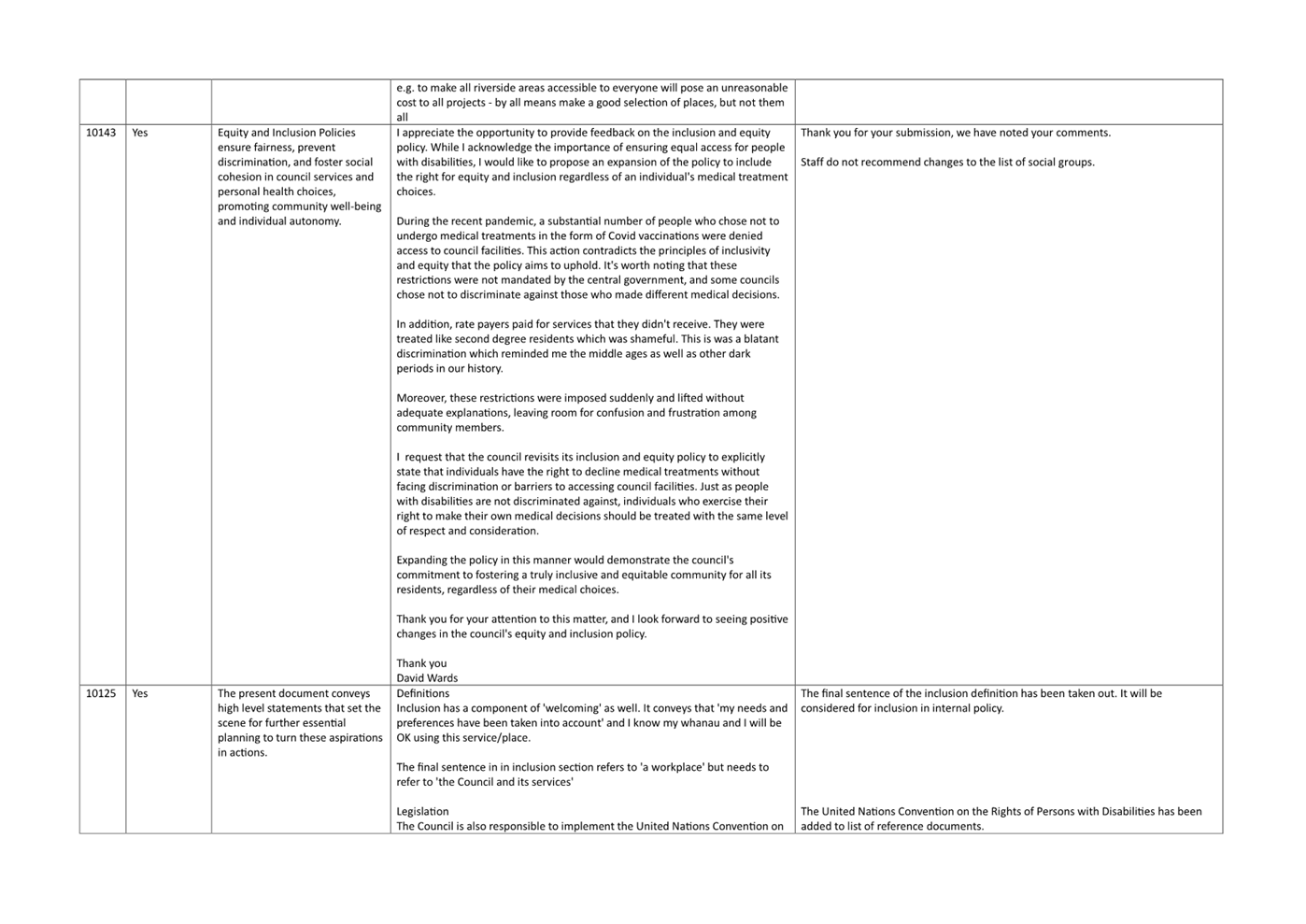
medical status or medical choice in the list of social groups. Submitters
expressed concern about those entering Council facilities being required to
show their My Vaccine Pass between December 2021 and April 2022. Staff do not
recommend changes to the Policy. The Council’s COVID-19 risk assessment
was published on the website in January 2022 and outlines the risk/benefit
assessment undertaken by the Council at the time.
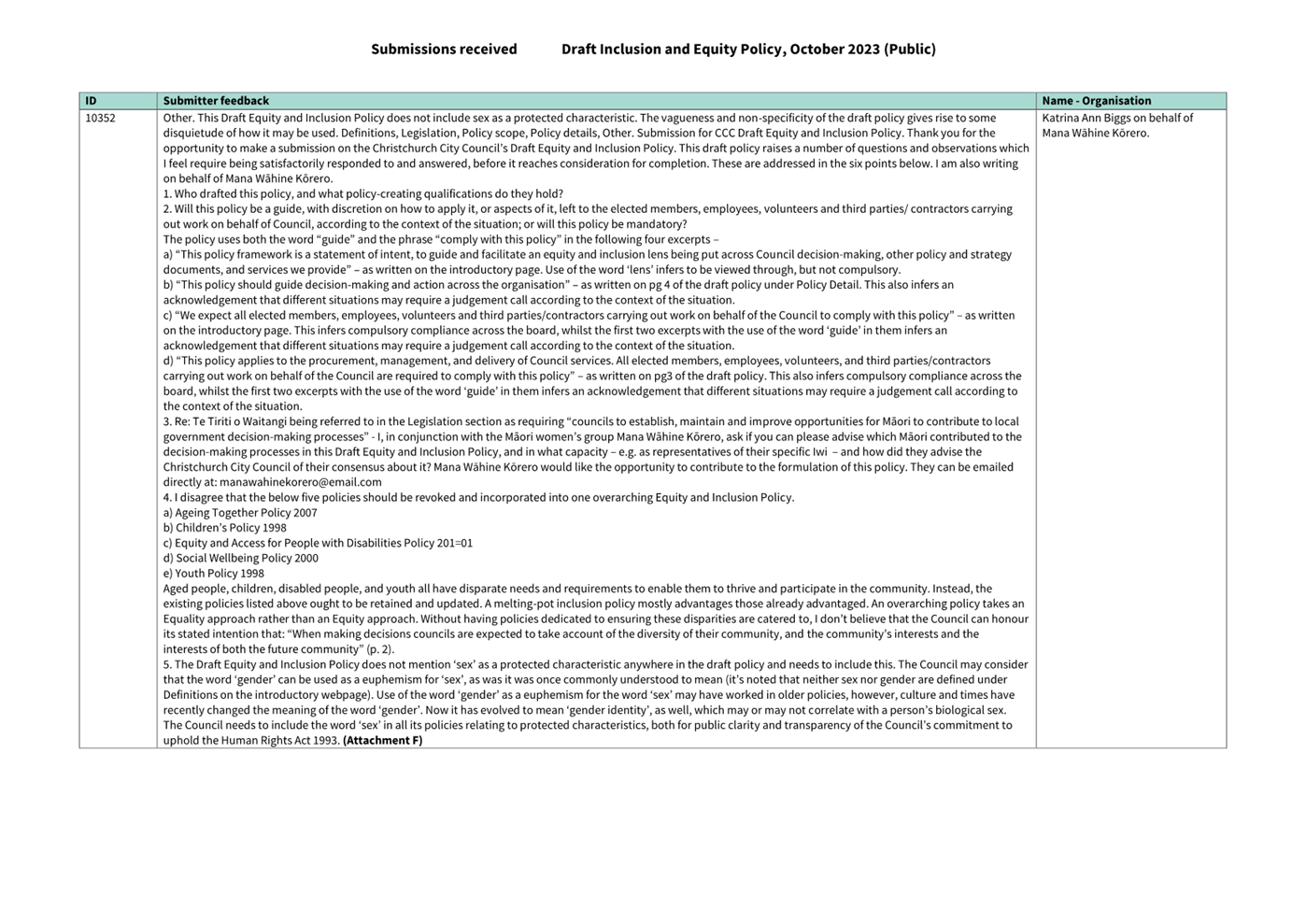
9.6 Fourteen
submissions were received asking the draft Policy to be amended to change the
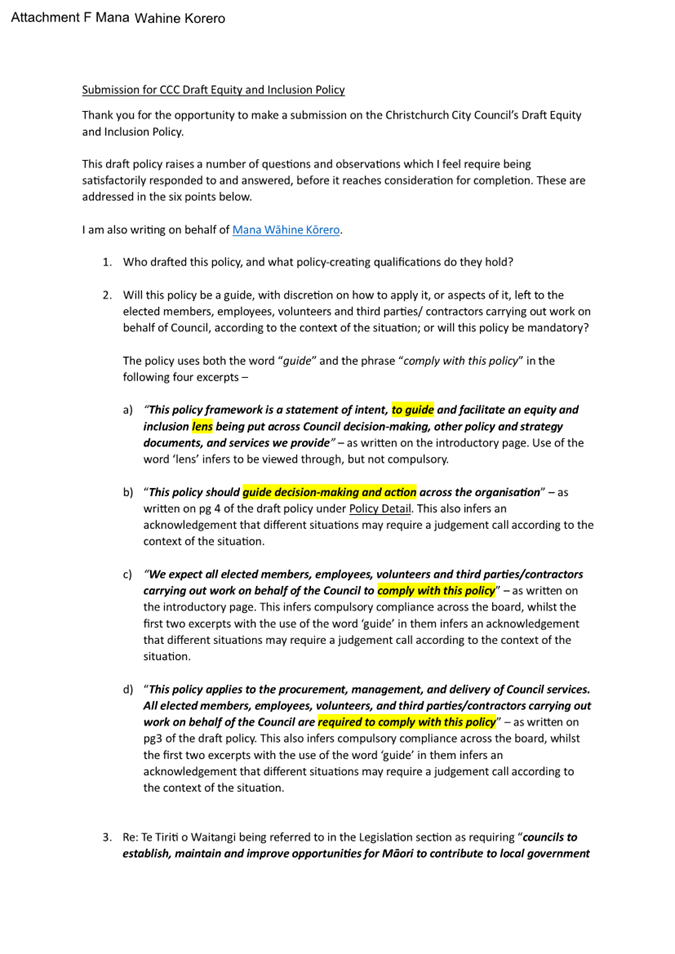
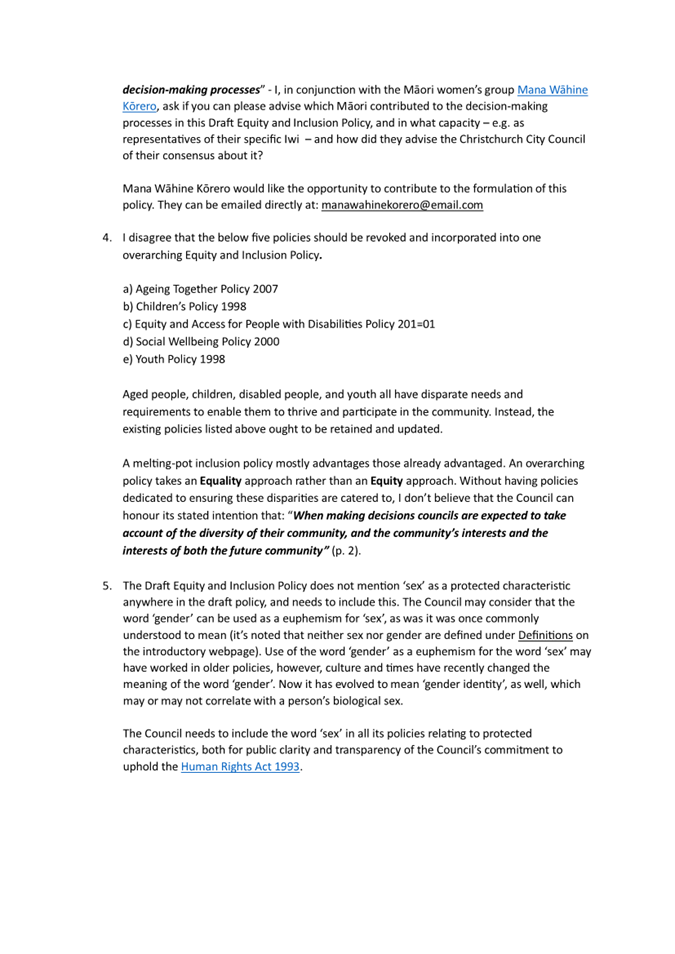
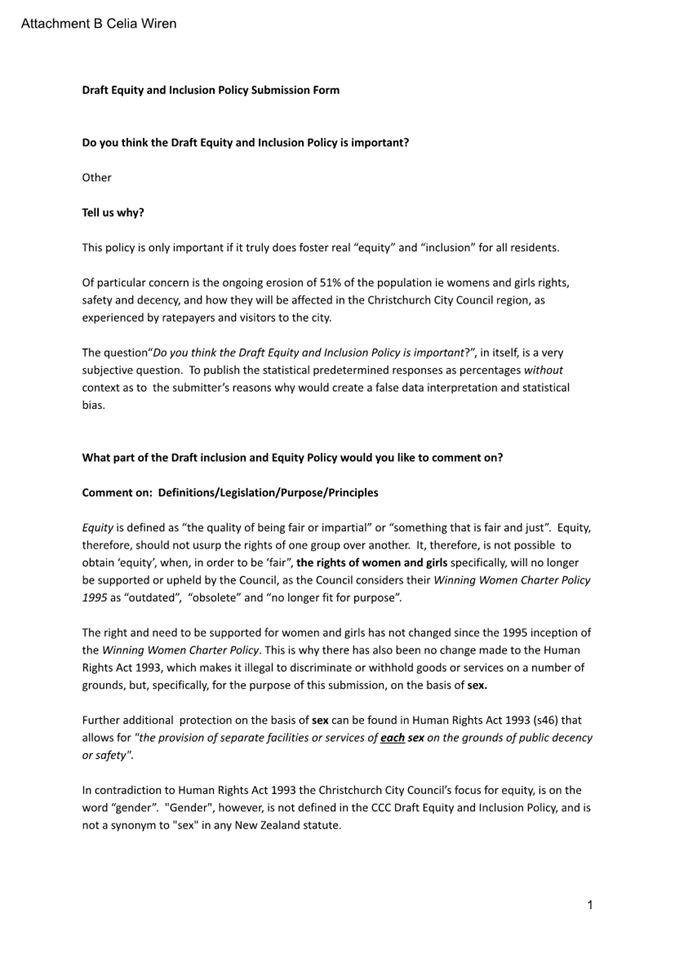
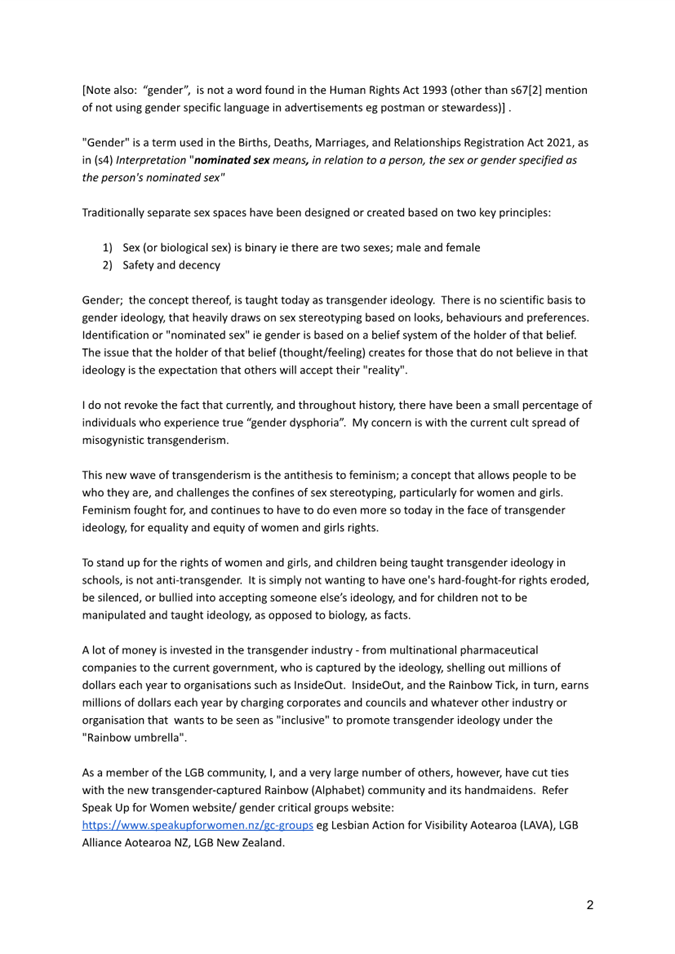
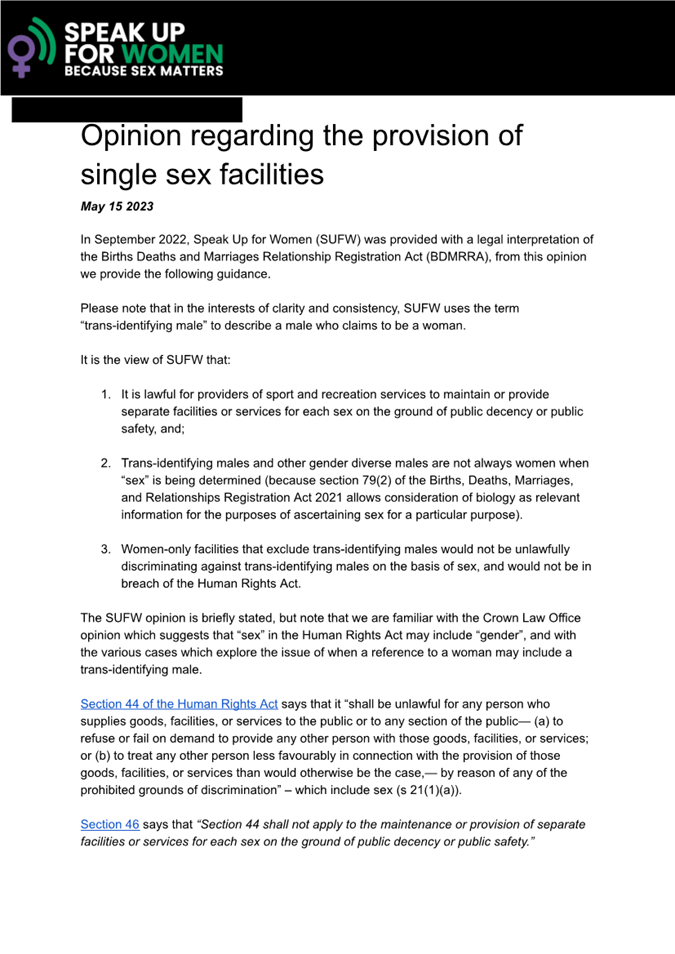
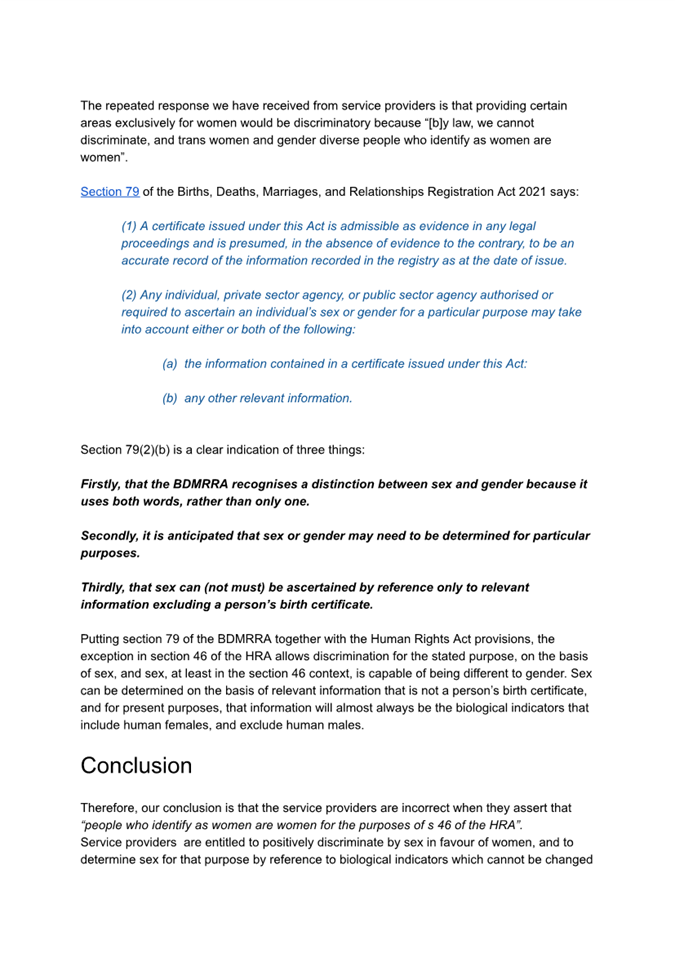
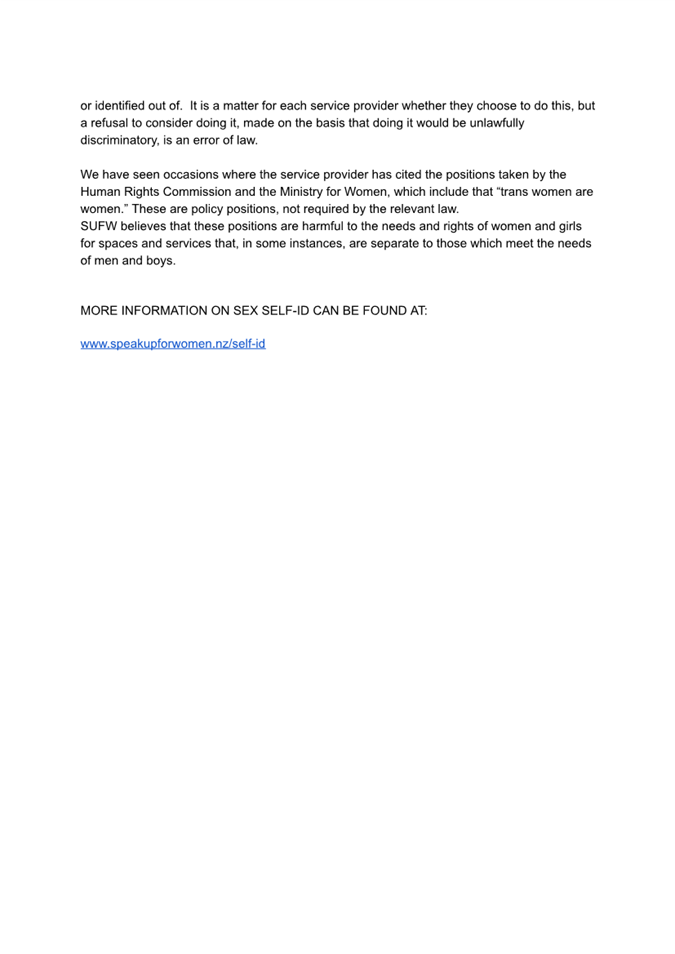
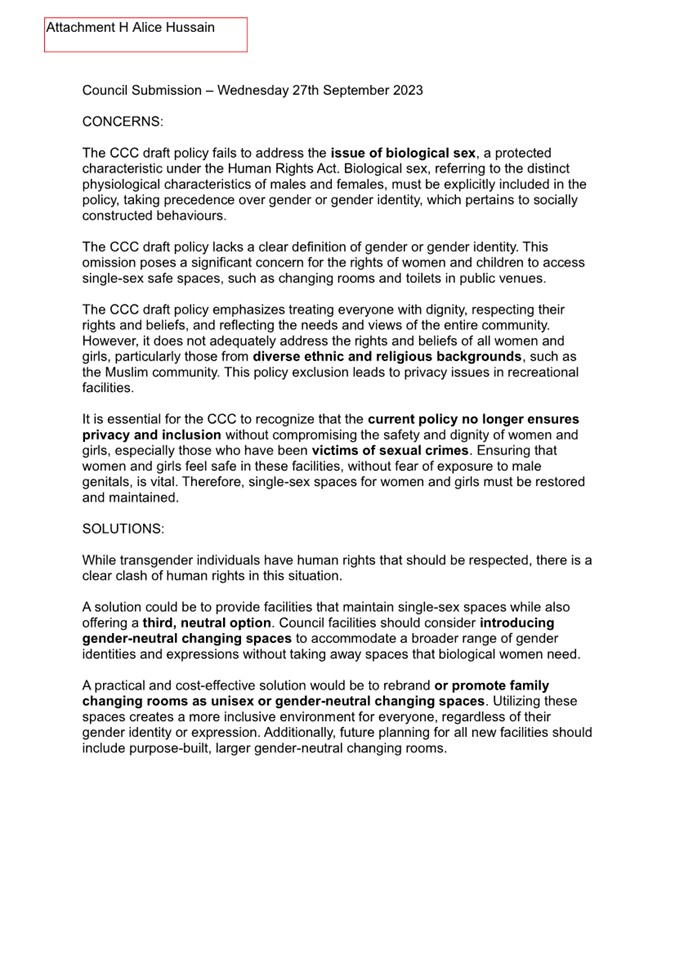
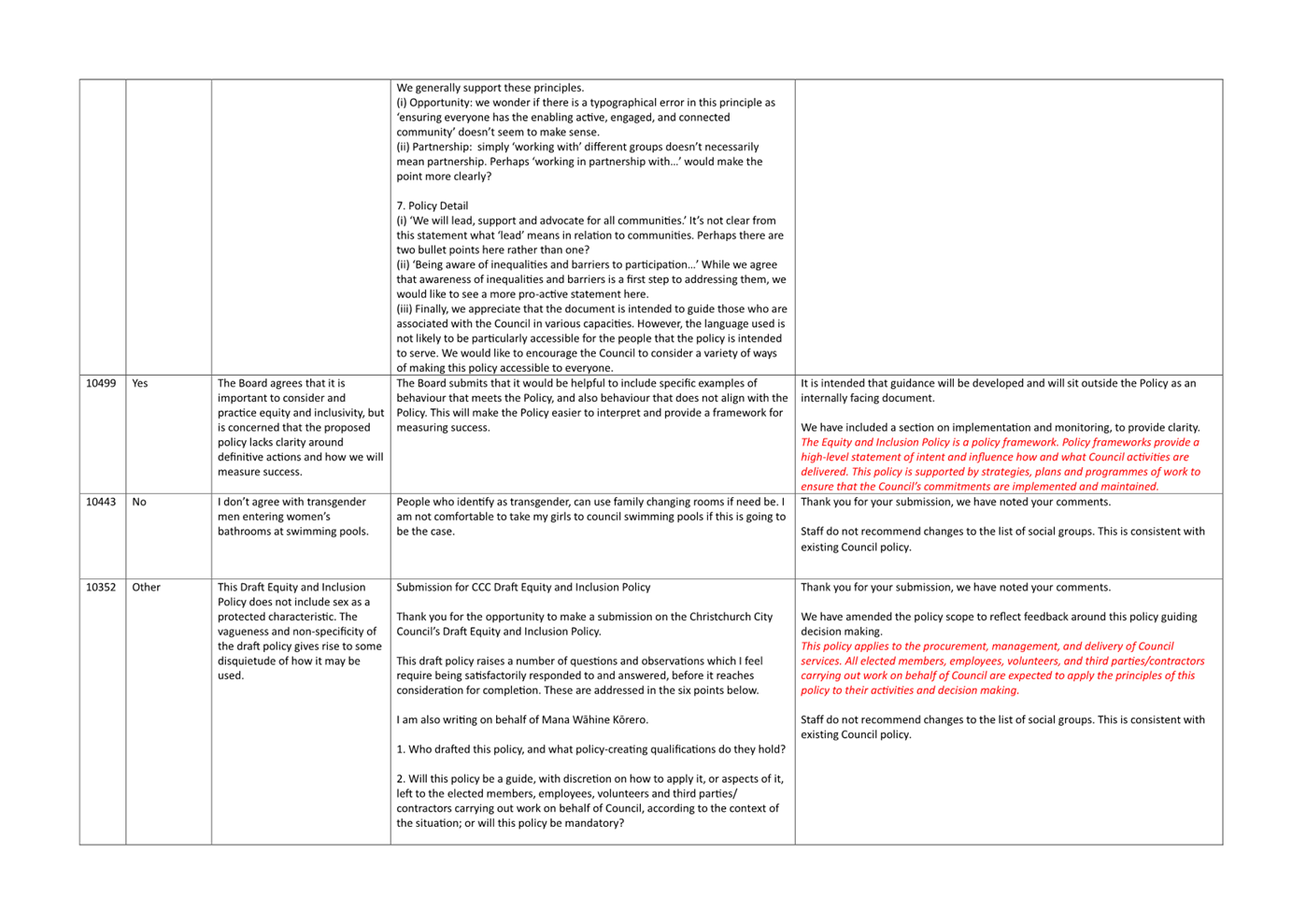
reference from ‘gender’ to ‘sex’. Staff do not
recommend this change be made to the Policy. The list of social groups is
consistent with existing Council policies and strategies. The term gender is
consistent with existing Council policy.
9.7 The
Social Wellbeing Policy includes the following principle:
“All people, no matter age, race,
gender, social and economic position or abilities, have opportunities to
contribute to society and develop their potential”.
9.8 The
current drafting is also consistent with the language used in the Strengthening
Communities Together Strategy:
“We want to understand and work
alongside the community to ensure these services and support systems are
accessible and appropriate irrespective of income, age, gender, ability,
ethnicity, religion or location”.
Purpose
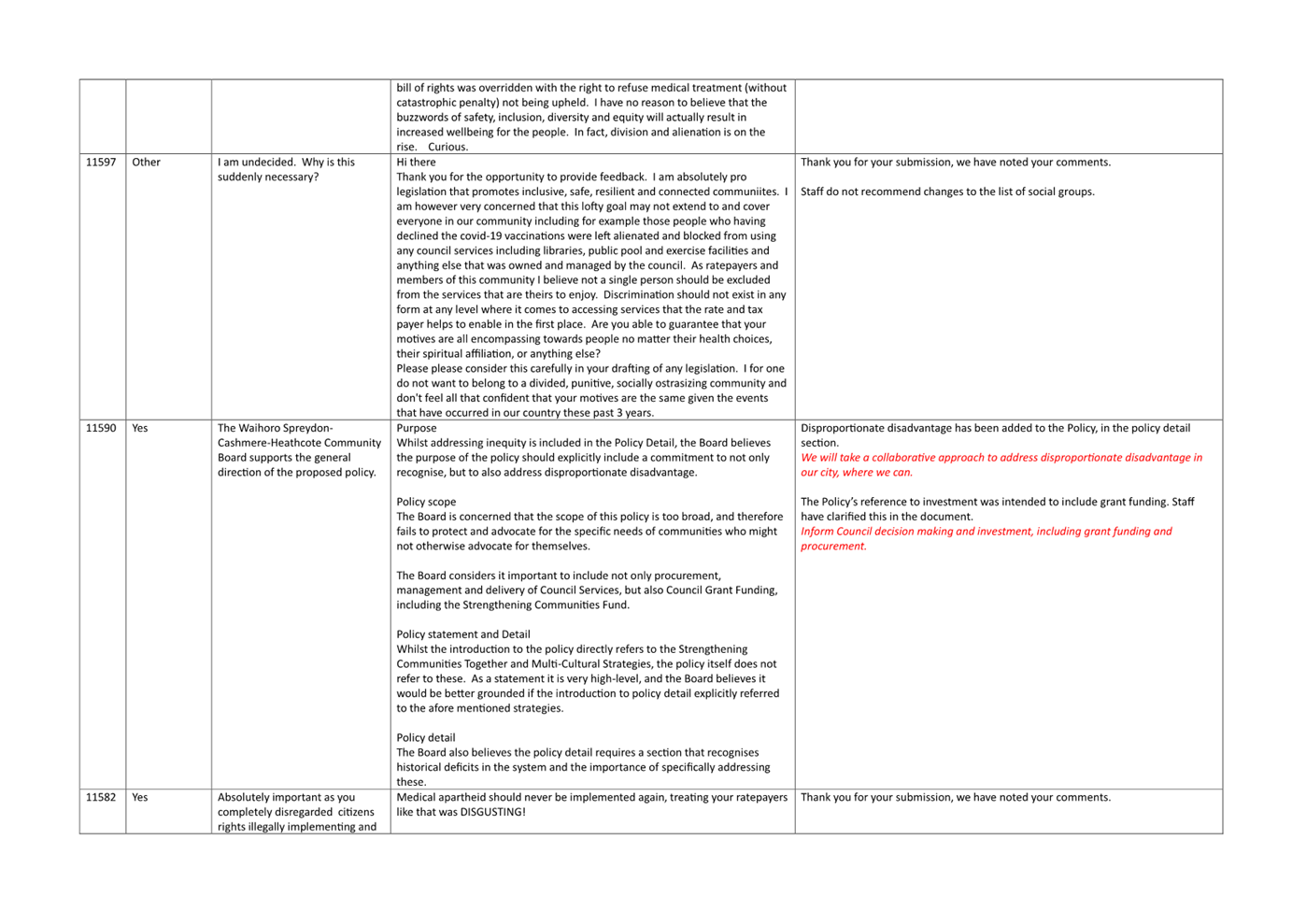
9.9 Three
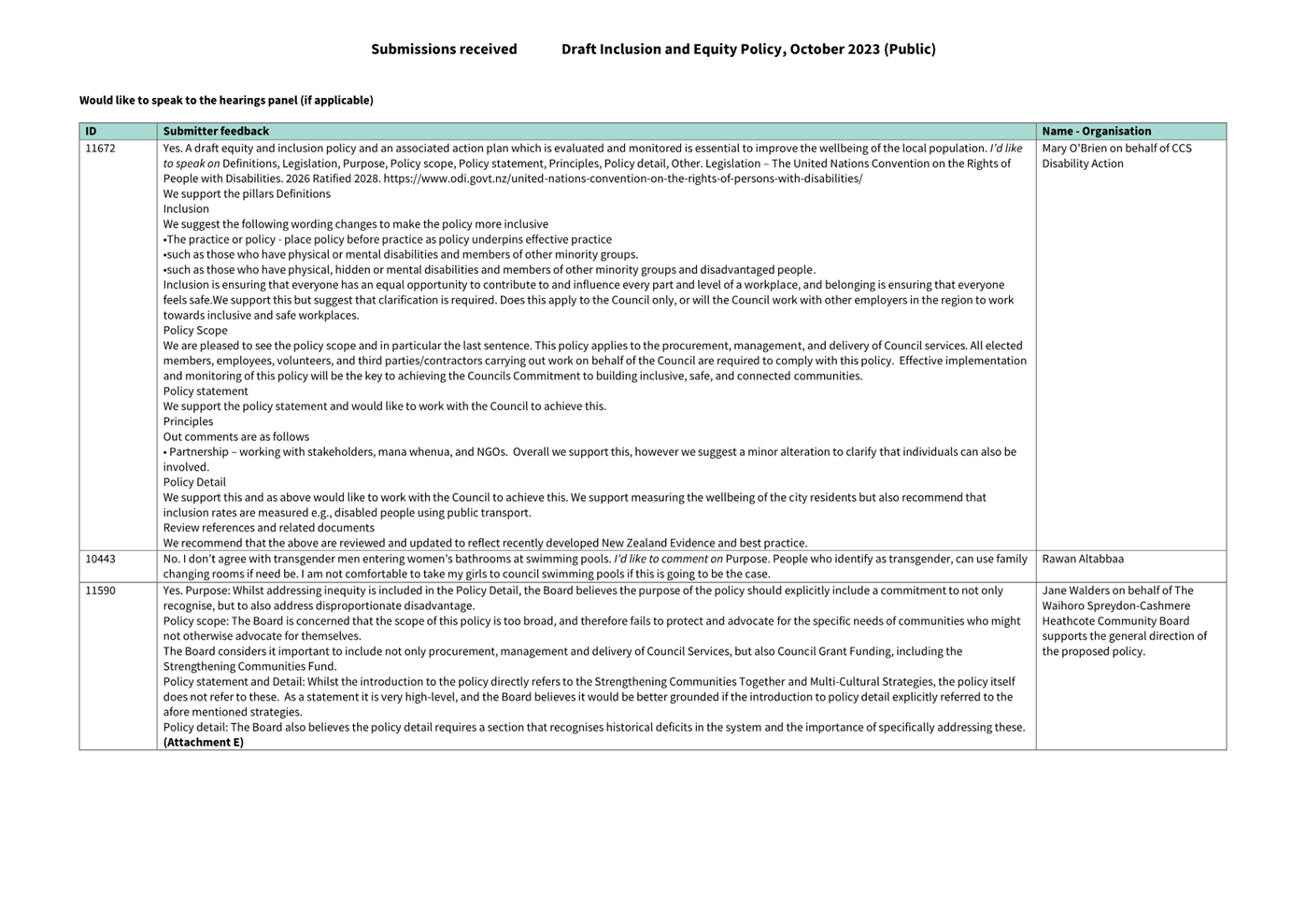
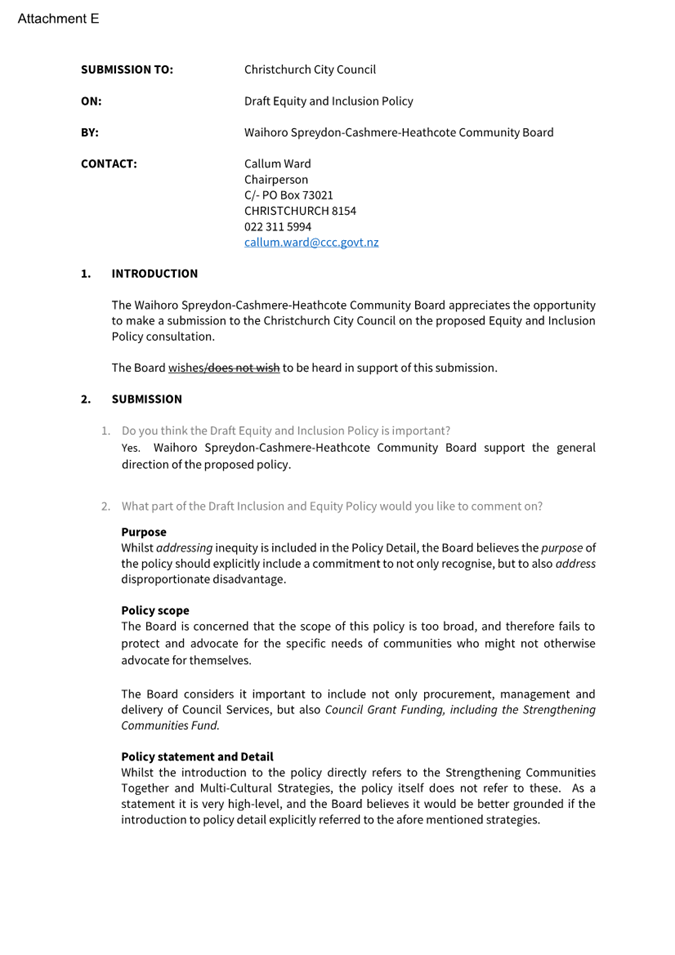
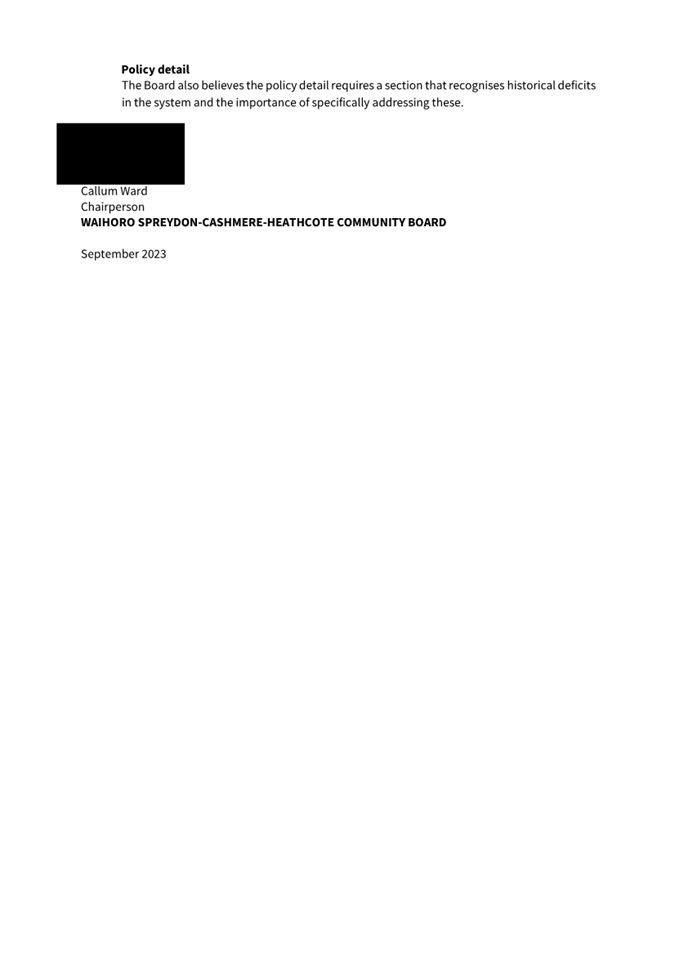
submitters suggested changes to the purpose section. Waihoro
Spreydon-Cashmere-Heathcote Community Board suggested clarifying that the
Policy includes Council grant funding. Staff intended for the purpose statement’s
reference to investment include grant funding and propose amending the Policy
to reflect this.
9.10 One
submitter asked that references to equity and inclusion also include access.
Staff suggest making this amendment to ensure consistency across the document
and reflect the principles of the existing policies.
Policy scope
9.11 Two
submitters commented on a need for clarity about the Policy being a statement
of intent to guide decision decision-making. One of these submitters noted that
an equity lens would not always be possible and that trade-offs will sometimes
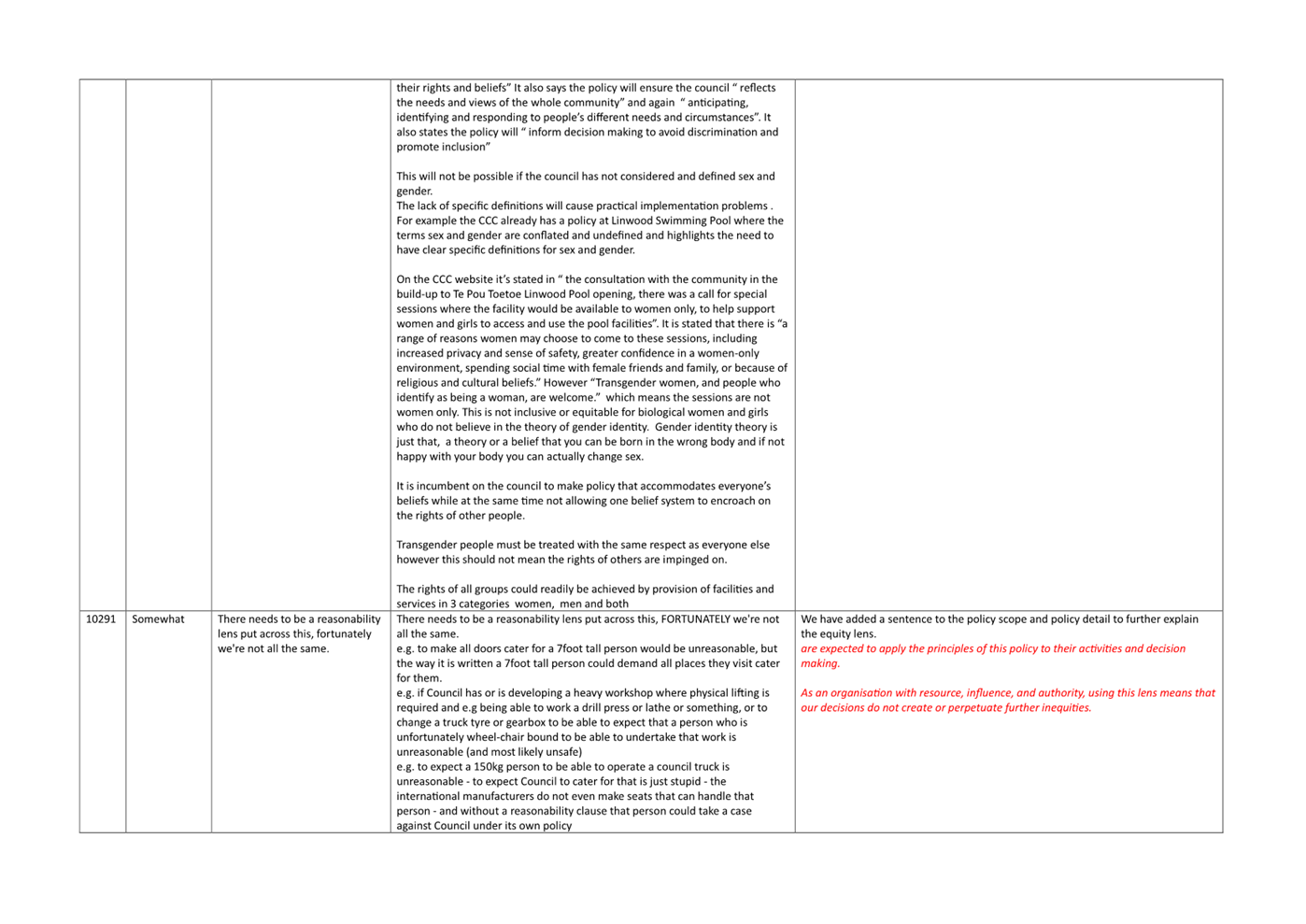
be required. Staff have proposed a drafting change to clarify the use of the
Policy.
Policy statement
9.12 One
submitter suggested including an explanation of structural exclusion. A
definition of exclusion has been proposed which aligns with the existing
definition in the Strengthening Communities Together Strategy.
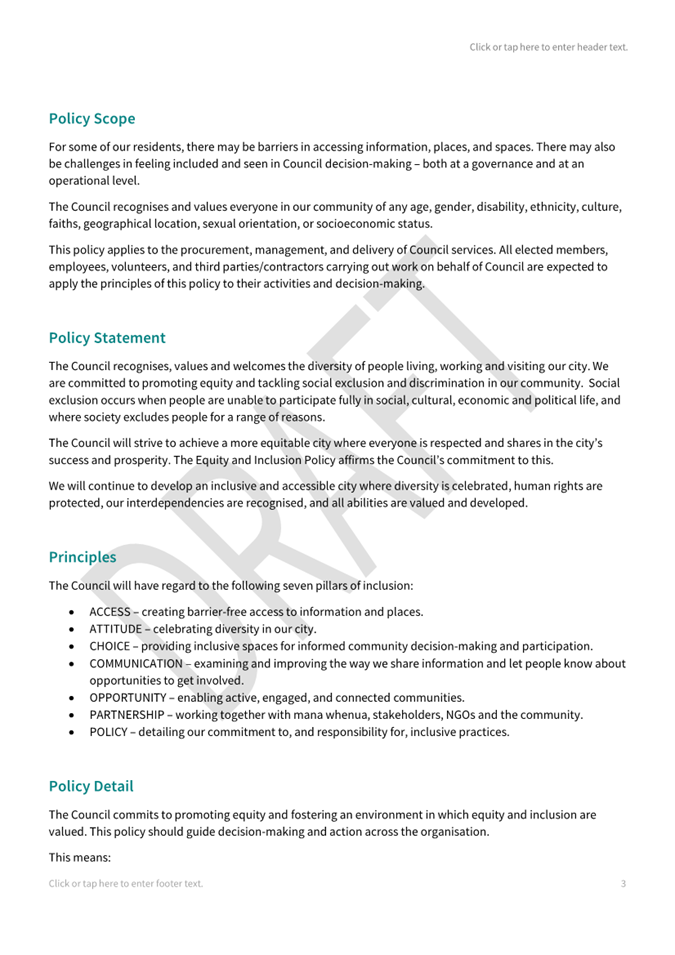
Principles
9.13 Four
submitters suggested draft changes to the seven pillars of inclusion. Staff
have proposed changes reflecting these suggestions where possible.
Policy detail
9.14 Six
submitters suggested changes to the policy detail, which have been incorporated
in the proposed changes.
9.14.1 Two submitters
suggested strengthened wording around providing a safe and inclusive space for
people to participate in decision-making.
9.14.2 One submitter
reiterated the importance of the Council providing information in a variety of
formats. Staff consider this is an important component of the Equity and Access
for People with Disabilities and Ageing Together Policies and propose
strengthened provision for this in the policy detail.
9.14.3 Staff propose a
drafting change to better reflect existing principles in the Strengthening
Communities Together Strategy and Social Wellbeing Policy relating to
supporting and advocating for all communities. This reflects feedback from two
submitters.
9.14.4 Staff also
propose clarifying the use of an equity, access, and inclusion lens in response
to feedback from a submitter.
Implementation and monitoring
9.15 Several
submitters, including Te Mana Ora and Waimāero Fendalton-Waimairi-Harewood
Community Board, raised the question of how the Policy would be implemented and
monitored. A proposed implementation section has been added to the draft
Policy. Staff consider the most appropriate avenue to monitor the
Policy’s implementation, progress and impact is as part of the
Strengthening Communities Together programme of work.
Revoking old policies
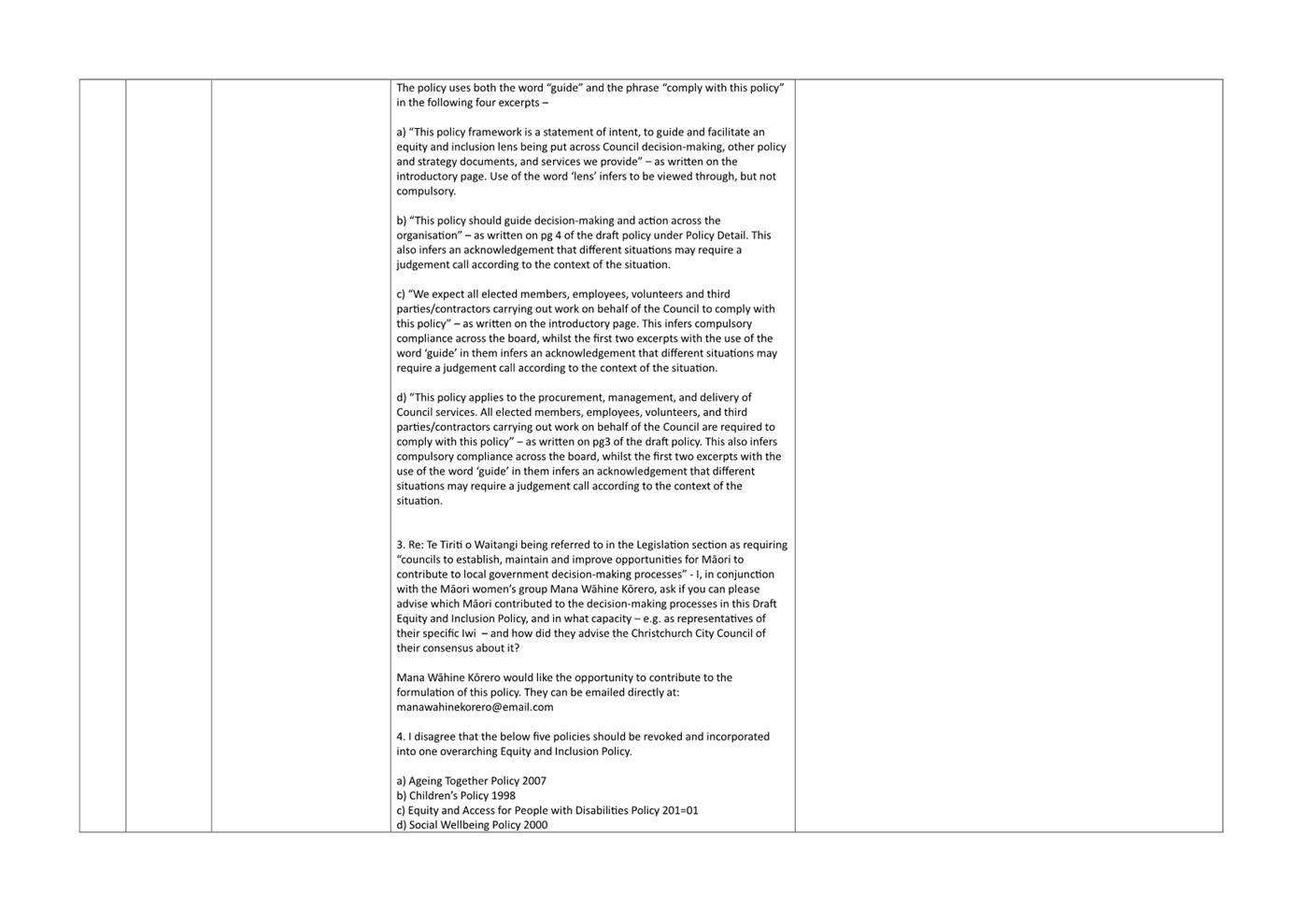
9.16 Some
submitters expressed concern that the draft Policy lacks the detail of some
existing policies. Submitters are also concerned about losing the specificity
that comes with having policies for different groups.
9.17 Staff
consider the existing policies have not been well implemented, used, or
reviewed regularly. While the policies addressed various social groups, they
broadly covered similar principles. The Strengthening Communities Together
Strategy also reflects the principles of these policies. The draft Policy
acknowledges that people identify with multiple communities, and that the needs
and aspirations of our diverse communities should weave through everything the
Council does.
9.18 Two
submitters noted the detail contained in the Equity and Access for People with
Disabilities Policy. A clause-by-clause review of the
Equity and Access policy found that most policy provisions are covered by other
Council documents (such as the Infrastructure
Design Standards, Strengthening Communities
Together Strategy, Intersection
& Pedestrian Crossing Design for People with Disabilities Policy 2016 and other external and internal policies) and/or legislation such
as the Building Act 2004.
9.19 There
are several clauses in the Equity and Access for People
with Disabilities Policy that are not explicitly
recorded in another Council document. These primarily relate to access to
information and fall mainly under the Communication Access section of
that policy:
· Ensure staff are aware of the need to
provide information in various ways to meet different needs.
· Ensure information is available in
alternative formats that are easier for the wider disability community to
access, for example of audio tape, website, teletext, Braille, message
services, large print, simple language and diagrams, radio, and email.
· Provide information about events and
services in a variety of media (for example, publicise telephone and fax
numbers, provide print information and radio notices).
· Provide sufficient notice of events to
ensure there is time to arrange transport or other requirements.
· Publicise information about Council events
and services through disability networks.
· Provide targeted information for people
with disabilities, their families and whānau and service providers for no
additional charge.
· Ensure all Council facilities have clear
signs which include internationally recognised symbols and indicators.
· Develop appropriate consultation and advisory guidelines for Council
Units.
· Provide services which meet the specific needs of people with visual
and hearing impairments and physical disabilities.
· Encourage the portrayal of persons with
disabilities by the media in a positive way, particularly the Council’s
own publications and publicity material.
· Initiate and support information campaigns concerning persons with
disabilities and disability policies, conveying the message that people with disabilities
are citizens with the same rights and obligations as others, thus justifying
measures to remove all obstacles to full participation.
9.20 The
draft Policy addresses the underlying principles of some of these provisions,
particularly around providing services that meet the specific needs of people
with disabilities and providing information in various ways to meet different
needs. However, staff recommend that the more specific provisions be included
in a guideline or procedure document, which can be readily updated as best
practice evolves. Staff note this work could be picked up as part of developing
the disability action plan.
10. Details Te Whakamahuki
Decision Making Authority Te Mana Whakatau
10.1 The decision-making authority to approve a policy sits with
the Council and has not been delegated to a Hearings Panel or Committee of
Council.
10.2 The role of the Hearings Panel is to consider and hear
submissions, deliberate on those matters raised and make recommendations to the
Council on the final form of the Policy.
Legal Implications Ngā Hīraunga ā-Ture
10.3 Submissions made on the proposals should be received by the
Hearings Panel with an open mind and should be given due consideration.
10.4 When deliberating on submissions, the Hearings Panel should
keep in mind the Council’s powers to make a policy, and the scope of the
consultation materials. Significant changes from the original proposals
may require further consultation.
Risks Ngā
Tūraru
10.5 With any process there is always a risk that members of the
public or organisations may not agree with the proposals finally adopted by the
Council and file judicial review proceedings. This risk can be
managed by careful compliance with the provisions in the Local Government Act
2002, and the common law.
Next Steps Ngā
Mahinga ā-muri
10.6 The Hearings Panel will consider the matters
raised in submissions, deliberate on those matters, seek any further advice
from staff, and make recommendations to the Council on the final form of the
Equity and Inclusion Policy.
Attachments Ngā Tāpirihanga
|
No.
|
Title
|
Reference
|
Page
|
|
a ⇩
|
Draft Equity
and Inclusion Policy (with track changes)
|
23/1874880
|
78
|
|
b ⇩
|
Draft Equity
and Inclusion Policy (clean copy)
|
23/1874647
|
83
|
|
c ⇩
|
Staff response
to submitter comments
|
23/1874575
|
88
|
Confirmation of Statutory
Compliance Te Whakatūturutanga ā-Ture
|
Compliance with Statutory Decision-making
Requirements (ss 76 - 81 Local Government Act 2002).
(a) This report contains:
(i) sufficient information about all reasonably practicable
options identified and assessed in terms of their advantages and
disadvantages; and
(ii) adequate consideration of the views and preferences of
affected and interested persons bearing in mind any proposed or previous
community engagement.
(b) The information reflects the level of significance of the
matters covered by the report, as determined in accordance with the Council's
significance and engagement policy.
|
Signatories Ngā Kaiwaitohu
|
Authors
|
Claire
Appleby-Phillips - Manager Community Planning & Projects
Abraham Larsen
- Community Development Advisor
Ellen Cavanagh
- Senior Policy Analyst
Irene
MacArthur - Engagement Advisor
|
|
Approved By
|
Elizabeth
Neazor - Manager Legal Service Delivery, Commercial & Property
John Filsell -
Head of Community Support and Partnerships
|