|
Ōtākaro Avon River Corridor
Co-governance Establishment Committee
21 August 2023
|

|
Ōtākaro
Avon River Corridor Co-governance Establishment Committee – Terms Of
Reference/ Ngā Ārahina Mahinga
|
Co-Chairs
|
Hon Lianne Dalziel and Dr Te Maire Tau
|
|
Membership
|
Councillor Barber
Tania Wati
Dr John Reid
Thomas Hildebrand
Tutehounuku Korako
Hayley Guglietta
Cynthia Roberts
Julyan Falloon
|
|
Meeting Cycle
|
Monthly
|
|
Reports To
|
Council
|
|
Focus
|
Council and Te Rūnanga o
Ngāi Tūāhuriri
|
Introduction
·
The Ōtākaro/Avon River is a taonga
which has been enjoyed by the people of Ōtautahi/Christchurch for
generations.
·
Ngāi Tūāhuriri is a principal hapū and
Papatipu Rūnanga of Ngāi Tahu, and Ngāi Tahu recognise
the tino rangatiratanga that resides within these bodies. The
Ōtākaro Avon River Corridor sits within Ngāi Tūāhuriri
takiwā . Ngāi Tahu hapū have exercised rangatiratanga
throughout its rohe for centuries. Its rangatiratanga existed before Te
Waipounamu was colonised after 1840. Te Tiriti o Waitangi confirmed the
right of Ngāi Tahu to its rangatiratanga, and the Crown reconfirmed
Ngāi Tahu rangatiratanga in the Ngāi Tahu Claims Settlement Act
1998. That Act also provided that the Crown would enter a new era of
cooperation with Ngāi Tahu.
·
Regenerating the 602-hectare Ōtākaro Avon River
Corridor (the Corridor) is a once in a life lifetime opportunity to create a
legacy which benefits present and future generations. Stretching from the city
to the sea the Corridor will provide a range of environmental, cultural,
social, and economic benefits, focusing on the health and wellbeing of the
Ōtākaro/Avon River (Te Mana O Te Wai) and ensuring a healthier place
for people, the natural ecosystem (Te taiao) and the natural security of the people
of Ōtautahi/Christchurch in preparation for climate change and the
environmental changes during the 21st century and beyond.
·
The regeneration of the Corridor is also an opportunity for
Ōtautahi/Christchurch and Ngāi Tūāhuriri to demonstrate
genuine partnership in a co-governance arrangement.
·
While this agreement recognises the rangatiratanga of Ngāi
Tūāhuriri, it also recognises the intergenerational investment and
ownership of the people of Ōtautahi /Christchurch and the Christchurch
City Council (the Council). This agreement does not undermine the authority of
the Crown or local government but commits to a coordinated approach wherein the
Corridor is forever protected and cloaked by both entities for the future
well-being of the people of Ōtautahi /Christchurch.
·
The role of Ngāi Tūāhuriri is to ensure that both
parties govern the Corridor so that the environmental integrity and mahinga kai
is secured and protected for future generations by the custom of Topuni
whereby the Corridor and awa are secured and developed as an environmental
taonga for all citizens of Ōtautahi /Christchurch.
·
In 2019, the global settlement agreement was entered into by the
Crown and the Council. It provided for the ownership of the Corridor to be
transferred progressively to Council during 2022 as property title matters
where resolved. Once the Council owns all or most of the land and exercises
decision-making powers over the land, an enduring co-governance entity will be
established by the Council and Ngāi Tūāhuriri. This entity will
make decisions under the delegation of the Council.
·
In December 2021, the Council confirmed its intent to establish
such a co-governance entity to govern the Corridor. That entity will comprise
equal membership by Ngāi Tūāhuriri and the Council, noting that
the Council appointees would be drawn from the Council and the wider community.
Council also agreed to set up a Co-governance Establishment Committee.
·
The establishment of a co-governance entity and
a partnership with Ngāi Tūāhuriri and the Council, provides for
and enables the exercise of rangatiratanga and kaitiakitanga by mana whenua,
and provides for the relationship of mana whenua and their cultures and
traditions with their ancestral lands, mahinga kai, water, sites, wāhi
tapu and other taonga.
Purpose
The purpose of the Committee is to:
●
Provide strategic direction, leadership and decision-making to
ensure the Ōtākaro Avon River Corridor (ŌARC, the Corridor) and
the Ōtākaro/Avon River are developed, managed and maintained to
provide the optimal ecological, cultural, social and economic benefits.
●
Provide advice on the development of the enduring co-governance
entity/framework for the ŌARC
Functions
Provide strategic
direction
●
Develop a collective understanding of current and proposed future
land uses, the various agreements already in place, and the strategic direction
of the Council.
●
Set the strategic direction for the integrated development of the
Corridor with reference to the ŌARC Regeneration Plan; Mahaanui Iwi
Management Plan; the Christchurch District Plan; the Council’s ŌARC
Activity Plan; and other national, regional and Council policies and
strategies.
●
Provide governance over-sight for the implementation of the
Ōtākaro Avon River Corridor Activity Plan.
Advise on the enduring
co-governance entity for the ŌARC
●
Provide advice on roles and functions of the co-governance entity
and the potential legal structure of the entity.
●
Investigate and develop advice on the development of a local bill
to establish the entity and provide an enduring legal status for the Corridor
within a local Act of Parliament.
Land uses and projects
●
Make decisions on leases, licenses, and access authorities for
use of the land within the Corridor.
●
Review significant applications for land uses to determine their
appropriateness for the proposed location; the benefits they offer for the
environment, adjacent communities and all residents; and their alignment with the
Activity Plan and any regeneration plans.
●
Approve project concept plans, feasibility and business cases.
Engagement and
consultation
●
Identify and understand stakeholder interests to be able to
direct engagement for specific decisions.
●
Establish and maintain effective dialogue and relationships with stakeholders
to support the role of the Committee.
●
Ensure appropriate engagement and consultation has occurred with
communities and organisations.
●
Provide information and report to the public using methods such
as reports, meetings, and newsletters.
Funding
●
Make financial decisions in accordance with the Council’s
delegations’ policy.
Monitoring performance
and reporting
●
Receive regular performance reports on the Activity Plan
●
Monitor the implementation of the Activity Plan including monitoring
the delivery of the Levels of Service.
●
The Activity Plan describes capital projects that will be
delivered in the Corridor through four other Council Activity Plans: Parks
Activity Plan; Stormwater Drainage Activity Plan; Flood protection and Control
works Activity Plan; and Transport Activity Plan. The Council Parks Unit is
responsible for the integrated planning and delivery of investment across
Council.
●
Consider and advise on conflicts and risks to achieving the
Activity Plan.
●
Report to Council quarterly, or more frequently if required.
Delegations
The Council delegates
the following responsibilities to the Establishment Committee:
●
To make decisions on land uses and activities on the
Council-owned Ōtākaro Avon River Corridor land to be able to develop
the land in accordance with the Committee’s strategic direction.
●
To make financial decisions in accordance with Council’s
delegations’ policy
Committee
membership
●
The Committee has eight to ten members selected for their
relevant skills, knowledge and leadership capabilities.
●
At least one member will be a City Councillor/Mayor, and half
will be identified by Ngāi Tūāhuriri.
●
Ngāi Tūāhuriri accepts the requirements under the
LGA 2002. Council will work with Ngāi Tūāhuriri to ensure the
tikanga of its four members is respected in the appointment process.
●
Co-Chairs will be appointed jointly by the Council and Ngāi
Tūāhuriri.
●
A quorum comprises 50% of members.
●
The Co-governance Establishment Committee will be discharged once
the establishment of an agreed and co-governing entity over ŌARC is constituted.
Meetings
●
The Committee will operate in accordance with the requirements of
the Local Government Official Information and Meetings Act 1987. Meetings will
be advertised, and an agenda published.
●
The Committee will meet monthly
●
The Committee will work to achieve consensus wherever possible,
and work in a collaborative and cooperative manner taking into account the
interests of all sectors of the community.
●
Members will contribute their knowledge and perspective but not
promote the views or positions of any particular interest or stakeholder group.
●
The Committee may receive presentations by invitation or
agreement of the Co-Chairs.
Committee
remuneration
●
Remuneration for chairs and members will be set annually.
●
The participation of an elected member in the Committee is part
of their remunerated role as a councillor or Mayor.
Support for the
Committee
The Council and Te
Rūnanga o Ngāi Tūāhuriri will provide support to the
Committee including:
●
A Council General Manager and an advisor from Ngāi Tūāhuriri
as Principal Advisors
●
A Committee Advisor from the Hearings and Council Support Team
will provide administrative and procedural support to the Committee.
●
Relevant staff from across the Council will provide advice to the
Committee.
Limitation of
powers
●
The Committee does not have the authority to commit Council to
any course of action or unbudgeted expenditure.
●
The general delegations to this Committee exclude any
specific decision-making powers that are delegated to a Community Board, another
Committee of Council or Joint Committee.
Delegations to staff are set out in the delegations register.
●
The Council retains the
authority to adopt policies, strategies and bylaws
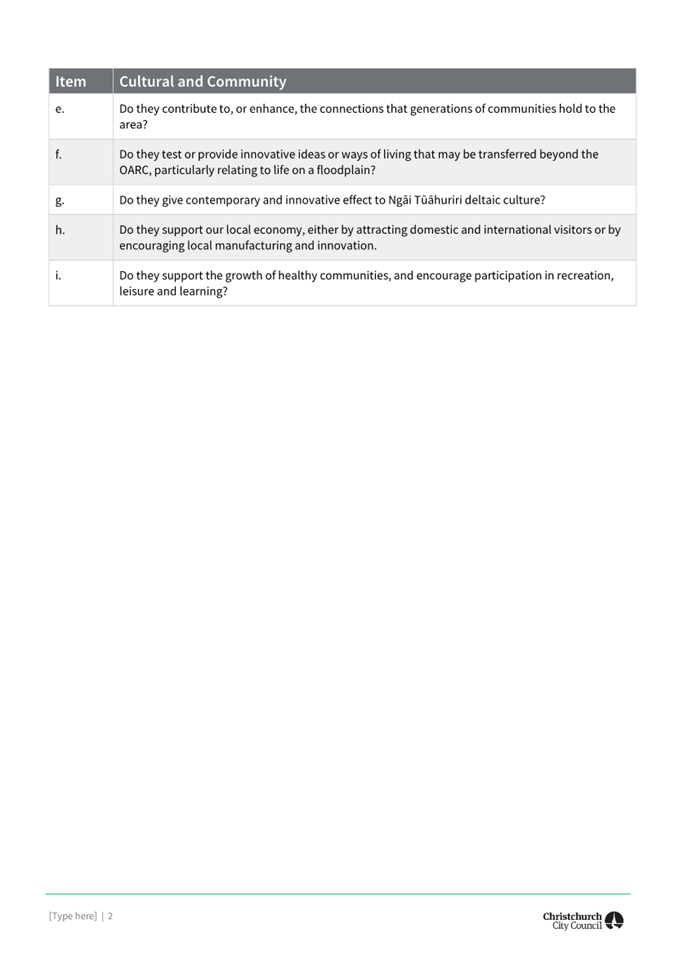
Appendix 1: Vision and Objectives of the ŌARC Regeneration
Plan
The Vision from the Regeneration Plan
The river
is part of us, and we are part of the river.
It
is a living part of our city.
A
place of history and culture
where
people gather, play, and celebrate together.
A
place of learning and discovery
Where
traditional knowledge, science and technology meet.
A
place for ideas and innovation
where
we create new ways of living and connecting.
Our
vision is for the river to connect us together –
with
each other, with nature and
with
new possibilities.
Nōku
te awa. The river is mine.
We
all share in the future of this river.
Ōtākaro
Avon River. Together we thrive.
The Objectives from the Regeneration Plan
For Christchurch:
●
Support safe, strong and healthy communities that are well
connected with each other and with the wider city.
●
Provide opportunities for enhanced community participation,
recreation and leisure.
●
Create a restored native habitat with good quality water so there
is an abundant source of mahinga kai, birdlife and native species.
●
Create opportunities for sustainable economic activity and connections
that enhance our wellbeing and prosperity now and into the future.
For New Zealand:
●
Develop the Ōtākaro Avon River Corridor as a
destination that attracts a wide range of domestic and international visitors.
●
Establish a world-leading living laboratory, where we learn,
experiment and research; testing and creating new ideas and ways of living.
●
Demonstrate how to adapt to the challenges and opportunities
presented by natural hazards, climate change and a river’s floodplain.
Appendix 2:
Guiding documents
Mahaanui Iwi Management
Plan 2013
●
The Mahaanui Iwi Management Plan 2013 and its successive plans
outlined by Ngāi Tūāhuriri must be given effect to when Council
prepares or changes a district plan. The section on Ihutai includes the
catchments of the Ōtākaro/Avon River and Ōpāwaho/Heathcote
River and is an essential resource and guide when making decisions on the
ŌARC.
Ōtākaro Avon
River Corridor Regeneration Plan
●
The ŌARC Regeneration Plan (August 2018) and the
Christchurch District Plan together contribute to the strategic direction for
the Corridor. The Regeneration Plan provides examples of preferred land uses,
and the variability of land use in different reaches of the ŌARC. The
Regeneration Plan centres on the awa/river and the vital role that the river
plays within the Corridor and within the city. The plan emphasises a restored
natural environment, and strengthened connection between people, the river and
the land.
●
The Regeneration Plan requires the development of an
Implementation Plan to provide greater certainty about the funding, sequencing
and delivery of the Regeneration Plan, and ensure coherent and co-ordinated
development of the ŌARC.
Christchurch District
Plan
●
Section 13.14 of the Christchurch District Plan is particularly
relevant. It defines the Specific Purpose (Ōtākaro Avon River
Corridor) Zone, and provides objectives, policies, rules, standards and
assessment criteria which seek to manage activities in the Zone. It sets out
specific provisions for each sub-area defined in the Development Plan in Appendix
13.14.6.1 of the District Plan.
Council’s
Ōtākaro Avon River Corridor Activity Plan
●
Regeneration will be delivered through significant investment in
projects within the Corridor that include regenerative planting, tidal wetland
development, long-term stopbank construction, stormwater treatment facilities,
bridges, landings, and walking and cycling corridors.
●
The Council has prepared an Ōtākaro Avon River Corridor
Activity Plan in its Draft Annual Plan 2022-23 which describes capital projects
that will be delivered through four other of Council’s activity plans:
Parks Activity Plan; Stormwater Drainage Activity Plan; Flood protection and
Control works Activity Plan; and Transport Activity Plan.
●
The infrastructure and environmental investments identified
within this Activity Plan will facilitate a broad range of uses and activities
within the Corridor, generating significant social, ecological and economic
benefits. Careful integrated planning and delivery of investment will be
required to ensure the most beneficial and cost-effective implementation.
●
The Council Parks Unit is responsible for coordinating the
cross-Council programme, reporting to the co-governance Establishment Committee
and engaging with the community.
●
The success of the Activity Plan will be measured by the health
of the river and the environment; the restoration of mahinga kai; and present
and future generations’ enjoyment of the river and the corridor. The
regeneration of the Ōtākaro Avon River Corridor is an opportunity for
Ōtautahi Christchurch and Ngāi Tūāhuriri to demonstrate
genuine co-governance, alongside innovative environmental leadership.
|
Ōtākaro Avon River Corridor
Co-governance Establishment Committee
21 August 2023
|

|
|
5. Ōtākaro Avon River
Corridor Assessment Framework
|
|
Reference / Te Tohutoro:
|
23/1198976
|
|
Report of / Te Pou Matua:
|
Dave
Little, Manager Residential Red Zone (david.little@ccc.govt.nz)
|
|
General Manager / Pouwhakarae:
|
Mary
Richardson, General Manager Citizens & Community
(Mary.Richardson@ccc.govt.nz)
|
1. Nature of Decision or Issue and Report Origin
1.1 This decision establishes an assessment framework for
members to evaluate projects and proposals in alignment with the Regeneration
Plan's intent.
1.2 This report has been staff-generated, in compliance with
items 3.6-3.7 (Land Uses and Projects) in the ŌARC Co-governance
Establishment Committee Terms of Reference / Ngā Rahina Mahinga.
1.3 The
decisions in this report are of low significance in relation to the
Christchurch City Council’s Significance and Engagement Policy. The
level of significance was determined as the framework simply builds on the
principles developed via the Regeneration Plan and does not materially impact
those.
2. Officer Recommendations Ngā
Tūtohu
That the
Ōtākaro Avon River Corridor Co-governance Establishment Committee:
1. Adopt the Ōtākaro Avon River
Corridor Assessment Framework, included as Attachment A to this report.
3. Reason for Report Recommendations Ngā Take mō te
Whakatau
3.1 The
Ōtākaro Avon River Corridor Regeneration Plan presents a vision for
the future of the River Corridor. It emphasises a restored natural environment,
and strengthened connection between people, the river and the land.
3.2 This
has been jointly funded by central government and Christchurch City Council,
and progress is well underway on delivery. As all land has transferred
from LINZ now, there is significant community expectation that the vision will
start to come to life.
3.3 The
Regeneration Plan contains a variety of guiding principles, including;
· A Vision
· Objectives for
Christchurch
· Objectives for New
Zealand
· Seven individual
Corridor-based objectives
· Up to eight bullet
points under each objective
3.4 While
the principles provide useful information and guidance, they do not provide
governance with a concise format to assess projects and third-party proposals
against. They also do not provide guidance on how they might be applied,
in an assessment sense.
3.5 The
assessment framework, included as Attachment A has been developed to
address this.
4. Alternative Options Considered Ētahi atu Kōwhiringa
Not developing an assessment
framework.
4.1 Advantages
· None identified.
4.2 Disadvantages
· Assessment of
projects and proposals would be complex and be carried out without any specific
guidance on how they are to be used (for instance, do projects have to comply
with all objectives, or is there a hierarchy?).
5. Detail Te Whakamahuki
5.1 The
Regeneration Plan was widely consulted on, and the objectives that are
contained within it represent a broad reflection of our local community’s
views.
5.2 To
distil these objectives into an assessment framework, the whakatauki "Ka
mua, ka muri" meaning "walking backwards into the future"
was applied. The Corridor provides a constant reminder of the risks
inherent of not looking to the past to inform thinking. This piece of
work is included for reference as Attachment B.
5.3 Following
this, a draft of the framework was workshopped and recommendations for a final
draft made. These changes have been included, and a check against the
principles and objectives of the Regeneration Plan carried out, to make sure
that all the ideas from that document are reflected in the framework. The
assessment framework is included as Attachment A.
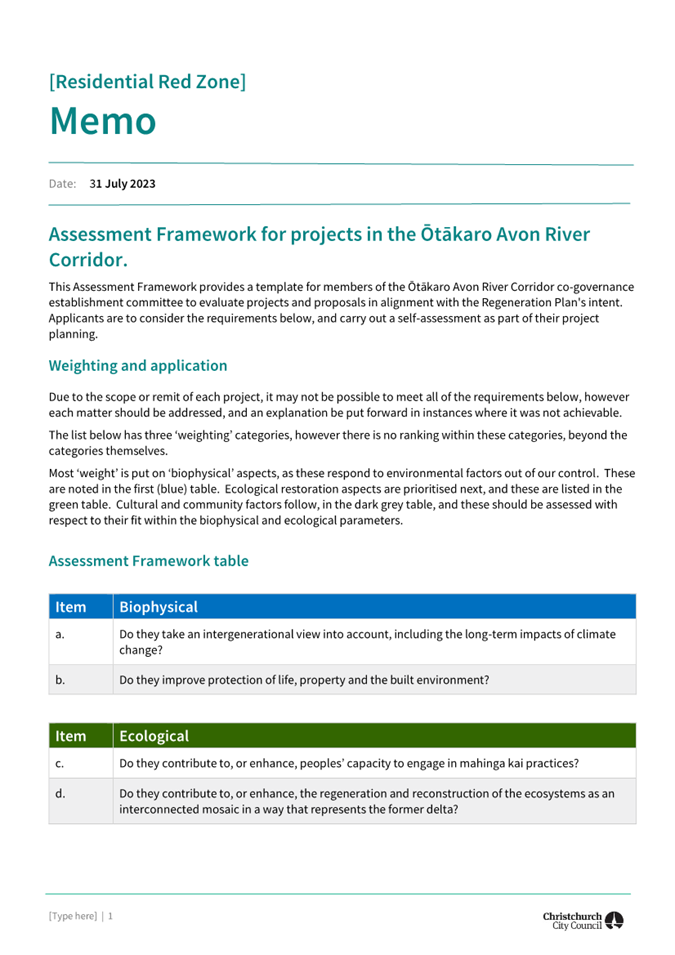
5.4 We
have considered how the framework might be applied to individual projects, not
all of which will necessarily be able to comply with all aspects due to their
scope, remit or area of responsibility. Details are included in the
advice notes provided in Attachment A, but in summary:
· Most ‘weight’ would be put on biophysical aspects, as
these respond to environmental factors out of our control, with ecological
restoration aspects prioritised after that.
· These two aspects set the parameters for all other aspects to be
considered, i.e how they fit within the biophysical and ecological parameters).
5.5 For clarity, proposals will not need to meet all criteria. For
instance, projects located on the ‘landward’ side of long-term
stopbanks will not necessarily need to improve protection of life, property
and the built environment. However the framework will require
applicants to address every aspect and explain the rationale behind any
omissions. Co-governance members will then decide whether this is
reasonable as part of their overall assessment.
 The decision affects the Waitai Coastal-Burwood-Linwood
Community Board area.
The decision affects the Waitai Coastal-Burwood-Linwood
Community Board area.
6. Policy Framework Implications Ngā Hīraunga ā- Kaupapa here
Strategic
Alignment Te Rautaki
Tīaroaro
6.1 This report supports the Council's
Long Term Plan (2021 - 2031):
6.2 Parks, Heritage and Coastal Environment
6.2.1 Activity: Otakaro Avon River Corridor
· Level of Service: 6.8.12.1 Implementation of the Otakaro
Avon River Corridor Regeneration Plan (Green Spine). Council-led capital
investment - Progress integrated Green Spine programme (Parks, Water and
Transport) as per the Implementation Plan.
· Target: 90 % of approved work programmes
delivered in the year funded
Policy
Consistency Te Whai
Kaupapa here
6.3 The
decision is consistent with Council’s Plans and
Policies, being a mechanism for assessing delivery of the Regeneration Plan.
Impact
on Mana Whenua Ngā
Whai Take Mana Whenua
6.4 This
decision will impact projects in, on and around an ancestral land or a body of
water or other elements of intrinsic value; therefore, this decision
specifically impacts Mana Whenua, their culture and traditions.
6.5 Accordingly,
Mana Whenua members have led this piece of work.
Climate
Change Impact Considerations Ngā Whai Whakaaro mā te Āhuarangi
6.6 This Framework elevates climate change considerations to the primary
level of consideration. This is reflective of the vulnerability of the
Corridor to impacts, as well as the long-term, intergenerational world view
held by Mana Whenua.
Accessibility
Considerations Ngā
Whai Whakaaro mā te Hunga Hauā
6.7 Accessibility considerations are also included in the Framework.
7. Resource Implications Ngā Hīraunga Rauemi
Capex/Opex Ngā Utu Whakahaere
7.1 As
this is a high-level mechanism for assessment, there are no CAPEX or OPEX
considerations.
Other He mea anō
7.2 There
are no other issues.
8. Legal Implications Ngā Hīraunga ā-Ture
Statutory power to undertake proposals in the report
Te Manatū Whakahaere Kaupapa
8.1 No
specific proposals are included in this decision which require statutory
powers.
Other Legal Implications Ētahi atu
Hīraunga-ā-Ture
8.2 There
is no legal context, issue or implication relevant to this decision.
9. Risk Management Implications Ngā Hīraunga Tūraru
9.1 As
this is a high-level mechanism for assessment, there are no Risk Management
implications.
Attachments Ngā Tāpirihanga
|
No.
|
Title
|
Reference
|
Page
|
|
a ⇩ 
|
Ōtākaro
Avon River Corridor Assessment Framework
|
23/1212046
|
23
|
|
b ⇩
|
Ōtākaro
Avon River Corridor Framework Discussion
|
23/1212048
|
25
|
In addition to the attached documents, the following background
information is available:
|
Document
Name – Location / File Link
|
|
Not
applicable
|
Confirmation of Statutory
Compliance Te Whakatūturutanga ā-Ture
|
Compliance with Statutory Decision-making
Requirements (ss 76 - 81 Local Government Act 2002).
(a) This report contains:
(i) sufficient information about all reasonably practicable
options identified and assessed in terms of their advantages and
disadvantages; and
(ii) adequate consideration of the views and preferences of
affected and interested persons bearing in mind any proposed or previous
community engagement.
(b) The information reflects the level of significance of the
matters covered by the report, as determined in accordance with the Council's
significance and engagement policy.
|
Signatories Ngā Kaiwaitohu
|
Author
|
David Little -
Manager Residential Red Zone
|
|
Approved By
|
Andrew
Rutledge - Head of Parks
Mary
Richardson - General Manager Citizens & Community
|