|
Banks Peninsula Water Management Zone
Committee
21 March 2023
|
 
|



Banks Peninsula Water Management Zone
Committee
Open Minutes
Date: Tuesday 21 February 2023
Time: 4.05 pm
Venue: Lyttelton Mt Herbert Community Boardroom,
25 Canterbury Street, Lyttelton
Present
|
Members
|
Gina Waibl - Community Representative
Trudi Bishop - Community Representative
Andrea Davis – Community
Representative
George Howden - Community Representative
Elisa Knight - Community Representative
Ben Manson - Community Representative
Tyrone Fields - Councillor Christchurch
City Council
Aurora Smith - Te Hapū o
Ngāti Wheke/Rapaki
Jaleesa Panirau - Te Rūnanga o Wairewa – via Audio / Video link
|
|
|
Zone Facilitator
Shelley Washington
Tel: 027 294 5219
Environment Canterbury
|
Committee Advisor
Katie Matheis
Tel: 941 5643
Christchurch City Council
|

The meeting opened with a Karakia Tīmatanga.
The agenda was dealt with in the following
order.
1. Apologies
|
Committee Resolved BPZC/2023/00001
That the apologies received from Rik
Tainui and Erana Riddell for absence and from Jaleesa Panirau, and Aurora
Smith for lateness be accepted.
Gina Waibl/Trudi Bishop Carried
|
2. Declarations
of Interest
There were no
declarations of interest recorded.
3. Updates from Banks Peninsula Zone Committee
Members
Members
highlighted events/meetings/issues relevant to the Zone Committee as follows:
· Forestry operations in Port Levy
· Farmers’ experience with poplar and willow poles for soil
conservation – lack of interest
· Availability of funding to Banks Peninsula farmers – raising
awareness
· Planting stream near marae in Koukourārata
· Little River Rating District Meeting – notes to be
circulated
· Little
River flooding – regular meetings between Christchurch City Council, ECan
and community to improve communication and find possible solutions
· Wongan
Hills consent application publicly notified
· Christchurch Foundation Report – Tui Corridor Project findings
· Committee display at Little River – misperceptions that
Committee is anti-fishing when fish passage actually improves fishing habitat
· Project Lyttelton – carbon neutrality work ongoing, but no
longer by carbon coach
· Water conservation on the Peninsula – promotion efforts by the
Committee
· Whaka-Ora Frontiers Abroad – U.S. students returning to assist
with projects on the Peninsula
· Whaka-Ora work programme – potential for funding of private
projects
· Green lip mussels washed up on Purau likely by storm – testing
by ECan
· Lack of water at Koukourārata
– Christchurch City Council budgeting potential deferral
· Plant
maintenance and pest control inclusion in biodiversity projects
· Whakaraupō treated wastewater discharge – no longer to
harbour, but to Bromley
· Zone delivery staff – May work programme discussions
· Lack of awareness of rules around waterways and stock exclusion
· Wairewa Rūnanga discussion of
project ideas to improve water in Wairewa catchment
Jaleesa Panirau
joined the meeting at 4.28 during discussion of Item 3.
Aurora Smith
joined the meeting at 4.34 during discussion of Item 3.
4. Confirmation
of Previous Minutes
|
Committee Resolved BPZC/2023/00002
That the
minutes of the Banks Peninsula Water Management Zone Committee meeting held
on Tuesday, 20 September 2022 be confirmed, noting a correction to the listed
membership, changing “Andrea Smith” to “Andrea
Davis.”
Trudi
Bishop/Gina Waibl Carried
|
5. Matters
Arising from the Minutes
Nil
6. Deputations
by Appointment
There were no deputations by appointment.
7. Identification
of Urgent Items
Nil
8. Identification
of General Public Contributions
Nil
|
9. 2023
Election of Chair and Deputy Chair, and Committee Meeting Dates
|
|
|
The Committee accepted the Officer
Recommendations with the inclusion of the names of the Committee members
elected to the roles of Chairperson and Deputy Chairperson.
Gina Waibl was nominated for Chairperson
by Trudi Bishop and this nomination was seconded by Aurora Smith.
Trudi Bishop was nominated for Deputy
Chairperson by Gina Waibl and this nomination was seconded by Elisa Knight.
The Committee also noted that the start
time of the 21 March 2023 meeting may change to 5.30pm rather than 4.00pm.
|
|
|
Committee Resolved BPZC/2023/00003
That the Banks
Peninsula Water Management Zone Committee agrees to:
1. Elect Gina Waibl as the Chair and Trudi Bishop as the Deputy Chair
for 2023 in accordance with the CWMS Zone Committees Revised Terms of
Reference (Attachment A to this report).
2. Meet in 2023 between 4:00-6:30pm on the following Tuesdays (and
Thursday):
a. 21 February (meeting)
b. 21 March (meeting) noting that the meeting start time may
change to 5:30pm
c. Thursday 27 April (joint workshop with Christchurch West Melton
Zone Committee and Whaka Ora Healthy Harbour, with other key stakeholders
invited)
d. 23 May (workshop)
e. 20 June (meeting)
f. 15 August (meeting)
g. 19 September (meeting)
h. 17 October (workshop)
i. 21 November (meeting)
George
Howden/Aurora Smith Carried
|
|
11. Co-option to
Banks Peninsula Water Management Zone Committee
|
|
|
Committee Resolved BPZC/2023/00004
Original Officer Recommendation Accepted
Without Change
That the Banks
Peninsula Water Management Zone Committee:
1. Agrees
to co-opt Tori Peden as an advisory member from March 2023 until the
completion of the next refresh process, taking place in 2024.
Elisa Knight/Aurora
Smith Carried
|
|
10. Canterbury
Water Management Strategy Action Plan Budget
|
|
|
The Committee generally supported the
Club’s planting proposal but raised some concerns about the existing
boundary fence and its state of repair. The Committee raised other questions
and requested additional information before making a determination on the
funding allocation.
|
|
|
Officer Recommendations
That the Banks
Peninsula Water Management Zone Committee:
1. Provide the Little River Pony Club with $8,370 towards their Okana
River fencing and planting project.
|
|
|
Committee Resolved BPZC/2023/00005
That the Banks
Peninsula Water Management Zone Committee:
1. Defer the decision to provide the Little River Pony Club with
funding towards their Okana River fencing and planting project and request
that staff and Committee members gather additional information from the
applicant regarding the types of natives being planted, whether the boundary
fence will be fixed, and that Christchurch City Council approval has been
received for the planned project to occur before the project begins.
Ben Manson/Gina
Waibl Carried
|
Before concluding the meeting, the
Committee further discussed issues around funding resources, noting that a
future workshop agenda item would be useful.
Item - 11. Co-option to Banks Peninsula
Water Management Zone Committee - has been moved to another part of the
document.
Councillor Fields left the meeting at
5.57pm.
The meeting closed with a Karakia/Whakamutunga.
Meeting
concluded at 6.30pm.
CONFIRMED THIS 21st DAY
OF MARCH 2023
GINA WAIBL
CHAIRPERSON
|
Banks Peninsula Water Management Zone
Committee
21 March 2023
|

|
|
9. Canterbury
Water Management Strategy Action Plan Budget
|
|
Reference Te Tohutoro:
|
23/354504
|
|
Presenter(s) Te Kaipāhō :
|
Shelley
Washington, Zone Facilitator
[email protected]
|
1. Purpose of Report Te
Pūtake Pūrongo
1.1 The purpose of this report is for the Banks Peninsula Water
Management Zone Committee to discuss and recommend the allocation of the
remaining Canterbury Water Management Strategy (CWMS) Action Plan budget for
the 2022-2023 financial year.
2. Officer Recommendations Ngā Tūtohu
That the Banks
Peninsula Water Management Zone Committee recommends to Environment Canterbury
the following allocations of the Canterbury Water Management Strategy Action
Plan Budget 2022-2023 for the Banks Peninsula Zone:
1. $8,370 as an additional contribution for
operational support to the Banks Peninsula Conservation Trust.
3. Report Te Pūrongo
3.1 There is $8,370 remaining in the CWMS Action Plan Budget for
2022-2023 in the Banks Peninsula zone.
3.2 The
Operational Support project has previously been recommended an allocation of
$10,000 by the Committee and subsequently decided by Environment Canterbury. As
this contributes to all of the work programmes of this Trust, providing an
additional allocation of budget will be useful.
3.3 It
was mentioned at the February 2023 Committee meeting that the Hukuhuka Turoa
Stream (Martin Property) project that has previously been recommended an
allocation of $2,130 by the Committee would benefit from an additional
allocation of funding because the landowner’s official quote from a
fencing company is greater than the preliminary figure provided by the
landowner. However, Environment Canterbury’s zone delivery team confirmed
on 16 March that they have some operational budget that they can provide
amongst the projects they are supporting in Wairewa Catchment, so an additional
amount is not needed from the CWMS Action Plan Budget.
3.4 Since
the February 2023 Committee meeting, the Little River Pony Club has been
advised that they need to update the information they provided about their
Okana River fencing and planting project and submit this to the Committee again
for consideration for a future financial year, once they are ready.
3.5 Diane
Shelander made some enquiries within the Christchurch City Council. The
Council’s Property Unit is aware of the project and will reduce the
license area (assuming the fence and planting are installed), under staff
delegation when the current lease expires in 2025.
3.6 The
Pony Club had made an application to the Council’s Parks Unit to
undertake fencing and planting in the reserve. The Parks Unit supports the
proposal but has requested further information for the Three Waters Unit. Once
the Parks Unit has received this information from the Club, they’ll share
that with the Three Waters Unit and then decide whether they give written
approval. The Council also confirmed that the Pony Club would be using the
reserve for many years into the future, but that if one day the use changes,
the fence and width of land planted would not be a problem.
4. Background
4.1 The
other projects that have been funded during this financial year are:
4.1.1 Biodiversity
enhancement planting Hukahuka Turoa Stream - Rimmell property - $1,000;
4.1.2 Biodiversity
enhancement planting and fencing Hukahuka Turoa Stream - Martin property -
$2,130;
4.1.3 Opuahou
and Hukahuka Turoa Streams biodiversity and bank protection planting
maintenance - Stanbury property - $7,000;
4.1.4 Banks
Peninsula Pekapeka (longtail bat) survey project multi-organisation,
coordinated by Environment Canterbury - $5,500;
4.1.5 Pest
and weed control around stream, Pigeon Bay - Lear property - $3,500;
4.1.6 Farm
Biodiversity Planning and Monitoring Programme – Banks Peninsula
Conservation Trust - $5,000;
4.1.7 Feral
Pig Control on Banks Peninsula – Banks Peninsula Conservation Trust -
$7,500; and
4.1.8 Operational
Support – Banks Peninsula Conservation Trust - $10,000.
Attachments Ngā Tāpirihanga
There are no
attachments to this report.
|
Banks Peninsula Water Management Zone Committee
21 March 2023
|

|
|
10. Monitoring
of Water Quality for Contact Recreation around Banks Peninsula
|
|
Reference Te Tohutoro:
|
23/355386
|
|
Presenter(s) Te Kaipāhō :
|
Shirley
Hayward, Science Team Leader - Water Quality and Ecology
Emily Gray, Senior Science Analyst, Surface Water Science
|
1. Purpose of Report Te Pūtake
Pūrongo
1.1 The purpose of this report is to inform the Banks Peninsula Water
Management Zone Committee of the Contact Recreation Monitoring Programme
operated by Environment Canterbury around Banks Peninsula.
1.2 It is also to provide information to the Committee on how
Environment Canterbury, along with te Mana Ora (Community and Public Health)
and Christchurch City Council utilises Ministry of Health and Ministry for the
Environment guidelines on contact recreation monitoring to inform the public on
the health risk, if any, of swimming at various sites around Banks Peninsula.
1.3 Finally, to also update the Committee on the latest results from the
2022-23 summer.
2. Officer Recommendations Ngā Tūtohu
That the Banks
Peninsula Water Management Zone Committee:
1. Receive the information provided on monitoring
of water quality for contact recreation around Banks Peninsula.
3. Report Te Pūrongo – Key Points
3.1 Environment
Canterbury’s Contact Recreation Monitoring Programme’s primary
focus is on understanding and communicating public health risks associated with
recreational activities at freshwater and coastal swimming sites.
3.2 In
conjunction with Te Mana Ora (Community and Public Health) and city and
district councils, we follow guidelines set out for monitoring and managing
microbial and cyanobacterial risks in recreational waters.
3.3 This
season, five of the eight sites in Whakaraupō/Lyttelton Harbour were
graded as Poor. This understandably caused considerable concern for communities
that use those sites. We have initiated investigations into the causes of poor
water quality at these sites. One site out of seven in Akaroa Harbour was also
graded as Poor.
3.4 We will also be investigating approaches that could be used in
future seasons where predictable health risks, such as rainfall-driven poor
water quality, can be adequately managed.
4. Background
4.1 Environment
Canterbury, along with all other Regional and Unitary Councils in New Zealand,
runs a summertime programme to monitor the water quality at swimming sites
within the region.
4.2 The
contact-recreation monitoring programme is based upon the monitoring of faecal
indicator bacteria (Escherichia coli (E. coli) in rivers or enterococci in
coastal waters. The bacteria indicate the likely presence of pathogens (disease
causing microorganism) in the water.
4.3 Monitoring
for faecal indicator bacteria assesses the human health risk of becoming ill
from ingesting or inhaling pathogens in recreational waters. The methods that
we use to monitor, analyse, and report on contact recreation data follow joint
guidelines from the Ministry of Health and the Ministry for the Environment.
4.3.1 Microbiological
water quality guidelines for marine and freshwater recreational areas |
Ministry for the Environment (2003) https://environment.govt.nz/publications/microbiological-water-quality-guidelines-for-marine-and-freshwater-recreational-areas/
4.3.2 Cyanobacteria
Interim Guidelines (environment.govt.nz) (2009) https://environment.govt.nz/assets/Publications/Files/nz-guidelines-cyanobacteria-recreational-fresh-waters.pdf
4.4 The
results from our contact-recreation monitoring are reported to the public
through the “Can I swim here?” pages of the LAWA (Land, Air &
Water Aotearoa) website: https://www.lawa.org.nz/explore-data/swimming.
Throughout the summer we run awareness campaigns promoting LAWA as the place to
view swimming water quality data.
4.5 As
set out in the guidelines, operation of the contact-recreation monitoring
programme involves three different agencies working closely together:
4.5.1 Environment
Canterbury carries out the monitoring, reports on the data and leads
investigations of causes of problems at sites.
4.5.2 Te
Mana Ora issue health warnings to the public based on their medical assessment
of the risk.
4.5.3 Local
territorial authorities (i.e. district and city councils) put up signage at
sites where there is a need to warn public of the risk of swimming at
particular sites.
4.6 Each
year before the summer monitoring starts, staff from the agencies meet to
ensure all the responsibilities are understood via an agreed protocol. This is
also an opportunity to review the results from the previous years’
monitoring and the long-term grades (based on previous five years monitoring).
We have a well-established relationship with the public health staff in these
agencies and appreciate the engagement and support they give to the programme.
5. Faecal Indicator Bacteria Monitoring and Grading
5.1 There
are two types of monitoring results that are reported on from the contact
recreation programme:
5.1.1 Weekly
surveillance monitoring - these show the latest monitoring result for a site
and whether it is above or below health warning levels. Due to sampling
frequency and time required for laboratory analysis, the results displayed on
LAWA can be up to nine days old.
5.1.2 Long-term
grades - these recognise that one sample does not always reflect the overall
quality, as water quality can be subject to short term changes. The long-term
grades work out the health risk at sites based upon the past five years of
samples and known risk factors at a site (e.g., stock access or sewage
discharges).
6. Weekly surveillance monitoring
6.1 We
sample 57 freshwater (river or lake) and 46 coastal (beach, harbour, or
estuary) sites weekly from late November to early March for faecal indicator
bacteria in Canterbury. The results are automatically reported on LAWA when
they become available from the laboratory.
6.2 For
sites that have a long-term grade of Fair or better (i.e., graded as generally
suitable for swimming), if a result exceeds alert or action guidelines, we
resample as soon as is practical and inform Te Mana Ora of the results (see Table
1).
6.3 Temporary
health warnings may be issued by Te Mana Ora at these sites if the results
exceed action levels. For coastal waters, this is usually after two consecutive
high results. However, Te Mana Ora has discretion to issue temporary health warnings
based on one high result in accordance with their protocols. The city or
district council is advised by Te Mana Ora that a health warning has been
issued, and that temporary signage is required. Rūnanga are also advised
of any results that exceed guideline values within their takiwā.
6.4 While
we aim to resample sites with temporary health warnings daily, it is not always
practical to do so. For rainfall affected results, we delay resampling for 1-2
days after rainfall.
6.5 Sites
with long-term grades of Poor or Very Poor are generally not resampled after
high results, as existing health warnings and signage are already in place.
Weekly sampling continues at these sites.
6.6 Table1:
Response modes for weekly sampling results at sites with long-term grades of
Fair or better
|
Mode
for weekly sampling responses
|
Coastal waters
–
enterococci/100 ml
|
Freshwaters –
E. coli/100 ml
|
|
Acceptable/Green
– routine monitoring
|
<130
|
<260
|
|
Alert/Amber
–– increase sampling
|
≤260
|
≤550
|
|
Action/Red
– elevated health risk – resample and inform public
|
>260
|
>550
|
7. Long-term Grades
7.1 The
microbial quality of natural waters can vary greatly from day to day. Sample
collection, analysis and reporting of results can take 1-3 days after samples
have been collected. For these reasons, relying on weekly or even higher
frequency data cannot tell us what the risks are today at a site. Therefore,
the guidelines include a risk-based approach to assess overall risk to human
health. This uses a combination of the past five years of sampling results and
a site assessment to determine long-term grades, called Suitability for
Recreation Grades. The site assessment includes assessing likely factors
influencing water quality at the site, such as stormwater discharges, treated
sewage discharges, and rural land run-off.
7.2 Rainfall
affected data - rainfall causes increased run-off of contaminants from land
into water, and therefore, water quality is often poorer for short periods (1-2
days) after rainfall. The guidelines outline where management interventions
(such as effectively communicating predictable risks so that swimmers are
deterred during high-risk times) can be demonstrated to effectively manage
known and predictable risks, and where long-term grades can be modified.
7.3 For
sites where it is determined that recent rainfall impacts on water quality, and
interventions can discourage swimming after rainfall, long-term grades can be
modified by removing rainfall affected data. This is our approach for assessing
long-term grades for river sites where water quality is impacted by rainfall
AND we can be confident that conditions after rainfall can sufficiently deter
swimmers (e.g., high flows and turbid waters). These sites have permanent
warnings signs erected to advise that swimming should be avoided for up to 48
hours after rainfall.
7.4 In
coastal waters and lakes, we have historically taken the same approach
(removing rainfall affected results and having signage in place). However, we
have observed that conditions at a beach or lake do not necessarily show that
it has rained recently, and we have observed swimmers using these sites after
recent rainfall. Therefore, since the 2020/21 season, we have not modified lake
or coastal long-term grades by removing rainfall affected data.
7.5 In
assessing grades, we use the past five years of results to calculate a 95th
percentile value and compare that to guidelines. What this statistic
essentially means is that no more than 5% of samples (or 5 samples in 100) can
exceed the long-term health-based guidelines (550 E. coli/100ml in freshwaters
– 500 enterococci/100 ml in coastal waters). These thresholds represent a
risk of >5% Campylobacter infection in freshwaters, and >10% risk of
gastrointestinal illness in marine waters. These guidelines are based on
well-established risks of infection or illness and are intended to protect the
more vulnerable members of our communities.
7.6 For
the 2021/22/23 season, long-term grade assessments have determined that 62.5%
of coastal sites in Banks Peninsula are generally suitable for primary contact
recreation. Of these, 87.5% are suitable in Akaroa Harbour (including Okains
Bay) and 37.5% in Lyttelton Harbour. Notably, the proportion of harbour sites
considered as suitable for primary contact recreation has reduced from 90% to
60%. Rainfall events last summer likely contributed to some of the grade
changes, but not at all sites or on all occasions. These results are presented
in the Water Quality for Contact Recreation Annual Summary Report 2021/22
Season.
8. Whakaraupō/Lyttelton Harbour results this year
8.1 At
the start of the season, the annual reassessment of long-term grades resulted
in five out of eight monitored sites in Whakaraupō/Lyttelton Harbour being
graded as Poor. These sites are: Corsair Bay; Sandy Bay; Purau Bay; Diamond
Harbour; and Rāpaki Bay. Akaroa Main beach site in Akaroa harbour was also
graded Poor. A Poor grade means there is an elevated health risk, and these
sites are considered generally unsuitable for swimming. This is a change from
the previous year, whereby only one site, Sandy Bay, had a long-term grade of
Poor.
8.2 Three
sites (Cass Bay, Charteris Bay and Church Bay) have grades ranging from Fair to
Good.
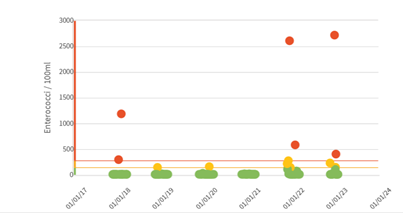
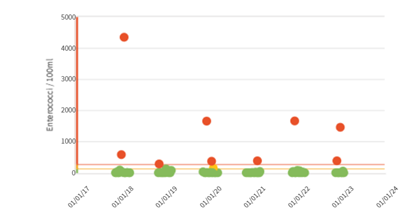
8.3 Many
of the sites graded as Poor have been affected by rainfall, but not all
“action level” exceedance results are because of rainfall events.
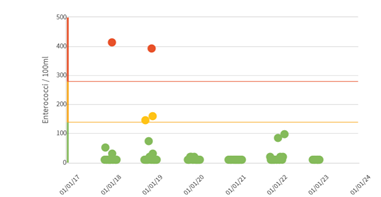
This is demonstrated by the high enterococci results that occurred in Corsair
Bay (1,467 enterococci/100 ml) and Cass Bay (2,720 enterococci/100 ml) this
season on the 29th December 2022.
8.4 Sheltered
coastal bays, such as Corsair and Cass bays, are generally calmer and shallower
waters than open coastal bays such as Sumner Beach. However, these features
also make them more vulnerable to contaminants from a variety of sources and
activities.
8.5 Figure
1 shows that high enterococci results at Sumner Beach are generally less
frequent and at lower concentration than that found in more sheltered bays such
as Cass and Corsair bays. As human use of these areas increases, so does the
risk of occasional or more frequent contamination. This can include faecal
wastes from people and children swimming, dog walkers and recreational boating.
Stormwater runoff from residential and rural areas are also significant
contributors to short term poor water quality after rainfall.
8.6 The
very high enterococci results found in samples taken on the 29th December 2022
at Corsair and Cass bays occurred during a dry period but with very high number
of people using these bays. It is unlikely we will be able to identify the
source(s) of contamination at that time. However, developing messaging about
responsible use of these areas is important to managing future risks.
8.7 Figure
1 - Weekly enterococci results at two bays in Whakaraupō/Lyttelton harbour
and at Sumner beach. N.B. these graphs have different vertical scales.
|
Sumner
beach
weekly results – long-term grade is currently Good
|
|
|
|
Cass
Bay
weekly results – long-term grade is currently Fair
|
|
|
|
Corsair
Bay
weekly results – long-term grade is currently Poor
|
|
|
8.8 Figure
1 – Weekly enterococci results at two bays in Whakaraupō/Lyttelton
harbour and at Sumner beach. N.B. these graphs have different vertical
scales.
9. This summer’s results so far - key results and
investigations
9.1 The
following temporary health warnings were issued by Te Mana Ora because of
elevated faecal indicator bacteria concentrations. These sites have long-term
grades of fair or better.
9.1.1 Cass
Bay - health warning issued on 30 December 2022 and removed on 10 January 2023
(note that Corsair Bay also had high results during the same period but did not
need temporary health warnings because of its Poor long-term grade).
9.2 We
have undertaken further investigations into sources and causes of poor grades
in Whakaraupō/Lyttelton Harbour bays. This includes taking additional
samples for faecal source tracking (FST) analyses, and further sampling during
wet weather events. These investigations need to occur during times when the
specialist laboratory (ESR) can accept FST samples and when elevated
concentrations of bacteria are present. The full suite of results will
not be available for a couple of months. We expect to be able to report
the findings of this investigation about July 2023.
9.3 Te
Roto o Wairewa/Lake Forsyth has health warnings in place because of potentially
toxic planktonic cyanobacterial blooms.
10. Climate Change Impacts
10.1 Climate
change may impact on a number of aspects of our contact recreation monitoring
programme. This includes predictions of more intense rainfall events affecting
water quality. But also, with more hot days predicted, increased demand for
access to safe swimming sites is likely.
11. Next Steps
11.1 The
Contact Recreation monitoring ends for this season finishes in early March and
these data will continue to be displayed on LAWA.
11.2 Over
the Autumn and Winter, the data from this summer will be analysed and new
long-term grades assigned ready for next Summer.
11.3 In
response to concerns raised by the community this summer we will also:
11.3.1 Investigate a
new approach so whereby rainfall affected results can be predicted (e.g.,
exploring a predictive modelling approach).
11.3.2 Look at new
ways to and to communicate the public health risks adequately to the community.
This approach would need the support of Te Mana Ora and the city and district
councils for managing public health risks and consistent messaging (including
signage) of those risks.
11.3.3 Continue with
faecal source tracking and other investigations of why sites have degraded.
11.3.4 Work with
Territorial Authorities and nearby landowners to improve water quality for
contact recreation.
Attachments Ngā Tāpirihanga
There are no
attachments to this report.